
Kirjailija
Peter Coyote
Kirjat ja teokset yhdessä paikassa: 7 kirjaa, julkaisuja vuosilta 2011–2026, suosituimpiin kuuluu Thumb to Thumb... and Yet. Vertaile teosten hintoja ja tarkista saatavuus suomalaisista kirjakaupoista.
7 kirjaa
Kirjojen julkaisuvuodet: 2011–2026.
Buddha’s core teachings explained in accessible, everyday language. During the nearly 3,000 years since the Buddha lived, his teachings have spread widely around the globe. In each culture where Buddhism was introduced, the Buddha’s teachings have been pruned and modified to harmonize with local customs, laws, and cultures. We can refer to these modifications as “gift wrapping,” translating the gifts of Buddha’s teachings in ways sensible to particular cultures in particular times. This gift-wrapping explains why Indian, Tibetan, Vietnamese, Japanese, Chinese, and Indonesian Buddhism have significant differences. In this engaging guide to Zen Buddhism, award-winning actor, narrator, and Zen Buddhist priest Peter Coyote helps us peer beneath the Japanese gift-wrapping of Zen teachings to reveal the fundamental teachings of the Buddha and show how they can be applied to contemporary daily life. The author explains that the majority of Western Buddhists are secular and many don’t meditate, wear robes, shave their heads, or believe in reincarnation. He reminds us that the mental/physical states achieved by Buddhist practice are universal human states, ones we may already be familiar with but perhaps never considered as possessing spiritual dimensions. Exploring Buddha’s core teachings, the author shares his own secular and accessible interpretations of the Four Noble Truths, the Three Treasures, and the Eightfold Path within the context of his lineage and the teachings of his teacher and the teachers before him. He looks at Buddha’s teachings on our singular reality that appears as a multiplicity of things and on the “self” that perceives reality, translating powerful spiritual experience into the vernacular of modern life. Revealing the practical usefulness of Buddhist philosophy and practice, Zen in the Vernacular shows how Zen offers a creative problem-solving mechanism and moral guide ideal for the stresses and problems of everyday life.
Reveals how to use masks, meditation, and improvisation to free yourself from overthinking, self-doubt, and fixed ideas of who you think you are Sharing a series of mindfulness techniques and acting exercises that show how malleable the self can be, award-winning actor, narrator, and Zen Buddhist priest Peter Coyote reveals how to use masks, meditation, and improvisation to free yourself from fixed ideas of who you think you are and help you release your ego from constant defensive strategizing, calm the mind’s overactivity, and allow spontaneous playfulness to arise out of your deepest nature. Developed through 40 years of research and personal study, Coyote’s synthesis of mask-based improv games and Zen practices is specifically designed to create an ego-suppressed state akin to the mystical experiences of meditation or the spiritual awakenings of psychedelics. After preparatory exercises, seeing yourself in a mask will temporarily displace your familiar self and the spirit of the mask will take over. Likening the liberated state induced by mask work to “Enlightenment-lite,” Coyote draws on Buddhist philosophy to describe how and why the exercises work as well as how to make your newly awakened and confident self part of daily life. In true Zen form, woven throughout the narrative is a lighthearted parable of an out-of-work Lone Ranger and Tonto, who meet Buddha and experience spiritual awakening. Illuminating the lessons of mask work, the transformation of the Lone Ranger mirrors that of the individual pursuing this practice, revealing how you will come to realize that the world is more magical and vaster than you thought possible.
"The rainman gave me two curesAnd he said,  Just jump right in.'The one was Texas MedicineAnd the other was railroad gin. And like a fool I mixed themAnd they strangled up my mindNow people just get uglierAnd I have no sense of time." --Bob Dylan,  Stuck Inside of Mobile with the Memphis Blues Again" The guiding metaphor in Peter Coyote's new spiritual biography is drawn from a line in an early Bob Dylan song. For Coyote, the twin forces Dylan identifies as Texas Medicine and Railroad Gin  represent the competing forces of the transcendental, inclusive, and ecstatic world of love with the competitive, status-seeking world of wealth and power. The Rainman's Third Cure is the tale of a young man caught between these apparently antipodal options and the journey that leads him from the privileged halls of power to Greenwich Village jazz bars, to jail, to the White House, lessons from a man who literally held the power of life and death over others, to government service and international success on stage and screen. Expanding his frame beyond the wild ride through the 1960's counterculture that occupied so much of his lauded debut memoir, Sleeping Where I Fall, Coyote provides readers intimate portraits of mentors that shaped him a violent, intimidating father, a be-bop Bass player who teaches him that life can be improvised, a Mafia consiglieri, who demonstrates to him that men can be bought and manipulated, an ex game-warden who initates him into the laws of nature, a gay dancer in Martha Graham's company who introduces him to Mexico and marijuana, beat poet Gary Snyder, who introduces him to Zen practice, and finally famed fashion designer Nino Cerruti who made the high-stakes world of haute monde Europe available to him. What begins as a peripatetic flirtation with Zen deepens into a life-long avocation, ordination as a priest, and finally the road to Transmission---acknowledgement from his teacher that he is ready to be an independent teacher. Through Zen, Coyote discovers a third option that offers an alternative to both the worlds of Love and Power's correlatives of status seeking and material wealth. Zen was his portal, but what he discovers on the inside is actually available to all humans. In this energetic, reflective and intelligent memoir, The Rainman's Third Cure is the way out of the box. The way that works.
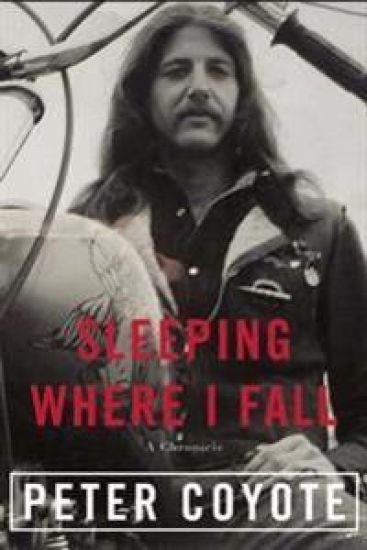
In his energetic, funny, and intelligent memoir, Peter Coyote relives his fifteen-year ride through the heart of the counterculture a journey that took him from the quiet rooms of privilege as the son of an East Coast stockbroker to the riotous life of political street theater and the self-imposed poverty of the West Coast communal movement known as The Diggers. With this innovative collective of artist-anarchists who had assumed as their task nothing less than the re-creation of the nation's political and social soul, Coyote and his companions soon became power players. In prose both graphic and unsentimental, Coyote reveals the corrosive side of love that was once called  free"; the anxieties and occasional terrors of late-night, drug-fueled visits of biker gangs looking to party; and his own quest for the next high. His road through revolution brought him to adulthood and to his major role as a political strategist: from radical communard to the chairman of the California Arts Council, from a street theater apprentice to a motion-picture star.
Growing up in the suburbs of Boston and raised on secular Judaism, Cocoa Puffs, and Gilligan's Island, Peter Bebergal was barely in his teens when the ancient desire to finding higher spiritual meaning in the universe struck. Already schooled in mysticism by way of comic books, Dungeons & Dragons, and Carlos Castaneda, he turned to hallucinogens, convinced they would provide a path to illumination. Was this profound desire for God--a god he believed that could only be apprehended by an extreme state of altered consciousness--simply a side effect of the drugs? Or was it a deeper human longing that was manifesting itself, even on a country club golf course at the edge of a strip mall? Too Much to Dream places Bebergal's story within the cultural history of hallucinogens, American fascination with mysticism, and the complex relationship between drug addiction, popular culture, rock 'n' roll, occultism, and psychology. With a captivating foreword by Peter Coyote, and interviews with writers, artists, and psychologists such as Dennis McKenna, James Fadima, Arik Roper, Jim Woodring, and Mark Tulin, Bebergal offers a groundbreaking exploration of drugs, religion, and the craving for spirituality entrenched in America's youth.
Alcatraz - infamous for its legendary inmates - is much more than its grim history. "Hidden Alcatraz" focuses on the current state of the island fortress, presenting a unique collection of nearly one hundred images taken over a four-year period by thirty-four photographers, including Steve Fritz, Deborah Roundtree, Robert Dawson, Alex Fradkin, Thom Sempere, and Michael Venera. As participants in workshops on 'the Rock',hosted by the National Park Service and Photo Alliance of San Francisco, these photographers were granted unprecedented access, even staying overnight in the main cellblock. The resulting pictures present diverse visions of beauty in decay. They highlight the eerie, almost supernatural mood of the former prison, bringing texture to its historical artifacts and architecture, and evoking the extreme isolation and despair of inmates whose only remaining traces are suggestions of blood spatters and scratches on the walls. "Hidden Alcatraz" includes a foreword by actor Peter Coyote, who was present during the 1971 occupation by members of the American Indian Movement, and an introduction by John Martini, one of the island's first park rangers and an expert on its history.