Kirjojen hintavertailu – 12 903 725 kirjaa ja 27 kauppaa

Kirjailija

Peter Flaschel

Kirjat ja teokset yhdessä paikassa: 34 kirjaa, julkaisuja vuosilta 1993–2021, suosituimpiin kuuluu Macrodynamics. Vertaile teosten hintoja ja tarkista saatavuus suomalaisista kirjakaupoista.

34 kirjaa

Kirjojen julkaisuvuodet: 1993–2021.

The Macrodynamics of Capitalism

The Macrodynamics of Capitalism

Peter Flaschel

Springer-Verlag Berlin and Heidelberg GmbH Co. K
2010
nidottu
This book provides an introduction to advanced macrodynamics, viewed as a di- quilibriumtheoryof?uctuatinggrowth. Itbuildsonanearlierattempttoreformulate 1 the foundations of macroeconomics from the perspective of real markets diseq- librium and the con?ict over income distribution between capital and labor. It does so, not because it wants to support the view that this class con?ict is inevitable, but with the perspective that an understanding of this con?ict may help to formulate socio-economic principles and policies that can help to overcome class con?ict at least in its cruder forms or that can even lead to rationally understandable proce- 2 dures and rules that turn this con?ict into a consensus-driven interaction between 3 capitalists or their representatives and the employable workforce. The book starts from established theories of temporary equilibrium positions, the forces of real growth, and the con?ict over income distribution, represented by basic modeling approaches, which it considers in detail in its Part I in order to prepare the ground for their integration in Part II of the book. In this way we inspect what types of models of disequilibrium, income distribution, and real growth we have at our disposal, as models that have proved to be of real interest and sound from a rigorous modeling perspective.
Monetary Macrodynamics

Monetary Macrodynamics

Toichiro Asada; Carl Chiarella; Peter Flaschel; Reiner Franke

Routledge
2010
sidottu
This book investigates the interaction of effective goods demand with the wage-price spiral, and the impact of monetary policy on financial and the real markets from a Keynesian perspective. Endogenous business fluctuations are studied in the context of long-run distributive cycles in an advanced, rigorously formulated and quantitative setup. The material is developed by way of self-contained chapters on three levels of generality, an advanced textbook level, a research-oriented applied level and on a third level that shows how the interaction of real with financial markets has to be modelled from a truly integrative Keynesian perspective. Monetary Macrodynamics shows that the balanced growth path of a capitalist economy is unlikely to be attracting and that the cumulative forces that surround it are controlled in the large by changes in the behavioural factors that drive the wage-price spiral and the financial markets. Such behavioural changes can in fact be observed in actual economies in the interaction of demand-driven business fluctuations with supply-driven wage and price dynamics as they originate from the conflict over income distribution between capital and labour. The book is a detailed critique of US mainstream macroeconomics and uses rigorous dynamic macro-models of a descriptive and applicable nature. It will be of particular relevance to postgraduate students and researchers interested in disequilibrium processes, real wage feedback channels, financial markets and portfolio choice, financial accelerator mechanisms and monetary policy.
Topics in Classical Micro- and Macroeconomics

Topics in Classical Micro- and Macroeconomics

Peter Flaschel

Springer-Verlag Berlin and Heidelberg GmbH Co. K
2009
sidottu
This book on Classical micro- and macrodynamics includes revised versions of papers which were written between 1983 and 2000, some jointly with co-authors, and it supplements them with recent work on the issues which are raised and treated in them. It attempts to demonstrate to the reader that themes of Classical economics, in particular in the tradition of Smith, Ricardo and Marx, can be synthesized into a coherent whole, from the perspective of formal model building. This is accomplished by means of mathematical techniques which, on the one hand, provide a consistent accounting framework (labor values and prices of p- duction) as point of reference for Classical micro- and macro-dynamics and which, on the other hand, attempt to apply these accounting schemes – or suitable ext- sions of them – by showing their usefulness as tools of analysis of the implications of technological change (labor values) and as potential tools for understanding the dynamics of market prices and of income distribution around their centers of gravity (production prices and the wage-pro?t curve).
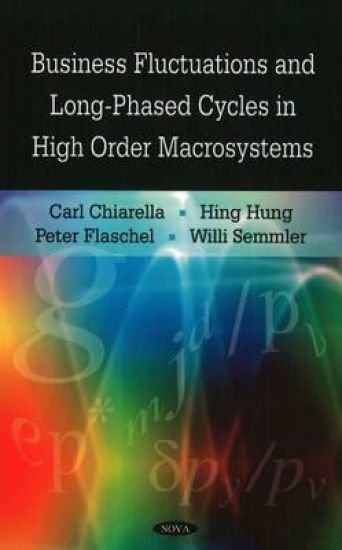
Business Fluctuations & Long-Phased Cycles in High Order Macrosystems

Business Fluctuations & Long-Phased Cycles in High Order Macrosystems

Carl Chiarella; Hing Hung; Peter Flaschel; Willi Semmler

Nova Science Publishers Inc
2009
sidottu
In this book the authors investigate, from the numerical perspective, the 18D core dynamics of a theoretical 39D representation of an applied Keynesian disequilibrium model of monetary growth of a small open economy. After considering the model from the viewpoint of national accounting, the authors provide a compact description of the intensive form of the model, its laws of motion and accompanying algebraic expressions and its unique interior steady state solution. The authors then give a survey of various types of subsystems that can be isolated from the integrated 18D dynamics by means of suitable assumptions. These subsystems and the full 18D dynamics are investigated and compared in the remainder of the paper from the perspective of bifurcation diagrams that separate situations of asymptotic stability from stable cyclical behaviour as well as pure explosiveness. In this way the authors lay the foundations for an analysis of business cycle fluctuations in applicable high order macrosystems, which will show, in contrast to what is generally believed to characterise such structural macroeconometric models, that applied integrated macrodynamical systems can have a variety of interesting more or less complex attractors which are surrounded by more or less long-phase transient behaviour. Such attractors are obtained in particular when locally explosive situations are turned into bounded dynamics by the addition of specifically tailored extrinsic behavioural non-linearities. The authors establish a Keynesian theory of endogenously generated business cycles where turning points are caused by globally non-linear behaviour, rather than by complex eigenvalues, around the steady state position of the economy.
Financial Markets and the Macroeconomy

Financial Markets and the Macroeconomy

Carl Chiarella; Peter Flaschel; Reiner Franke; Willi Semmler

Routledge
2009
sidottu
The financial instability and its spillover to the real sector have become a great challenge to macro-economic theory. The book takes a Keynesian theoretical perspective, representing an attempt to revive what Keynes stressed in his General Theory, namely the role of the financial market in macroeconomic outcomes. Although this book is inspired and motivated by the Asian currency and financial crises in the years 1997-8 and the experiences of the currently evolving U. S. financial disruptions, it also focuses on reviving a modeling tradition that provides a theoretical framework that throws light on recent financial market episodes and disturbances and their macroeconomic effects. It brings to the forefront, as Keynes has suggested, the role of financial market stability for growth and macroeconomics. It criticizes theories that see economic disruptions and shocks rooted solely in the real side of the economy. It stresses the financial real interaction as the major source for macroeconomic instability and disruptions. This important new book from a group of Keynesian, but nonetheless technically oriented economists would be of most interest to specialists and graduate students in macroeconomics and financial economics, especially those with an interest in US and European financial markets, emerging market analysis, and dynamic economic modeling.
The Macrodynamics of Capitalism

The Macrodynamics of Capitalism

Peter Flaschel

Springer-Verlag Berlin and Heidelberg GmbH Co. K
2008
sidottu
This book provides an introduction to advanced macrodynamics, viewed as a di- quilibriumtheoryof?uctuatinggrowth. Itbuildsonanearlierattempttoreformulate 1 the foundations of macroeconomics from the perspective of real markets diseq- librium and the con?ict over income distribution between capital and labor. It does so, not because it wants to support the view that this class con?ict is inevitable, but with the perspective that an understanding of this con?ict may help to formulate socio-economic principles and policies that can help to overcome class con?ict at least in its cruder forms or that can even lead to rationally understandable proce- 2 dures and rules that turn this con?ict into a consensus-driven interaction between 3 capitalists or their representatives and the employable workforce. The book starts from established theories of temporary equilibrium positions, the forces of real growth, and the con?ict over income distribution, represented by basic modeling approaches, which it considers in detail in its Part I in order to prepare the ground for their integration in Part II of the book. In this way we inspect what types of models of disequilibrium, income distribution, and real growth we have at our disposal, as models that have proved to be of real interest and sound from a rigorous modeling perspective.

Topics in Applied Macrodynamic Theory

Topics in Applied Macrodynamic Theory

Peter Flaschel; Gangolf Groh; Christian Proano; Willi Semmler

Springer-Verlag Berlin and Heidelberg GmbH Co. K
2008
sidottu
This book is about the study of topics in macro dynamics from an applied, empirical perspective. The modeling philosophy behind most of the chapters ofthisbookisofKeynesiannature,representinganattempttorevivethist- oreticalperspectiveontheworkingofthemacroeconomy. Themacroeconomic research pursued here is somewhat di?erent from the mainstream literature using the Dynamic Stochastic General Equilibrium (DSGE) approach as the basic modeling device. The main features of the latter are the assumptions of intertemporally optimizing agents, rational expectations, competitive m- kets and price mediated market clearing through su?ciently ?exible prices and wages. The New Keynesian approach to macroeconomics has, in the last decade or so, to a large extent, also adopted the DSGE framework, building on intertemporally optimizing agents and market clearing, but favoring more the concept of monopolistic competition, sticky wages and prices and nominal as well as real rigidities. An path breaking work of this type is the recent book by Woodford (2003). However, it is well known that the intertemporal approach of smoothly optimizing agents and fast adjustments in order to establish temporal or - tertemporal marginal conditions in the product market, labor and capital markets, has not been very successful to match certain stylized facts on those markets. A further de?ciency of those intertemporal decision models is that macroeconomic feedback e?ects—and their stabilizing or destabilizing impact on the macroeconomy—have rarely been considered in those models. Yet, those feedback mechanisms, relevant for the interaction of all three markets, have been theoretically and empirically explored since the 1930s.
Foundations for a Disequilibrium Theory of the Business Cycle

Foundations for a Disequilibrium Theory of the Business Cycle

Carl Chiarella; Peter Flaschel; Reiner Franke

Cambridge University Press
2005
sidottu
Building on The Dynamics of Keynesian Monetary Growth by Chiarella and Flaschel (2000), this book is a key contribution to business cycle theory, setting out a disequilibrium approach with gradual adjustments of the key macroeconomic variables. Its analytic study of a deterministic model of economic activity, inflation and income distribution integrates elements in the tradition of Keynes, Metzler and Goodwin (KMG). After a qualitative analysis of the basic feedback mechanisms, the authors calibrate the KMG model to the stylized facts of the business cycle in the U. S. economy, and then undertake a detailed numerical investigation of the local and global dynamics generated by the model. Finally, topical issues in monetary policy are studied in small macromodels as well as for the KMG model by incorporating an estimated Taylor-type interest rate reaction function. The stability features of this enhanced model are also compared to those of the original KMG model.
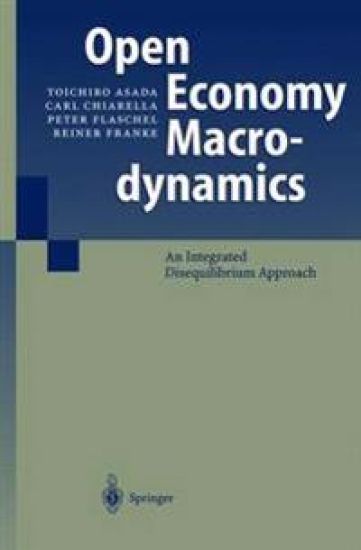
Open Economy Macrodynamics

Open Economy Macrodynamics

Toichiro Asada; Carl Chiarella; Peter Flaschel; Reiner Franke

Springer-Verlag Berlin and Heidelberg GmbH Co. K
2003
sidottu
In the first part of this book, we treat interacting and small open economies. We do this from an historical perspective, starting from the Classical model of the gold standard and the specie-flow mechanism and aim to show there that the Dornbusch IS-LM-PC approach, with or without rational expectations, can still be considered as a (if not the) core contribution to contemporaneous open economy macrodynamics, also on the level of structural macroeconometric model building. In the second part we then extend this analysis to the incorporation of more disequilibrium on the real markets, prominent further feedback channels of the macrodynamic literature and integrated macromodel building. We start from the closed economy, consider large open economies in a fixed exchange rate system, small open economies subject to high capital mobility, and finally two large interacting economies like the USA and Euroland. Our macrofounded approach extends and integrates non-market clearing traditions to macrodynamics and can be usefully compared with the New Keynesian approaches which are generally rigorously microfounded, but often much more limited in scope in capturing full market and agent interactions.
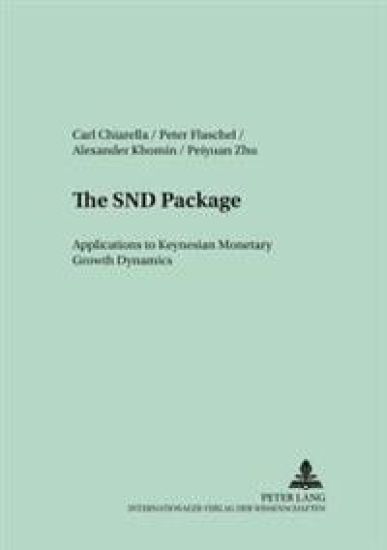
The SND Package

The SND Package

Carl Chiarella; Peter Flaschel; Alexander Khomin; Peiyuan Zhu

Peter Lang GmbH
2001
nidottu
This book is a companion volume to The Dynamics of Keynesian Monetary Growth. Macro Foundations by Chiarella & Flaschel, CUP 2000. It describes the computer package, Simulating Nonlinear Dynamics, designed to simulate the various high order macrodynamic models of that book. The package is quite general and can be applied to any well-defined continuous and discrete time dynamical system. One feature of the package is a set of powerful interactive graphical facilities. The first part of the book outlines the philosophy and mode of use ot the package, the second part provides an extensive set of applications to the macrodynamic models referred to in the title. The package is downloadable from http://www.business.uts.edu.au./finance/staff/carl.html.
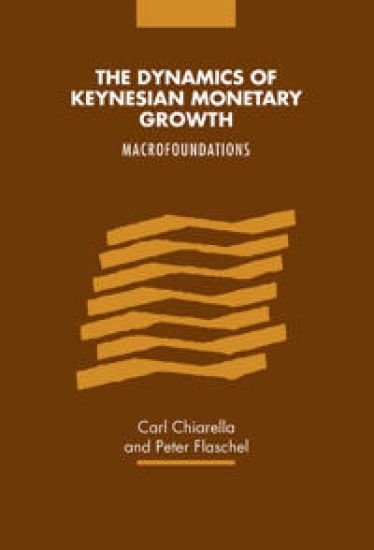
The Dynamics of Keynesian Monetary Growth

The Dynamics of Keynesian Monetary Growth

Carl Chiarella; Peter Flaschel

Cambridge University Press
2000
sidottu
Originally published in 2000, this book is in the tradition of non-market-clearing approaches to macrodynamic approaches. It builds a series of integrated disequilibrium growth models of increasing complexity, which display the economic interaction between households, firms and government across labour, goods, money, bonds and equities markets. Chiarella and Flaschel demonstrate how macrodynamics can be developed in a hierarchical way from economically simple structures to more advanced ones. In addition it investigates complex macrodynamic feedback mechanisms.
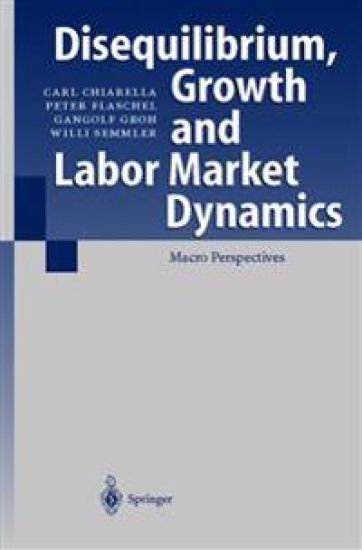
Disequilibrium, Growth and Labor Market Dynamics

Disequilibrium, Growth and Labor Market Dynamics

Carl Chiarella; Peter Flaschel; Gangolf Groh; Willi Semmler

Springer-Verlag Berlin and Heidelberg GmbH Co. K
2000
sidottu
In this book on disequilibrium, growth and labor market dynamics we take predominantly a macroeconomic perspective. We present a working model that can easily be varied in different directions in order to subsume innovations in the literature on macroeconomics, old and new, and to contribute to important currently discussed macroeconomic issues. Our working model is set up in a way that there is a close relationship between our presented dynamic models and modern macro econometric models with disequilibrium both in the labor and the goods markets. One of our objectives is, therefore, to narrow the gap between theoretical and applied structural macrodynamic model building. We hope that the book will be a useful reference for all researchers, academic teachers and practitioners of macroeconomic and macro econometric model building who are interested in economic dynamics, independently of whether they use equilibrium or disequilibrium methods in their own research. We base this hope on the fact that our approach contains a number of unique features. The emphasis on the identification and analysis of the basic feedback mechanisms at work in modern macro economies. A detailed study of the partial as well as integrated dynamic interaction between these feedback mechanisms that consti­ tute the interdependence of markets and sectors of the modern macro economy. The rela­ tionship between the macroeconomic framework of our working model and the Walrasian, Non-Walrasian and New-Keynesian reformulations of macroeconomics.
Fixkapital Und Profitabilitaet

Fixkapital Und Profitabilitaet

Peter Flaschel

Peter Lang AG
1995
nidottu
Diese Arbeit uber Produktionspreistheorie und gesamtwirtschaftliche Rentabilitat untersucht dieses angebotsorientierte Preisbildungskonzept im Rahmen linearer Modelle, die Fixkapital einschliessen. In ihrem ersten Teil werden drei Vorgehensweisen zur Definition von Produktionspreisen dargestellt und verglichen, die Fixkapital als Kuppelprodukt behandeln. Im zweiten Teil werden auf dieser Basis und mittels eines Ansatzes, der Fixkapital input-output-theoretisch behandelt, Argumente und Gegenargumente zum Marxschen -Gesetz einer fallenden Profitrate- analysiert und dabei insbesondere Verallgemeinerungen des sog. Okishio-Theorems vorgestellt. Bezuge zu empirischen und einzelwirtschaftlichen Fragestellungen erganzen die beiden Teile des Buches."
Macrodynamics

Macrodynamics

Peter Flaschel

Peter Lang GmbH
1993
nidottu
This book on macrodynamic theories of growth, (in-)stability and cycles shows that the debate between Keynesians, Monetarists and New Classical economists can be reformulated from the perspective of a further and quite different approach to macroeconomic model building. Basis of this reformulation is the growth cycle model of Goodwin which is extended in various ways in the pursuit of this aim. Besides this central theme, the book also introduces into Keynesian, Marxian and Neoclassical models of short-, medium- and long-run macroeconomics in its part I, II. Models which synthesize these approaches and which thus provide a (deterministic) framework for the investigation of the adequateness of the various explanations of cyclical growth and inflation are considered in part III.