Kirjojen hintavertailu – 12 903 725 kirjaa ja 27 kauppaa
Kirjailija
Peter Fonagy
Kirjat ja teokset yhdessä paikassa: 35 kirjaa, julkaisuja vuosilta 2001–2026, suosituimpiin kuuluu Mentalisaatioon perustuva terapia persoonallisuushäiriöiden hoidossa. Vertaile teosten hintoja ja tarkista saatavuus suomalaisista kirjakaupoista.
Mentalizing - the ability to understand oneself and others by inferring mental states that lie behind overt behaviour - develops within the context of attachment relationships. It is crucial to self-regulation and constructive, intimate relationships, both of which are impaired in personality disorders because of sensitivity to losing mentalizing at times of anxiety and attachment stress. Loss of mentalizing leads to interpersonal and social problems, emotional variability, impulsivity, self-destructive behaviours, and violence. This practical guide on mentalization-based treatment (MBT) of personality disorders outlines the mentalizing model of borderline and antisocial personality disorders and how it translates into clinical treatment. The book, divided into four parts - the mentalizing framework, basic mentalizing practice, mentalizing and groups, and mentalizing systems - covers the aims and structure of treatment, outlines how patients are introduced to the mentalizing model so that their personality disorder makes sense to them, explains why certain interventions are recommended and others are discouraged, and systematically describes the process of treatment in both group and individual therapy to support more stable mentalizing. People with personality disorders commonly have comorbid mental health problems, such as depression and eating disorders, which complicate clinical treatment. Therefore, the book advises the clinician on how to manage comorbidity in treatment. In addition, mentalizing problems in families and social systems, for example, schools and mental health services are also covered. A families and carers training and support guide is provided as families and others are often neglected during the treatment of people with personality disorder. The book is a valuable guide for all mental health workers on how to effectively treat personality disorders.

The standard reference in the field, this acclaimed work synthesizes findings from hundreds of carefully selected studies of mental health treatments for children and adolescents. Chapters on frequently encountered clinical problems systematically review the available data, identify gaps in what is known, and spell out recommendations for evidence-based practice. The authors draw on extensive clinical experience as well as research expertise. Showcasing the most effective psychosocial and pharmacological interventions for young patients, they also address challenges in translating research into real-world clinical practice. New to This Edition *Incorporates over a decade of research advances and evolving models of evidence-based care. *New chapter topic: child maltreatment. *Separate chapters on self-injurious behavior, eating disorders, and substance use disorders (previously covered in a single chapter on self-harming disorders). *Expanded chapters on depression, anxiety, and conduct disorder. *Includes reviews of the burgeoning range of manualized psychosocial "treatment packages" for children.
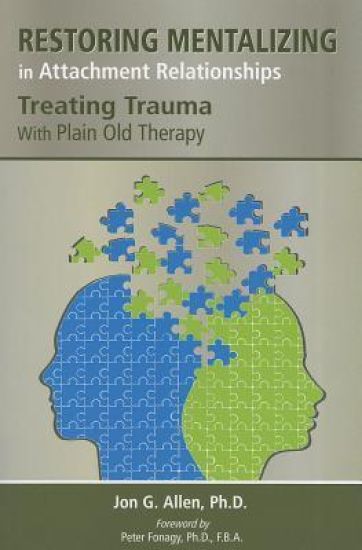
In Restoring Mentalizing in Attachment Relationships: Treating Trauma With Plain Old Therapy, Jon G. Allen, Ph. D., argues that the incorporation of mentalizing into attachment theory and research provides a solid foundation for trauma treatment, and offers therapists and patients a pathway to recovery. In plain language accessible to clinicians and laypeople alike, Allen describes trauma in attachment relationships, reviews the literature, and makes a compelling, evidence-based argument for the efficacy of psychotherapy. Specifically, the book: • Presents a comprehensive view of attachment trauma across diverse diagnostic conditions, directly linking these to the psychotherapeutic interventions that work best.• Allows therapists from different theoretical frameworks, by using these best practices, to treat patients with a wide range of problems and disorders.• Situates mindfulness and mentalizing as central to secure attachment, focusing clinicians' attention on these most critical dimensions of healing relationships.• Provides a thorough review of the research on attachment, mindfulness, and mentalizing, and evaluates the effectiveness of the most popular trauma treatments, thereby equipping clinicians to treat patients across the spectrum of trauma-related psychiatric disorders.• Employs a down-to-earth, conversational writing style that makes the book accessible to patients and family members as well as to professionals. Trauma can be the result of blatant events, such as violence, abuse, and neglect, or the subtle yet pervasive failure to connect. Both contribute to developmental psychopathology and cause lasting emotional pain. "Plain old therapy," according to Allen, is a valuable and proven resource for addressing trauma and treating patients with complex psychiatric disorders. This fascinating and eminently useful book should help to restore psychotherapy to its well-deserved stature.
Dynamic Interpersonal Therapy (DIT) is a brief psychodynamic psychotherapy developed for the treatment of mood disorders. It is being rolled out as part of the Improving Access to Psychological Therapies (IAPT) initiative as the psychodynamic model for the treatment of depression. This book is a user-friendly, practical guide for the implementation of a brief psychodynamic intervention in routine clinical practice as well as in research protocols. It sets out clearly the theoretical framework, as well as the rationale and strategies for applying DIT with patients presenting with mood disorders (depression and anxiety). Throughout, it is illustrated with detailed examples that help the reader to implement the approach in their practice. The book will be required reading to support the national IAPT training initiative, as well as providing a resource for mental health professionals specialising in psychodynamic psychotherapy and wishing to work within a limited time frame.
At mentalisere vil sige at forstå adfærd som udtryk for mentale tilstande som tanker og følelser. Denne bog giver en udførlig redegørelse for begrebet mentalisering og dets anvendelse i klinisk praksis. Forfatterne lægger op til, at mentalisering betragtes som grundlaget for alle psykoterapeutiske handlinger, og ønsker med bogen at styrke fundamentet for psykoterapeutisk praksis. Udviklingen af interessen for mentalisering er sket i tre bølger. Den første bølge kom, da Uta Frith, John Morton og deres medarbejdere beskrev mentaliseringsvanskeligheder som det centrale psykologiske problem i forbindelse med autisme. Kort tid efter skabte Peter Fonagy, Mary Target og deres kolleger bølge nummer to ved at anvende mentaliseringsbegrebet i forbindelse med traumerelateret udviklingspsykologi, sådan som den kom til udtryk i borderline-personlighedsforstyrrelse. Nu er der så ved at danne sig en tredje bølge med henblik på at inddrage mentalisering i det kliniske arbejde med et bredere spektrum af forstyrrelser, behandlingsmodaliteter og teoretiske tilgange. Bogens første del er en grundig gennemgang af den forskningsmæssige og teoretiske litteratur af relevans for mentalisering, herunder dens mange aspekter og relationer til beslægtede begreber, dens udviklingsmæssige udspring i tilknytningsforhold og dens neurobiologiske forankring. Bogens anden del omhandler mentaliserende interventioner i psykoterapi, og hvordan disse anvendes i fx traumebehandling, terapi med børn og deres forældre, behandling af borderline-personlighedsforstyrrelse, psykoedukation og i forebyggelse af fx voldelig adfærd. Bogen henvender sig til faggrupper, der arbejder med mennesker, særligt i terapeutiske sammenhænge, herunder psykologer, psykiatere, psykoterapeuter. Den forsyner praktikere med alt, hvad de har brug for at vide om mentaliseringsbaseret behandling. Jon G. Allen, Peter Fonagy og Anthony W. Batemaner alle tre professorer og de største internationale kapaciteter inden for mentaliseringsbaseret terapi.
Mentalizing, the fundamental human capacity to understand behavior in relation to mental states such as thoughts and feelings, is the basis of healthy relationships and self-awareness. A growing evidence base supports the effectiveness of mentalizing-focused interventions in the treatment of borderline personality disorder. This volume explores wider applications, construing mentalizing as a core common factor in the effectiveness of psychotherapeutic interventions that cuts across treatment modalities and theoretical approaches ranging from psychodynamic to interpersonal and cognitive therapies. This book distills the burgeoning literature on mentalizing for clinicians of diverse professional backgrounds. The book is divided into two parts: Understanding Mentalizing fully explicates the concept of mentalizing and its foundations in developmental research and social-cognitive neuroscience; Practicing Mentalizing presents the general principles of psychotherapeutic interventions that promote mentalizing as well as a range of current clinical applications. Mentalizing is multifaceted - for example, pertaining to self and others as well as explicit and implicit processes - and links to myriad overlapping concepts including empathy, metacognition, theory of mind, mindfulness, and psychological mindedness. Two sides of research on the development of mentalizing in attachment relationships have significant clinical implications: interactions in secure attachment relationships enhance mentalizing and illuminate the conditions of optimal psychotherapeutic relationships; conversely, trauma in attachment relationships undermines the development of mentalizing and eventuates in developmental psychopathology that poses special challenges for psychotherapy. Neuroimaging is illuminating diverse brain regions that contribute to mentalizing capacity, including a ""mentalizing region"" in the medial prefrontal cortex that is consistently activated in mentalizing tasks; concomitantly, research on autism and psychopathy attests to the neurobiological basis of psychopathologies in which stable impairments of mentalizing are most conspicuous. In development and in psychotherapy, mentalizing begets mentalizing, as exemplified by a mentalizing stance that fosters inquisitiveness and curiosity about mental states in oneself and others; basic principles and clinical examples, including the use of transference, demonstrate the spirit and technique of mentalizing, capped off by a patient's first-hand account of mentalization-based treatment for borderline personality disorder. Attachment trauma is the wellspring of disrupted mentalizing capacity, and a focus on mentalizing provides an integrative framework for psychodynamic and cognitive-behavioral treatment of trauma as well as for parenting, family, and social-systems interventions directed toward interrupting the perpetuation of trauma in relationships. Psychoeducational interventions, including patient education and structured exercises, are employed to cultivate a therapeutic alliance around mentalizing; the book includes a straightforward explanation clinicians can use with patients, ""What is Mentalizing and Why Do It?"" In the chapter on mentalizing interventions, the authors propose to clinicians, ""You are already doing it."" If the effectiveness of treatment depends on therapists mentalizing and helping their patients do so more consistently and skillfully, clinicians of all persuasions can benefit from the extensive knowledge now available to hone further their attention to this vital therapeutic process.
Ligesom deres forgængere René Spitz, Margaret M. Mahler, John Bowlby og Daniel N. Stern bidrager denne bogs forfattere med vigtig nyfortolkning og omformulering af vores forståelse - både hvad angår udvikling af relationer, tilknytning, kognition og følelser. Forfatterne fremlægger modeller for psykoterapeutisk praksis, som muliggør en gradvis tilegnelse af mentaliseringsfærdigheder - også når det drejer sig om patienter, som har været massivt udsat for vold og omsorgssvigt. Bogen demonstrerer, at en aktiv og støttende terapeutisk holdning kan hjælpe patienter med at udvikle de evner til selv-refleksion, der er så nødvendige for at kunne navigere i den emotionelle, kognitive og gennemgribende sociale verden, vi lever i. Affektregulering, mentalisering og selvets udvikling har fået afgørende indflydelse på behandlingen af mange forskellige psykiske problemer, og er oplagt som referenceværk for både klinikere og forskere.
Social inequality and social disadvantage provide an all too fertile soil that sustains the majority of the serious mental health problems suffered by children in our society. The complexity of the issues clinicians routinely encounter in working with children with mental health problems is widely acknowledged. However, few books concern themselves with how such difficult populations can be effectively approached and the strategies that are likely to deliver effective treatment to them. This book, based on a highly successful seminar for grant-giving children's charities held at the Anna Freud Centre and sponsored by John Lyon's Charity, provides pragmatic solutions to this major therapeutic challenge of our age. The chapters bridge statutory and voluntary initiatives and are held firmly together by the commitment to evidence-based, systematically offered, programmatic and innovative approaches that can help those who, although hard to reach, are in greatest need of our efforts: the socially excluded children and families in our society. As such, this book will be invaluable to psychologists, psychotherapists, counselors and family therapists.
This acclaimed work provides a systematic, comprehensive, and balanced evaluation of the current status of all major psychotherapeutic approaches. With a primary focus on adults, detailed evidence is presented for the efficacy of widely used interventions for frequently encountered mental disorders and specific populations. The book also explains the concepts that underpin psychotherapy research, examines methodological challenges in translating research into practice, and considers the impact on outcome of factors common to all therapies, such as therapist and patient characteristics.
Psychoanalytic theory influenced many facets of twentieth century culture, and shows every sign of continuing to have an impact in the new century. However, in order to sustain this influence it has to adapt to the challenges of our current intellectual environment. This book attempts to build a bridge between psychoanalysis and a dominant perspective in modern psychiatry and psychology: developmental psychopathology. This perspective studies biological, psychological and social influences that act on individuals, shaping their pathways through life. While psychoanalytic perspectives are inherently developmental, this is often left implicit. This book highlights the developmental bases for psychoanalytic ideas, and examines their assumptions and claims in relation to observational and other data gathered within neighbouring disciplines. The book reaches back to the work of Freud, and covers North American and European ideas including the Klein-Bion model, the British Object Relations tradition, the work of Kernberg and Kohut as well as modern Relational Psychoanalysts.
A Bestseller Attachment Theory shows scientifically how our earliest relationships with our mothers influence our later relationships in life. This book offers an excellent introduction to the findings of attachment theory and the major schools of psychoanalytic thought. "The book every student, colleague, and even rival theoretician has been waiting for. With characteristic wit, philosophical sophistication, scholarship, humanity, incisiveness, and creativity, Fonagy succinctly describes the links, differences, and future directions of his twin themes. His book] is destined to take its place as one of a select list of essential psychology books of the decade."-Jeremy Holmes, Senior Lecturer in Psychotherapy, University of Exeter "Extraordinary--an invaluable resource for developmental psychoanalysis." -Joy D. Osofsky, Professor, Louisiana State University