

Kirjailija
Peter Galison
Kirjat ja teokset yhdessä paikassa: 5 kirjaa, julkaisuja vuosilta 1987–2024, suosituimpiin kuuluu Objectivity. Vertaile teosten hintoja ja tarkista saatavuus suomalaisista kirjakaupoista.
5 kirjaa
Kirjojen julkaisuvuodet: 1987–2024.

The emergence of objectivity in the mid-nineteenth-century sciences, as revealed through images in scientific atlases-a story of how lofty epistemic ideals fuse with workaday practices. Objectivity has a history, and it is full of surprises. In Objectivity, Lorraine Daston and Peter Galison chart the emergence of objectivity in the mid-nineteenth-century sciences-and show how the concept differs from its alternatives, truth-to-nature and trained judgment. This is a story of lofty epistemic ideals fused with workaday practices in the making of scientific images. From the eighteenth through the early twenty-first centuries, the images that reveal the deepest commitments of the empirical sciences-from anatomy to crystallography-are those featured in scientific atlases, the compendia that teach practitioners what is worth looking at and how to look at it. Galison and Daston use atlas images to uncover a hidden history of scientific objectivity and its rivals. Whether an atlas maker idealizes an image to capture the essentials in the name of truth-to-nature or refuses to erase even the most incidental detail in the name of objectivity or highlights patterns in the name of trained judgment is a decision enforced by an ethos as well as by an epistemology. As Daston and Galison argue, atlases shape the subjects as well as the objects of science. To pursue objectivity-or truth-to-nature or trained judgment-is simultaneously to cultivate a distinctive scientific self wherein knowing and knower converge. Moreover, the very point at which they visibly converge is in the very act of seeing not as a separate individual but as a member of a particular scientific community. Embedded in the atlas image, therefore, are the traces of consequential choices about knowledge, persona, and collective sight. Objectivity is a book addressed to anyone interested in the elusive and crucial notion of objectivity-and in what it means to peer into the world scientifically.
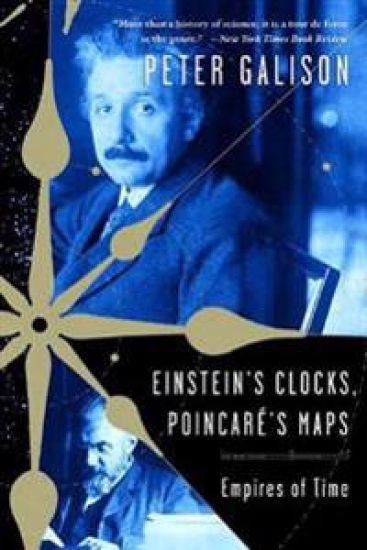
Einstein's Clocks, Poincare's Maps
Peter Galison
WW Norton Co
2004
pokkari
Halvin toimitettuna 28,90 €
A dramatic new account of the parallel quests to harness time that culminated in the revolutionary science of relativity, "Einstein's Clocks, Poincare's Maps" is "part history, part science, part adventure, part biography, part meditation on the meaning of modernity.... In Galison's telling of science, the meters and wires and epoxy and solder come alive as characters, along with physicists, engineers, technicians and others.... Galison has unearthed fascinating material" ("New York Times"). Clocks and trains, telegraphs and colonial conquest: the challenges of the late nineteenth century were an indispensable real-world background to the enormous theoretical breakthrough of relativity. And two giants at the foundations of modern science were converging, step-by-step, on the answer: Albert Einstein, an young, obscure German physicist experimenting with measuring time using telegraph networks and with the coordination of clocks at train stations; and the renowned mathematician Henri Poincare, president of the French Bureau of Longitude, mapping time coordinates across continents. Each found that to understand the newly global world, he had to determine whether there existed a pure time in which simultaneity was absolute or whether time was relative. Esteemed historian of science Peter Galison has culled new information from rarely seen photographs, forgotten patents, and unexplored archives to tell the fascinating story of two scientists whose concrete, professional preoccupations engaged them in a silent race toward a theory that would conquer the empire of time."
This study engages with the impact of modern technology on experimental physicists. It reveals how the ever-increasing scale and complexity of apparatus has distanced physicists from the very science which drew them into experimenting, and has fragmented microphysics into different technical traditions. At the beginning of this century, physics was usually done by a lone researcher who put together experimental apparatus on a benchtop. Now experiments are frequently larger than a city block, and experimental physicists lead very different lives - programming computers, working with industry, co-ordinating vast teams of scientists and engineers, and playing politics. The author describes how, as a result of these changes, the necessity for teamwork in operating multimillion-dollar machines has created dynamic "trading zones", where instrument makers, theorists and experimentalists meet, share knowledge, and co-ordinate the extraordinarily diverse pieces of the culture of modern microphysics - work, machines, evidence and argument.
"Galison provides excellent histories of three experimental episodes: the measurement of the gyromagnetic ratio of the electron, the discovery of the mu meson, or muon, and the discovery of weak neutral currents. These studies of actual experiments will provide valuable material for both philosophers and historians of science and Galison's own thoughts on the nature of experiment are extremely important. . . . Galison has given both philosophers and historians much to think about. I strongly urge you to read this book."—Allan Franklin, British Journal of the Philosophy of Science"Anyone who is seriously concerned with understanding how research is done should read this. There have been many books on one or another part of its subject matter but few giving such insights into how the research is done and how the consensus of discovery is arrived at."—Frank Close, New Scientist"[Galison] is to be congratulated on producing a masterpiece in the field."—Michael Redhead, Synthese"How Experiments End is a major historical work on an exciting topic."—Andy Pickering, Isis