
Kirjojen hintavertailu – 12 859 828 kirjaa ja 27 kauppaa

Kirjailija

Peter Günter

Kirjat ja teokset yhdessä paikassa: 2 kirjaa, julkaisuja vuosilta 2013–2015, suosituimpiin kuuluu Organic Electro-Optics and Photonics. Vertaile teosten hintoja ja tarkista saatavuus suomalaisista kirjakaupoista.

2 kirjaa

Kirjojen julkaisuvuodet: 2013–2015.

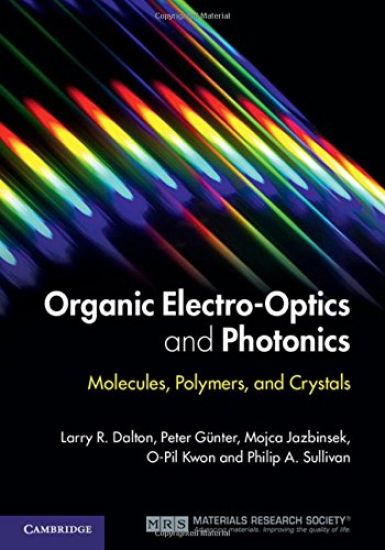
Organic Electro-Optics and Photonics

Organic Electro-Optics and Photonics

Larry R. Dalton; Peter Günter; Mojca Jazbinsek; O-Pil Kwon; Philip A. Sullivan

Cambridge University Press
2015
sidottu
This definitive guide to modern organic electro-optic and photonic technologies provides critical insight into recent advances in organic electro-optic materials, from the underlying quantum and statistical concepts through to the practical application of materials in modern devices and systems. • Introduces theoretical and experimental methods for improving organic electro-optic and photonic technologies • Reviews the central concepts of nonlinear optics, focusing on multi-scale theoretical methods • Provides clear insight into the structure and function relationships critical to optimizing the performance of devices based on organic electro-optic materials. Serving as a primer for the systematic nano-engineering of soft matter materials, this is an invaluable resource for those involved in the development of modern telecommunication, computing, and sensing technologies depending on electro-optic technology. It is also an indispensable work of reference for academic researchers and graduate students in the fields of chemistry, physics, electrical engineering, materials science and engineering, and chemical engineering.
Laser-Induced Dynamic Gratings

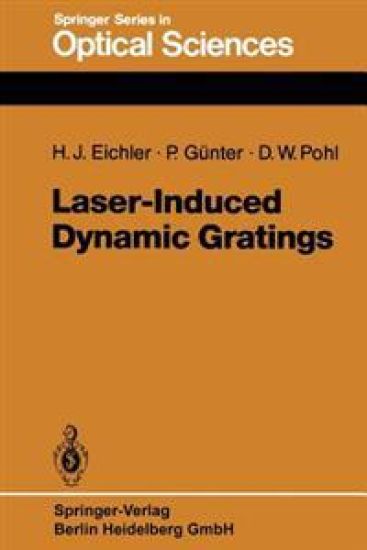
Laser-Induced Dynamic Gratings

Hans Joachim Eichler; Peter Günter; Dieter W. Pohl

Springer-Verlag Berlin and Heidelberg GmbH Co. K
2013
nidottu
The invention ofthe laser 25years ago resulted in powerfullight sources which led to the observation of unexpected and striking phenomena. New fields of science such as holography and nonlinear optics developed constituting the basis of this volume. The classical principle of linear superposition of light wavesdoes not hold anymore. Two laser beams crossing in a suitable material may produce a set of new beams with different directions and frequencies. The interaction of light waves can be understood by considering the optical grating structures which develop in the overlap region. The optical properties of matter become spatially modulated in the interference region of two light waves. Permanent holographic gratings have been produced in this way by photographic processes for many years. In contrast, dynamic or transient gratings disappear after the inducing light source, usually a laser, has been switched off. The grating amplitude is controlled by the light intensity. Dynamic gratings have been induced in a large number ofsolids, liquids, and gases, and are detected by diffraction, 'forced light scattering' of a third probing beam, or by self-diffraction of the light waves inducing the grating. The combined interference and diffraction effect corresponds to four-wave mixing (FWM) in the language of nonlinear optics. The process is called degenerate ifthe frequenciesofthe three incident wavesand the scattered wave are equal. Degenerate four-wave mixing (DFWM) is a simple method to achieve phase conjugation, i.e. to generate a wave which propagates time reversed with respect to an incident wave.