Kirjailija
Peter I. Kattan
Kirjat ja teokset yhdessä paikassa: 22 kirjaa, julkaisuja vuosilta 2005–2026, suosituimpiin kuuluu MELATONIN - The Magic Cure. Vertaile teosten hintoja ja tarkista saatavuus suomalaisista kirjakaupoista.
Nimi esiintyy myös muodoissa: Peter I Kattan
22 kirjaa
Kirjojen julkaisuvuodet: 2005–2026.
Etsitkö jännitystä, uusia näkökulmia tai rentouttavaa lukuelämystä? Tutustu kirjakategorioihimme ja löydä seuraava suosikkikirjasi.
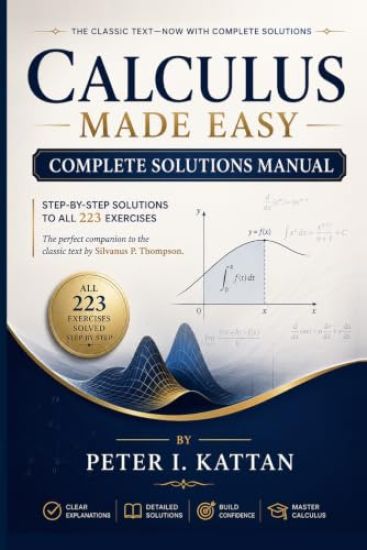
Calculus Made Easy - Complete Solutions Manual
Silvanus P. Thompson; Peter I. Kattan

Kattan
2026
Nidottu
Tervetuloa Pohjoismaiden suurimpaan verkkokirjakauppaan! Adlibris kannattaa sananvapautta, ja haluamme edistää kirjallisuuden ja tiedon saatavuutta.
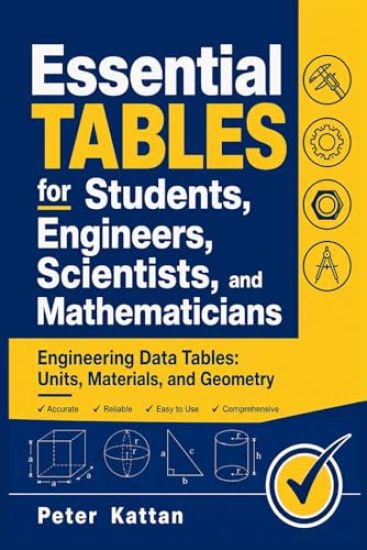
Essential Tables for Students, Engineers, Scientists, and Mathematicians - Engineering Data Tables
Peter I. Kattan
Kattan
2026
Nidottu
Etsitkö jännitystä, uusia näkökulmia tai rentouttavaa lukuelämystä? Tutustu kirjakategorioihimme ja löydä seuraava suosikkikirjasi.
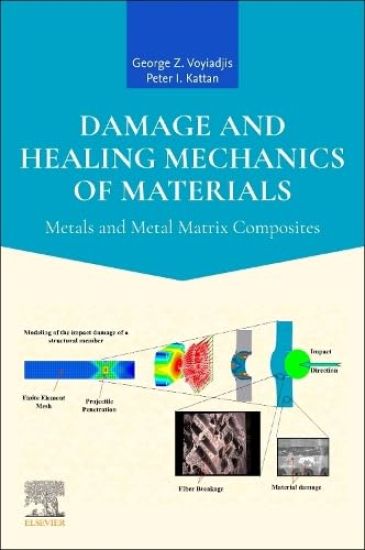
Damage and Healing Mechanics of Materials
George Z. Voyiadjis; Peter I. Kattan
Elsevier - Health Sciences Division
2025
sidottu
Damage and Healing Mechanics of Materials: Metals and Metal Matrix Composites covers the fundamentals of damage mechanics, with various damage models presented coupled with elastic and elasto-plastic behavior. Experimental investigations and the related data for damage in composite materials are included, as are computational modeling and simulation methods for investigating damage and healing in various materials and structures. Healing mechanics using both scalars and more general theory based on tensor notations are discussed, as are applications of damage mechanics. Undamageable materials, the generalized method of cells, phase field modeling, cyclic plasticity concepts, and more are all also covered.
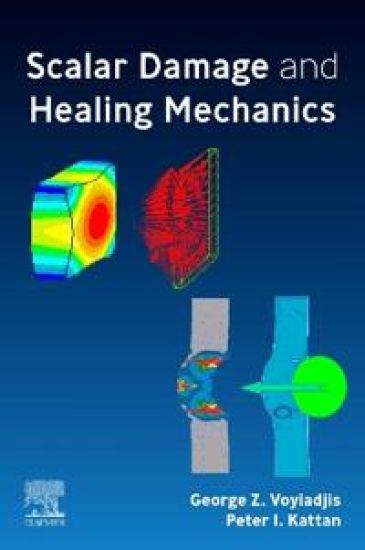
Scalar Damage and Healing Mechanics
George Z. Voyiadjis; Peter I. Kattan
ELSEVIER SCIENCE PUBLISHING CO INC
2022
nidottu
Scalar Damage and Healing Mechanics outlines the latest cutting-edge research in the field of scalar damage and healing mechanics, providing step-by-step insight on how to use scalar damage variables in various modeling scenarios. Additionally, the book discusses the latest advances in healing mechanics, covering the evolution of healing and damage, small damage and small healing, healing processes in series and in parallel, super healing, and the thermodynamics of damage and healing. Coupled systems, in which damage triggers self-healing as well as a decoupled system where healing occurs after damage is identified by external detection, are also discussed. Readers are additionally introduced to fundamental concepts such as effective stress, damage evolution, plane stress damage decomposition, and other damage processes that form the basis for a better understanding of the more advanced chapters.
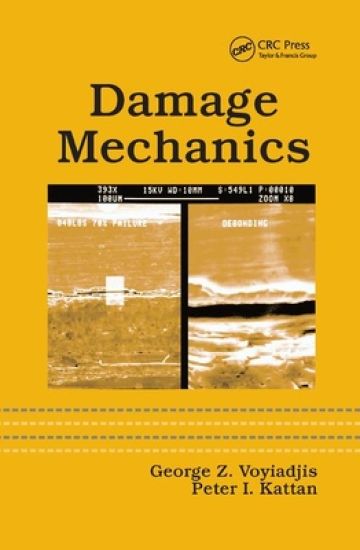
Before a structure or component can be completed, before any analytical model can be constructed, and even before the design can be formulated, you must have a fundamental understanding of damage behavior in order to produce a safe and effective design. Damage Mechanics presents the underlying principles of continuum damage mechanics along with the latest research. The authors consider both isotropic and anisotropic theories as well as elastic and elasto-plastic damage analyses using a self-contained, easily understood approach. Beginning with the requisite mathematics, Damage Mechanics guides you from the very basic concepts to advanced mathematical and mechanical models. The first chapter offers a brief MAPLE® tutorial and supplies all of the MAPLE commands needed to solve the various problems throughout the chapter. The authors then discuss the basics of elasticity theory within the continuum mechanics framework, the simple case of isotropic damage, effective stress, damage evolution, kinematic description of damage, and the general case of anisotropic damage. The remainder of the book includes a review of plasticity theory, formulation of a coupled elasto-plastic damage theory developed by the authors, and the kinematics of damage for finite-strain elasto-plastic solids. From fundamental concepts to the latest advances, this book contains everything that you need to study the damage mechanics of metals and homogeneous materials.
Mechanics of Composite Materials with MATLAB
George Z Voyiadjis; Peter I. Kattan
Springer-Verlag Berlin and Heidelberg GmbH Co. K
2014
nidottu
This is a book for people who love mechanics of composite materials and ? MATLAB . We will use the popular computer package MATLAB as a matrix calculator for doing the numerical calculations needed in mechanics of c- posite materials. In particular, the steps of the mechanical calculations will be emphasized in this book. The reader will not ?nd ready-made MATLAB programs for use as black boxes. Instead step-by-step solutions of composite material mechanics problems are examined in detail using MATLAB. All the problems in the book assume linear elastic behavior in structural mechanics. The emphasis is not on mass computations or programming, but rather on learning the composite material mechanics computations and understanding of the underlying concepts. The basic aspects of the mechanics of ?ber-reinforced composite materials are covered in this book. This includes lamina analysis in both the local and global coordinate systems, laminate analysis, and failure theories of a lamina.
MATLAB Guide to Finite Elements
Peter I. Kattan
Springer-Verlag Berlin and Heidelberg GmbH Co. K
2014
nidottu
later versions. In addition, the CD-ROM contains a complete solutions manual that includes detailed solutions to all the problems in the book. If the reader does not wish to consult these solutions, then a brief list of answers is provided in printed form at the end of the book. Iwouldliketothankmyfamilymembersfortheirhelpandcontinuedsupportwi- out which this book would not have been possible. I would also like to acknowledge the help of the editior at Springer-Verlag (Dr. Thomas Ditzinger) for his assistance in bringing this book out in its present form. Finally, I would like to thank my brother, Nicola, for preparing most of the line drawings in both editions. In this edition, I am providing two email addresses for my readers to contact me (pkattan@tedata. net. jo and pkattan@lsu. edu). The old email address that appeared in the ?rst edition was cancelled in 2004. December 2006 Peter I. Kattan PrefacetotheFirstEdition 3 This is a book for people who love ?nite elements and MATLAB . We will use the popular computer package MATLAB as a matrix calculator for doing ?nite element analysis. Problems will be solved mainly using MATLAB to carry out the tedious and lengthy matrix calculations in addition to some manual manipulations especially when applying the boundary conditions. In particular the steps of the ?nite element method are emphasized in this book. The reader will not ?nd ready-made MATLAB programsforuseasblackboxes. Insteadstep-by-stepsolutionsof?niteelementpr- lems are examined in detail using MATLAB.
MATLAB Guide to Finite Elements
Peter I. Kattan
Springer-Verlag Berlin and Heidelberg GmbH Co. K
2007
sidottu
later versions. In addition, the CD-ROM contains a complete solutions manual that includes detailed solutions to all the problems in the book. If the reader does not wish to consult these solutions, then a brief list of answers is provided in printed form at the end of the book. Iwouldliketothankmyfamilymembersfortheirhelpandcontinuedsupportwi- out which this book would not have been possible. I would also like to acknowledge the help of the editior at Springer-Verlag (Dr. Thomas Ditzinger) for his assistance in bringing this book out in its present form. Finally, I would like to thank my brother, Nicola, for preparing most of the line drawings in both editions. In this edition, I am providing two email addresses for my readers to contact me (pkattan@tedata. net. jo and pkattan@lsu. edu). The old email address that appeared in the ?rst edition was cancelled in 2004. December 2006 Peter I. Kattan PrefacetotheFirstEdition 3 This is a book for people who love ?nite elements and MATLAB . We will use the popular computer package MATLAB as a matrix calculator for doing ?nite element analysis. Problems will be solved mainly using MATLAB to carry out the tedious and lengthy matrix calculations in addition to some manual manipulations especially when applying the boundary conditions. In particular the steps of the ?nite element method are emphasized in this book. The reader will not ?nd ready-made MATLAB programsforuseasblackboxes. Insteadstep-by-stepsolutionsof?niteelementpr- lems are examined in detail using MATLAB.
Advances in Damage Mechanics: Metals and Metal Matrix Composites With an Introduction to Fabric Tensors
George Z. Voyiadjis; Peter I. Kattan
Elsevier Science Ltd
2006
sidottu
The book presents the principles of Damage Mechanics along with the latest research findings. Both isotropic and anisotropic damage mechanisms are presented. Various damage models are presented coupled with elastic and elasto-plastic behavior. The book includes two chapters that are solely dedicated to experimental investigations conducted by the authors. In its last chapter, the book presents experimental data for damage in composite materials that appear in the literature for the first time.