Kirjojen hintavertailu – 12 903 724 kirjaa ja 27 kauppaa

Kirjailija

Peter J. Boettke

Kirjat ja teokset yhdessä paikassa: 27 kirjaa, julkaisuja vuosilta 1990–2021, suosituimpiin kuuluu Living Economics. Vertaile teosten hintoja ja tarkista saatavuus suomalaisista kirjakaupoista.

Nimi esiintyy myös muodoissa: Peter J Boettke

27 kirjaa

Kirjojen julkaisuvuodet: 1990–2021.

Money and the Rule of Law

Money and the Rule of Law

Peter J. Boettke; Alexander William Salter; Daniel J. Smith

Cambridge University Press
2021
sidottu
Contemporary monetary institutions are flawed at a foundational level. The reigning paradigm in monetary policy holds up constrained discretion as the preferred operating framework for central banks. But no matter how smart or well-intentioned are central bankers, discretionary policy contains information and incentive problems that make macroeconomic stability systematically unlikely. Furthermore, central bank discretion implicitly violates the basic jurisprudential norms of liberal democracy. Drawing on a wide body of scholarship, this volume presents a novel argument in favor of embedding monetary institutions into a rule of law framework. The authors argue for general, predictable rules to provide a sturdier foundation for economic growth and prosperity. A rule of law approach to monetary policy would remedy the flaws that resulted in misguided monetary responses to the 2007-8 financial crisis and the COVID-19 pandemic. Understanding the case for true monetary rules is the first step toward creating more stable monetary institutions.
Money and the Rule of Law

Money and the Rule of Law

Peter J. Boettke; Alexander William Salter; Daniel J. Smith

Cambridge University Press
2021
pokkari
Contemporary monetary institutions are flawed at a foundational level. The reigning paradigm in monetary policy holds up constrained discretion as the preferred operating framework for central banks. But no matter how smart or well-intentioned are central bankers, discretionary policy contains information and incentive problems that make macroeconomic stability systematically unlikely. Furthermore, central bank discretion implicitly violates the basic jurisprudential norms of liberal democracy. Drawing on a wide body of scholarship, this volume presents a novel argument in favor of embedding monetary institutions into a rule of law framework. The authors argue for general, predictable rules to provide a sturdier foundation for economic growth and prosperity. A rule of law approach to monetary policy would remedy the flaws that resulted in misguided monetary responses to the 2007-8 financial crisis and the COVID-19 pandemic. Understanding the case for true monetary rules is the first step toward creating more stable monetary institutions.

The Struggle for a Better World

The Struggle for a Better World

Peter J Boettke

Mercatus Center at George Mason University
2021
sidottu
In The Struggle for a Better World, Peter J. Boettke explores how the social sciences, and political economy in particular, help us understand society and its institutions of governance. Boettke advances an approach for understanding, articulating, and pursuing a coherent and consistent vision of a society of free and responsible individuals who may prosper through voluntary participation in the market and their communities. In this volume, a collection of addresses, lectures, and papers over the past two decades, Boettke articulates ideas which, if consistently pursued, can help fulfill liberalism's emancipatory promise to advance human flourishing and overcome adversity caused by economic, social, and political injustice and repression. Boettke advocates for liberal cosmopolitanism, grounded in the principles of equality, justice, and liberty, and the basic recognition that all people are dignified equals, as the best hope for a better world.
The Struggle for a Better World

The Struggle for a Better World

Peter J. Boettke

Mercatus Center at George Mason University
2021
nidottu
In The Struggle for a Better World, Peter J. Boettke explores how the social sciences, and political economy in particular, help us understand society and its institutions of governance. Boettke advances an approach for understanding, articulating, and pursuing a coherent and consistent vision of a society of free and responsible individuals who may prosper through voluntary participation in the market and their communities. In this volume, a collection of addresses, lectures, and papers over the past two decades, Boettke articulates ideas which, if consistently pursued, can help fulfill liberalism's emancipatory promise to advance human flourishing and overcome adversity caused by economic, social, and political injustice and repression. Boettke advocates for liberal cosmopolitanism, grounded in the principles of equality, justice, and liberty, and the basic recognition that all people are dignified equals, as the best hope for a better world.
F. A. Hayek

F. A. Hayek

Peter J. Boettke

Palgrave Macmillan
2019
nidottu
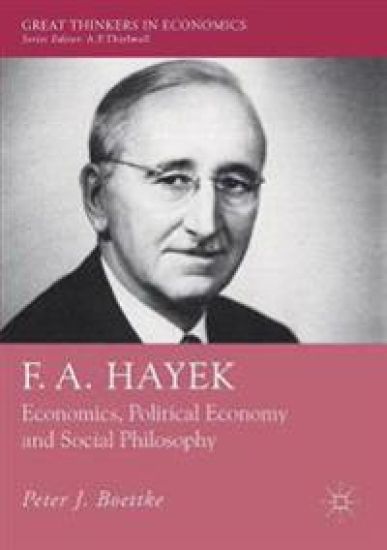
This book explores the life and work of Austrian-British economist, political economist, and social philosopher, Friedrich Hayek. Set within a context of the recent financial crisis, alongside the renewed interest in Hayek and the Hayek-Keynes debate, the book introduces the main themes of Hayek’s thought. These include the division of knowledge, the importance of rules, the problems with planning and economic management, and the role of constitutional constraints in enabling the emergence of unplanned order in the market by limiting the perverse incentives and distortions in information often associated with political discretion. Key to understanding Hayek's development as a thinker is his emphasis on the knowledge problem that economic decision makers face and how alternative institutional arrangements either hinder or assist them in overcoming that epistemic dilemma. Hayek saw order emerging from individual action and responsibility under the appropriate institutional order that itself emerges from actors discovering new and better ways to coordinate their behavior. This book will be of interest to all those keen to gain a deeper understanding of this great 20th century thinker in economics.
Public Governance and the Classical-Liberal Perspective

Public Governance and the Classical-Liberal Perspective

Paul Dragos Aligica; Peter J. Boettke; Vlad Tarko

Oxford University Press Inc
2019
sidottu
Classical liberalism entails not only a theory about the scope of government and its relationship with the market but also a distinct view about how government should operate within its proper domain of public choices in non-market settings. Building on the political economy principles underpinning the works of diverse authors such as Friedrich Hayek, James Buchanan and Vincent and Elinor Ostrom, this book challenges the technocratic-epistocratic perspective in which social goals are defined by an aggregated social function and experts simply provide the means to attain them. The authors argue that individualism, freedom of choice, and freedom of association have deep implications on how we design, manage and assess our public governance arrangements. The book examines the knowledge and incentive problems associated with bureaucratic public administration while contrasting it with democratic governance. Aligica, Boettke, and Tarko argue that the focus should be on the diversity of opinions in any society regarding "what should be done" and on the design of democratic and polycentric institutions capable of limiting social conflicts and satisfying the preferences of as many people as possible. They thus fill a large gap in the literature, the public discourse, and the ways decision makers understand the nature and administration of the public sector.
Discovery, Capitalism & Distributive Justice

Discovery, Capitalism & Distributive Justice

Peter J Boettke; Frederic Sautet

Liberty Fund Inc
2016
nidottu
"Discovery, Capitalism, and Distributive Justice" makes Kirzners case for the idea that entrepreneurial profit is both essential for an economy and profoundly just. Asserting that the problem with standard criticism of capitalist income distribution is a failure to see capitalism as a discovery procedure, Kirzner argues that production and subsequent profit are neither automatic nor guaranteed. This important contribution to the larger debate of the capitalist system clarifies core economic issues, so that the positive science of economics can enlighten our understanding of justice in capitalist distribution. Successful production always results from the discovery of an opportunity to obtain new gains from trade, (ie: the discovery of entrepreneurial profit). Kirzner shows that profit is the just and fair possession of its discoverer. This is what he calls the "finders-keepers" rule: "The finders-keepers rule asserts that an unowned object becomes the justly owned property of the first person who, discovering its availability and its potential value, takes possession of it." Richard Ebeling reviewed the work in 1989, saying, "the heart of Professor Kirzner's argument is that every discovery of a new opportunity is the appropriation of that which had not existed before a human mind had seen the potential in that object. Kirzner's monograph is complemented here by three important articles on the subject of economic justice, a critique of Kirzner's theory, and a reply from Kirzner to that critique. Kirzner's finders-keepers rule of entrepreneurial profit and market distribution stands as one of the foremost defenses of the distribution of income and profit in the free-enterprise system.
Discovery, Capitalism & Distributive Justice

Discovery, Capitalism & Distributive Justice

Peter J Boettke; Frederic Sautet

Liberty Fund Inc
2016
sidottu
"Discovery, Capitalism, and Distributive Justice" makes Kirzners case for the idea that entrepreneurial profit is both essential for an economy and profoundly just. Asserting that the problem with standard criticism of capitalist income distribution is a failure to see capitalism as a discovery procedure, Kirzner argues that production and subsequent profit are neither automatic nor guaranteed. This important contribution to the larger debate of the capitalist system clarifies core economic issues, so that the positive science of economics can enlighten our understanding of justice in capitalist distribution. Successful production always results from the discovery of an opportunity to obtain new gains from trade, (ie: the discovery of entrepreneurial profit). Kirzner shows that profit is the just and fair possession of its discoverer. This is what he calls the "finders-keepers" rule: "The finders-keepers rule asserts that an unowned object becomes the justly owned property of the first person who, discovering its availability and its potential value, takes possession of it." Richard Ebeling reviewed the work in 1989, saying, "the heart of Professor Kirzner's argument is that every discovery of a new opportunity is the appropriation of that which had not existed before a human mind had seen the potential in that object. Kirzner's monograph is complemented here by three important articles on the subject of economic justice, a critique of Kirzner's theory, and a reply from Kirzner to that critique. Kirzner's finders-keepers rule of entrepreneurial profit and market distribution stands as one of the foremost defenses of the distribution of income and profit in the free-enterprise system.
Why Perestroika Failed

Why Perestroika Failed

Peter J Boettke

Routledge
2015
nidottu
Perestroika was acclaimed in the west but brought empty shelves in the east. Why Perestroika Failed argues that this was inevitable because it was not based on a sound understanding of market and political processes. Even if the perestroika programme had been carried out to the full it would have failed to bring about the structural changes necessary to transform what was the Soviet economy.
Institutional Economics

Institutional Economics

Wolfgang Kasper; Manfred E. Streit; Peter J. Boettke

Edward Elgar Publishing Ltd
2013
nidottu
This thoroughly revised, extended and updated edition of a critically acclaimed textbook provides an accessible and cohesive introduction to the burgeoning discipline of institutional economics. Requiring only a basic understanding of economics, this lucid and well-written text will be essential reading for undergraduate and postgraduate students wanting to understand the problems of the real world - such as entrepreneurship, innovation, the cost of the welfare state, international financial crises, and economic development. As institutional economics is now revolutionizing policymaking, the book can also serve as a guide to the pressing problems facing policymakers in mature and emergent countries alike. Key features include: A short 'Primer' at the beginning of each chapter to highlight the main issues and their relevance. Key Concepts such as 'institutions', 'economic order', 'coordination costs', 'competition' and 'public policy' are highlighted and clearly defined. International coverage is ensured as the three authors, experienced academic teachers, work in the US, Europe and the Asia Pacific.
Institutional Economics

Institutional Economics

Wolfgang Kasper; Manfred E. Streit; Peter J. Boettke

Edward Elgar Publishing Ltd
2012
sidottu
This thoroughly revised, extended and updated edition of a critically acclaimed textbook provides an accessible and cohesive introduction to the burgeoning discipline of institutional economics. Requiring only a basic understanding of economics, this lucid and well-written text will be essential reading for undergraduate and postgraduate students wanting to understand the problems of the real world - such as entrepreneurship, innovation, the cost of the welfare state, international financial crises, and economic development. As institutional economics is now revolutionizing policymaking, the book can also serve as a guide to the pressing problems facing policymakers in mature and emergent countries alike. Key features include: A short 'Primer' at the beginning of each chapter to highlight the main issues and their relevance. Key Concepts such as 'institutions', 'economic order', 'coordination costs', 'competition' and 'public policy' are highlighted and clearly defined. International coverage is ensured as the three authors, experienced academic teachers, work in the US, Europe and the Asia Pacific.
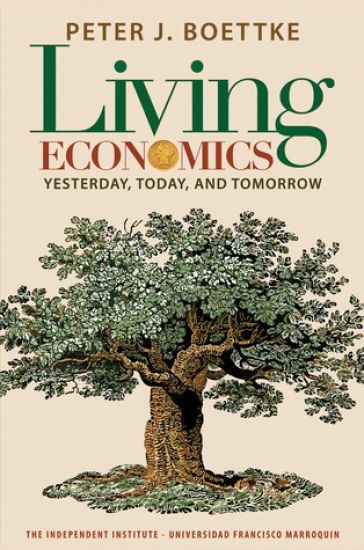
Living Economics

Living Economics

Peter J. Boettke

Independent Institute,U.S.
2012
nidottu
A great supplemental text for the teaching of economics, this book offers a clear perspective and a passion for a deeper understanding of the subject. Economics is not merely a game to be played by clever professionals, but a discipline that touches upon the most pressing practical issues at any historical juncture. The wealth and poverty of nations is at stake; the length and quality of life turns on the economic conditions individuals find themselves living within. Touching upon a variety of subjects—including market socialism, political economy, and economics education—this reference contains the wisdom of an expert in the field.
Living Economics

Living Economics

Peter J. Boettke

Independent Institute,U.S.
2012
sidottu
A great supplemental text for the teaching of economics, this book offers a clear perspective and a passion for a deeper understanding of the subject. Economics is not merely a game to be played by clever professionals, but a discipline that touches upon the most pressing practical issues at any historical juncture. The wealth and poverty of nations is at stake; the length and quality of life turns on the economic conditions individuals find themselves living within. Touching upon a variety of subjects—including market socialism, political economy, and economics education—this reference contains the wisdom of an expert in the field.
The Political Economy of Soviet Socialism: the Formative Years, 1918-1928
This book presents a narrative of one of the more interesting utopian experiments in comparative political and economic history: the first decade of the Soviet experience with socialism (1918-1928). Though historical and textual analysis, the book’s goal is to render this experience intelligible, to get at the meaning of the Soviet experience with socialism for comparative political economy today. The book examines the texts of Lenin, Bukharin, and other revolutionaries, as well as the interpretations of contemporary historians of the revolution and the writings of more recent interpreters of Soviet political and economic history. Arguing that the first three years of the Bolshevik regime (1918-1921) constitute an attempt to carry out the Marxian ideal of comprehensive central planning, and that the disastrous results, which all commentators agree occurred, were the inevitable outcome of this Marxian ideal coming into conflict with the economic reality of the coordination problem that all economic systems face, the book draws clear conclusions and elucidates the air of mystery that often surrounds the subject. Offering a radical challenge to contemporary comparative political economy at the level of high theory, applied research, and public policy, this book is appropriate for students and scholars interested in Marxism, economic history, political economy, and Austrian economics.
Challenging Institutional Analysis and Development

Challenging Institutional Analysis and Development

Paul agos Aligica; Peter J. Boettke

Routledge
2009
nidottu
Challenging Institutional Analysis and Development demonstrates the importance of one of the 2009 Nobel Prize in Economics winners Elinor Ostrom's research program. The Bloomington School has become one of the most dynamic, well recognized and productive centers of the New Institutional Theory movement. Its ascendancy is considered to be the result of a unique and extremely successful combination of interdisciplinary theoretical approaches and hard-nosed empiricism. This book demonstrates that the well-known interdisciplinary and empirical agenda of the Bloomington Research Program is the result of a less-known but very bold proposition: an attempt to revitalize and extend into the new millennium a traditional mode of analysis illustrated by authors like Locke, Montesquieu, Hume, Adam Smith, Hamilton, Madison and Tocqueville. As such, the School tries to synthesize the traditional perspectives with the contemporary developments in social sciences and thus to re-ignite the old approach in the new intellectual and political context of the twentieth century. The book presents an outline and a systematic analysis of the vision behind the Bloomington Research Program in Institutional Analysis and Development, explaining its basic assumptions and its main themes as well as the foundational philosophy that frames its research questions and theoretical and methodological approaches. This book will be of interest to students and scholars of social science, especially those in the fields of economics, political sciences, sociology and public administration.
Challenging Institutional Analysis and Development

Challenging Institutional Analysis and Development

Paul agos Aligica; Peter J. Boettke

Routledge
2009
sidottu
Challenging Institutional Analysis and Development demonstrates the importance of one of the 2009 Nobel Prize in Economics winners Elinor Ostrom's research program. The Bloomington School has become one of the most dynamic, well recognized and productive centers of the New Institutional Theory movement. Its ascendancy is considered to be the result of a unique and extremely successful combination of interdisciplinary theoretical approaches and hard-nosed empiricism. This book demonstrates that the well-known interdisciplinary and empirical agenda of the Bloomington Research Program is the result of a less-known but very bold proposition: an attempt to revitalize and extend into the new millennium a traditional mode of analysis illustrated by authors like Locke, Montesquieu, Hume, Adam Smith, Hamilton, Madison and Tocqueville. As such, the School tries to synthesize the traditional perspectives with the contemporary developments in social sciences and thus to re-ignite the old approach in the new intellectual and political context of the twentieth century. The book presents an outline and a systematic analysis of the vision behind the Bloomington Research Program in Institutional Analysis and Development, explaining its basic assumptions and its main themes as well as the foundational philosophy that frames its research questions and theoretical and methodological approaches. This book will be of interest to students and scholars of social science, especially those in the fields of economics, political sciences, sociology and public administration.
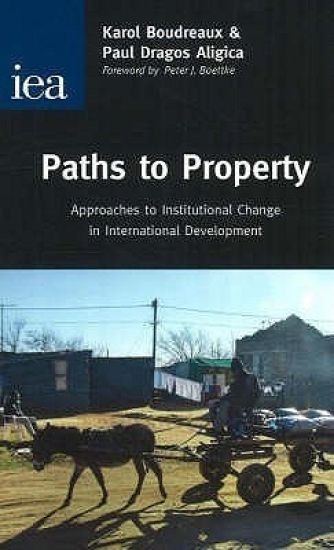
Paths to Property

Paths to Property

Peter J. Boettke

Institute of Economic Affairs
2007
nidottu
Sub-Saharan Africa has received tens of billions of dollars in foreign aid over the last fifty years, yet economic development has remained elusive. In many countries absolute poverty has increased and life expectancy has declined. Karol Boudreaux and Paul Aligica argue that instead of traditional approaches to development policy, the focus needs to be on adoption of sound political and legal institutions, with clearly defined and enforced private property rights to encourage entrepreneurship and economic growth. The authors examine several case studies of property rights reform in the developing world and suggest that universal policies applied regardless of local culture and tradition tend to fail. Reforms are more likely to succeed when they evolve gradually and are tailored to local norms and values rather than imposed from above by governments, aid agencies and supranational institutions.
Modern Austrian Economics

Modern Austrian Economics

Peter J Boettke

Pickering Chatto (Publishers) Ltd
2002
muu
Examines the post-1970s area of the Austrian economic tradition, from its revival to its contemporary directions and development. The book comprises texts on the relationship of Austrian economics to Institutionalism, Evolution, and Post-Keynesian economics to present a look at "the way forward".
Modern Austrian Economics Vol 3

Modern Austrian Economics Vol 3

Sandye Gloria; Peter J Boettke; Stephan Bohm

Routledge
2002
sidottu
Examines the post-1970s area of the Austrian economic tradition, from its revival to its contemporary directions and development. The book comprises texts on the relationship of Austrian economics to Institutionalism, Evolution, and Post-Keynesian economics to present a look at "the way forward".