Kirjojen hintavertailu – 12 903 725 kirjaa ja 27 kauppaa

Kirjailija

Peter Kelly

Kirjat ja teokset yhdessä paikassa: 28 kirjaa, julkaisuja vuosilta 2004–2026, suosituimpiin kuuluu Handbok för informationsdriven vård och AI. Vertaile teosten hintoja ja tarkista saatavuus suomalaisista kirjakaupoista.

28 kirjaa

Kirjojen julkaisuvuodet: 2004–2026.

Young People and the Aesthetics of Health Promotion

Young People and the Aesthetics of Health Promotion

Kerry Montero; Peter Kelly

Routledge
2019
nidottu
Health promotion with young people has largely been framed by theories of behaviour change to target ‘unsafe’, ‘unhealthy’ and/or ‘risky’ behaviours. These theories and models seek to encourage the development in young people of reasoned, rational and risk-aware personal strategies. This book presents an innovative and critical perspective on young people and health promotion. It explores the limits and possibilities of traditional health behaviour change models with their focus on reason, risk and rationality by examining the embodied dimensions of meaning-making in health promotion programs. Drawing on an array of critical social theories and approaches to knowledge production the authors identify and engage the aesthetic and affective dimensions of young people’s engagement with issues such as road safety, sexualities, alcohol and drug use, and physical and mental health and well-being. The book will appeal to researchers and practitioners in the fields of health promotion and health education, public health, education, the sociology of health and illness, youth studies and youth work.
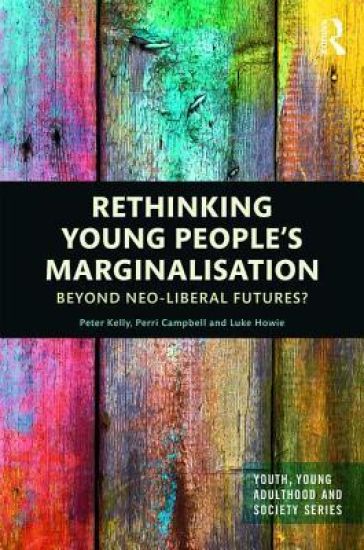
Rethinking Young People’s Marginalisation

Rethinking Young People’s Marginalisation

Peter Kelly; Perri Campbell; Luke Howie

Routledge
2018
sidottu
In the 21st century myriad earth systems – atmospheric systems, ocean systems, land systems, neo-Liberal capitalism – are in crisis. These crises are deeply related. Taking diverse and multiple forms, they have diverse and multiple consequences and are evidenced in such things as war, everyday violence, hate and extremism, global flows of millions of the dispossessed and homeless; and in the precarious, uncertain, and marginal existence of millions more. Rethinking Young People’s Marginalisation is concerned with the experience, affect, and effects of these earth systems crises on: • young people’s life chances, life choices, and life courses• young people’s engagement with education, training, and work• the character of young people’s being and becoming, their genderedembodiment, their participation in cultures of democracy, their resilience,and their marginalisation. Indeed, in setting out to rethink young people’s marginalisation, this insightful volume makes a contribution to troubling key concepts in Youth Studies, primarily: structure and agency; transitions and pathways; gender and embodiment, citizenship, risk, and resilience. It does this by drawing on a variety of critical, theoretical traditions, including Bauman’s engagement with the ambivalence of the human condition; Foucault’s studies of mentalities of government and genealogies of the subject; the critique of the politics of disposability and violence of neo-Liberalism undertaken by Giroux, and the authors of Kilburn Manifesto;Braidotti’s vitalist posthumanism; and Haraway’s figure of the Chthulucene. Analysing the ways in which young people engage in and develop new cultures of democracy, Rethinking Young People’s Marginalisation will appeal to postgraduate students and postdoctoral researchers interested in fields such as Youth Studies, Youth Sociology, Education Studies, and Critical Social Theory.
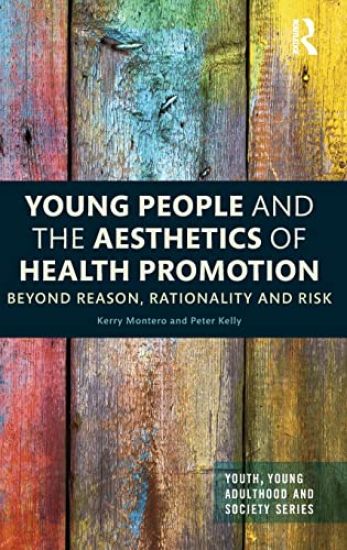
Young People and the Aesthetics of Health Promotion

Young People and the Aesthetics of Health Promotion

Kerry Montero; Peter Kelly

Routledge
2016
sidottu
Health promotion with young people has largely been framed by theories of behaviour change to target ‘unsafe’, ‘unhealthy’ and/or ‘risky’ behaviours. These theories and models seek to encourage the development in young people of reasoned, rational and risk-aware personal strategies. This book presents an innovative and critical perspective on young people and health promotion. It explores the limits and possibilities of traditional health behaviour change models with their focus on reason, risk and rationality by examining the embodied dimensions of meaning-making in health promotion programs. Drawing on an array of critical social theories and approaches to knowledge production the authors identify and engage the aesthetic and affective dimensions of young people’s engagement with issues such as road safety, sexualities, alcohol and drug use, and physical and mental health and well-being. The book will appeal to researchers and practitioners in the fields of health promotion and health education, public health, education, the sociology of health and illness, youth studies and youth work.
The Self as Enterprise

The Self as Enterprise

Peter Kelly

Ashgate Publishing Limited
2013
sidottu
Twenty first century, flexible capitalism creates new demands for those who work to acknowledge that all aspects of their lives have come to be seen as performance related, and consequently of interest to those who employ them (or fire them). At the start of the 21st century we can identify, borrowing from Max Weber, new work ethics that provide novel ethically slanted maxims for the conduct of a life, and which suggest that the cultivation of the self as an enterprise is the life-long activity that should give meaning, purpose and direction to a life. The book provides an innovative theoretical and methodological approach that draws on the problematising critique of Michel Foucault, the sociological imagination of Zygmunt Bauman and the work influenced by these authors in social theory and social research in the last three decades. The author takes seriously the ambivalence and irony that marks many people’s experience of their working lives, and the demands of work at the start of the 21st century. The book makes an important contribution to the continuing debate about the nature of work related identities and the consequences of the intensification of the work regimes in which these identities are performed and regulated. In a post global financial crisis (GFC) world of sovereign debt, austerity and recession the author’s analysis focuses academic and professional interest on neo-liberal injunctions to imagine ourselves as an enterprise, and to reap the rewards and carry the costs of the conduct of this enterprise.
Smashed!

Smashed!

Peter Kelly; Jenny Advocat; Lyn Harrison; Chris Hickey

Monash University Publishing
2011
nidottu
Everyone knows what intoxication and drunkenness are, what they look like, how to define and measure them and what their consequences are. At least we might assume so given the ways these words are used by the media, by politicians and policy makers and by various medical, educational and legal experts in Australia and around the world. A whole variety of concerns about young people, individual and public health, road safety, sexual assault and violence are connected to these taken-for-granted understandings of intoxication and drunkenness. Drawing on an extensive review of research from biomedicine, psychology, sociology and legal studies, and from news media reporting, the authors reveal a far more complex picture. This is a picture marked by little agreement on how to define intoxication and drunkenness, how to measure intoxication, what getting drunk means to those who drink (including young people, men and women and people from different cultural and national backgrounds), and where responsibility lies for many of the individual, social, medical and legal consequences of intoxication and drunkenness. Smashed! presents an overview of the history of these concerns and an extensive account of the many meanings of intoxication and drunkenness at the start of the 21st century. It provides a valuable resource for researchers, policy makers, the media and members of the community who are involved in these ongoing, often emotive, debates.
Using Thinking Skills in the Primary Classroom

Using Thinking Skills in the Primary Classroom

Peter Kelly

SAGE Publications Inc
2004
sidottu
`The good practice points add depth to the practical nature of this book and clearly set out its intention to provide reflection for teachers to extend their own skills and practice' - Jan Baker, Head Teacher of Orchard Vale Community School 'Thoughtfully written and certainly of value to trainee teachers and those already teaching in school' - National Association for Gifted Children Newsletter Most children already display a range of thinking skills when they communicate with each another and when they talk about their interests (whether those are soap operas or car engines), and this book presents an approach for classroom practice that will encourage teachers to build on the often quite sophisticated thinking skills the children in their class already have. The author highlights points for good pratice, suggests some lesson ideas and builds in opportunities for professional reflection. Advice on the following is included: } classroom organization } approaches to collaborative groupwork } developing children's (and teachers') speaking and listening skills } building on the thinking skills that children of all abilities display } using questioning techniques to promote thinking skills in the classroom } whole-school issues. Each chapter ends with a summary of key points and there is some photocopiable material included. All teachers, teaching assistants and those co-ordinating the learning of gifted and talented pupils will find this book thought-provoking, stimulating and inspiring.
Using Thinking Skills in the Primary Classroom

Using Thinking Skills in the Primary Classroom

Peter Kelly

SAGE Publications Inc
2004
nidottu
`The good practice points add depth to the practical nature of this book and clearly set out its intention to provide reflection for teachers to extend their own skills and practice' - Jan Baker, Head Teacher of Orchard Vale Community School 'Thoughtfully written and certainly of value to trainee teachers and those already teaching in school' - National Association for Gifted Children Newsletter Most children already display a range of thinking skills when they communicate with each another and when they talk about their interests (whether those are soap operas or car engines), and this book presents an approach for classroom practice that will encourage teachers to build on the often quite sophisticated thinking skills the children in their class already have. The author highlights points for good pratice, suggests some lesson ideas and builds in opportunities for professional reflection. Advice on the following is included: } classroom organization } approaches to collaborative groupwork } developing children's (and teachers') speaking and listening skills } building on the thinking skills that children of all abilities display } using questioning techniques to promote thinking skills in the classroom } whole-school issues. Each chapter ends with a summary of key points and there is some photocopiable material included. All teachers, teaching assistants and those co-ordinating the learning of gifted and talented pupils will find this book thought-provoking, stimulating and inspiring.