Kirjojen hintavertailu – 12 903 725 kirjaa ja 27 kauppaa

Kirjailija

Peter Kloeden

Kirjat ja teokset yhdessä paikassa: 6 kirjaa, julkaisuja vuosilta 1994–2023, suosituimpiin kuuluu Introduction To Nonautonomous Dynamical Systems And Their Attractors, An. Vertaile teosten hintoja ja tarkista saatavuus suomalaisista kirjakaupoista.

6 kirjaa

Kirjojen julkaisuvuodet: 1994–2023.

Introduction To Nonautonomous Dynamical Systems And Their Attractors, An

Introduction To Nonautonomous Dynamical Systems And Their Attractors, An

Peter Kloeden; Meihua Yang

World Scientific Publishing Co Pte Ltd
2020
sidottu
The nature of time in a nonautonomous dynamical system is very different from that in autonomous systems, which depend only on the time that has elapsed since starting rather than on the actual time itself. Consequently, limiting objects may not exist in actual time as in autonomous systems. New concepts of attractors in nonautonomous dynamical system are thus required. In addition, the definition of a dynamical system itself needs to be generalised to the nonautonomous context. Here two possibilities are considered: two-parameter semigroups or processes and the skew product flows. Their attractors are defined in terms of families of sets that are mapped onto each other under the dynamics rather than a single set as in autonomous systems. Two types of attraction are now possible: pullback attraction, which depends on the behaviour from the system in the distant past, and forward attraction, which depends on the behaviour of the system in the distant future. These are generally independent of each other. The component subsets of pullback and forward attractors exist in actual time. The asymptotic behaviour in the future limit is characterised by omega-limit sets, in terms of which form what are called forward attracting sets. They are generally not invariant in the conventional sense, but are asymptotically invariant in general and, if the future dynamics is appropriately uniform, also asymptotically negatively invariant. Much of this book is based on lectures given by the authors in Frankfurt and Wuhan. It was written mainly when the first author held a 'Thousand Expert' Professorship at the Huazhong University of Science and Technology in Wuhan.
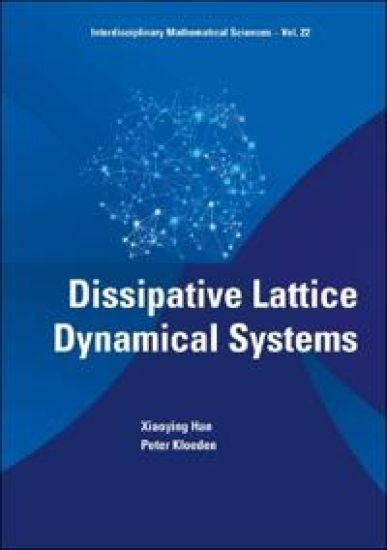
Dissipative Lattice Dynamical Systems

Dissipative Lattice Dynamical Systems

Xiaoying Han; Peter Kloeden

WORLD SCIENTIFIC PUBLISHING CO PTE LTD
2023
sidottu
There is an extensive literature in the form of papers (but no books) on lattice dynamical systems. The book focuses on dissipative lattice dynamical systems and their attractors of various forms such as autonomous, nonautonomous and random. The existence of such attractors is established by showing that the corresponding dynamical system has an appropriate kind of absorbing set and is asymptotically compact in some way. There is now a very large literature on lattice dynamical systems, especially on attractors of all kinds in such systems. We cannot hope to do justice to all of them here. Instead, we have focused on key areas of representative types of lattice systems and various types of attractors. Our selection is biased by our own interests, in particular to those dealing with biological applications. One of the important results is the approximation of Heaviside switching functions in LDS by sigmoidal functions. Nevertheless, we believe that this book will provide the reader with a solid introduction to the field, its main results and the methods that are used to obtain them.
Attractors Under Discretisation

Attractors Under Discretisation

Xiaoying Han; Peter Kloeden

Springer International Publishing AG
2017
nidottu
This work focuses on the preservation of attractors and saddle points of ordinary differential equations under discretisation. In the 1980s, key results for autonomous ordinary differential equations were obtained – by Beyn for saddle points and by Kloeden & Lorenz for attractors. One-step numerical schemes with a constant step size were considered, so the resulting discrete time dynamical system was also autonomous. One of the aims of this book is to present new findings on the discretisation of dissipative nonautonomous dynamical systems that have been obtained in recent years, and in particular to examine the properties of nonautonomous omega limit sets and their approximations by numerical schemes – results that are also of importance for autonomous systems approximated by a numerical scheme with variable time steps, thus by a discrete time nonautonomous dynamical system.
Stability and Bifurcation Theory for Non-Autonomous Differential Equations

Stability and Bifurcation Theory for Non-Autonomous Differential Equations

Anna Capietto; Peter Kloeden; Jean Mawhin; Sylvia Novo; Miguel Ortega

Springer-Verlag Berlin and Heidelberg GmbH Co. K
2012
nidottu
This volume contains the notes from five lecture courses devoted to nonautonomous differential systems, in which appropriate topological and dynamical techniques were described and applied to a variety of problems. The courses took place during the C. I. M. E. Session "Stability and Bifurcation Problems for Non-Autonomous Differential Equations," held in Cetraro, Italy, June 19-25 2011. Anna Capietto and Jean Mawhin lectured on nonlinear boundary value problems; they applied the Maslov index and degree-theoretic methods in this context. Rafael Ortega discussed the theory of twist maps with nonperiodic phase and presented applications. Peter Kloeden and Sylvia Novo showed how dynamical methods can be used to study the stability/bifurcation properties of bounded solutions and of attracting sets for nonautonomous differential and functional-differential equations. The volume will be of interest to all researchers working in these and related fields.
From Elementary Probability to Stochastic Differential Equations with MAPLE®

From Elementary Probability to Stochastic Differential Equations with MAPLE®

Sasha Cyganowski; Peter Kloeden; Jerzy Ombach

Springer-Verlag Berlin and Heidelberg GmbH Co. K
2001
nidottu
Measure and integration wereonceconsidered,especially by many ofthe more practically inclined, to be an esoteric area ofabstract mathematics best left to pure mathematicians. However,it has become increasingly obvious in recent years that this area is now an indispensable, even unavoidable, language and provides a fundamental methodology for modern probability theory, stochas­ tic analysis and their applications, especially in financial mathematics. Our aim in writing this book is to provide a smooth and fast introduction to the language and basic results ofmodern probability theory and stochastic differential equations with help ofthe computer manipulator software package MAPLE. It is intended for advanced undergraduate students or graduates, not necessarily in mathematics, to provide an overviewand intuitive background for more advanced studies as wellas somepractical skillsin the use of MAPLE software in the context of probability and its applications. This book is not a conventional mathematics book. Like such books it provides precise definitions and mathematical statements, particularly those based on measure and integration theory, but instead ofmathematical proofs it uses numerous MAPLE experiments and examples to help the reader un­ derstand intuitively the ideas under discussion. The pace increases from ex­ tensive and detailed explanations in the first chapters to a more advanced presentation in the latter part of the book. The MAPLE is handled in a sim­ ilar way, at first with simple commands, then some simple procedures are gardually developed and, finally, the stochastic package is introduced.
Metric Spaces Of Fuzzy Sets: Theory And Applications

Metric Spaces Of Fuzzy Sets: Theory And Applications

Phil Diamond; Peter Kloeden

World Scientific Publishing Co Pte Ltd
1994
sidottu
The primary aim of the book is to provide a systematic development of the theory of metric spaces of normal, upper semicontinuous fuzzy convex fuzzy sets with compact support sets, mainly on the base space Rn. An additional aim is to sketch selected applications in which these metric space results and methods are essential for a thorough mathematical analysis. This book is distinctly mathematical in its orientation and style, in contrast with many of the other books now available on fuzzy sets, which, although all making use of mathematical formalism to some extent, are essentially motivated by and oriented towards more immediate applications and related practical issues. The reader is assumed to have some previous undergraduate level acquaintance with metric spaces and elementary functional analysis.