Kirjojen hintavertailu – 12 903 724 kirjaa ja 27 kauppaa

Kirjailija

Peter M. Smith

Kirjat ja teokset yhdessä paikassa: 5 kirjaa, julkaisuja vuosilta 1980–2019, suosituimpiin kuuluu An Agenda for a Growing Europe. Vertaile teosten hintoja ja tarkista saatavuus suomalaisista kirjakaupoista.

5 kirjaa

Kirjojen julkaisuvuodet: 1980–2019.

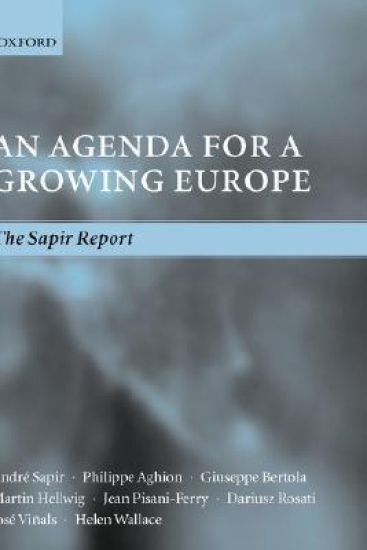
An Agenda for a Growing Europe

An Agenda for a Growing Europe

André Sapir; Philippe Aghion; Giuseppe Bertola; Martin Hellwig; Jean Pisani-Ferry; Dariusz Rosati; José Viñals; Helen Wallace; Marco Buti; Mario Nava; Peter M. Smith

Oxford University Press
2004
sidottu
Over the past decade European economic integration has seen considerable institutional success, but the economic performance of the EU has been varied. While macroeconomic stability has improved and an emphasis on cohesion preserved, the EU economic system has not delivered satisfactory growth performance. This book is the report of a high-level group commissioned by the President of the European Commission to review the EU economic system and propose a blueprint for an economic system capable of delivering faster growth along with stability and cohesion. It assesses the EU s economic performance, examines the challenges facing the EU in the coming years, and presents a series of recommendations. The report views Europe's unsatisfactory growth performance during the last decades as a symptom of its failure to transform into an innovation-based economy. It has now become clear that the context in which economic policies have been developed has changed fundamentally over the past thirty years. A system built around the assimilation of existing technologies, mass production generating economics of scale, and an industrial structure dominated by large firms with stable markets and long term employment patterns no longer delivers in the world of today, characterized by economic globalization and strong external competition. What is needed now is more opportunity for new entrants, greater mobility of employees within and across firms, more retraining, greater reliance on market financing, and higher investment in both R&D and higher education. This requires a massive and urgent change in economic policies in Europe.

Lines Against Vicissitudes: 100 Sonnets

Lines Against Vicissitudes: 100 Sonnets

Peter M. Smith

Independently Published
2019
nidottu
This collection of sonnets, written over the author's lifetime, demonstrates the powerful strengths of this format. Noteable in this collection is the wide variety of structures, even within the formal discipline of strict sonnet styles. We have echo sonnets, mirror sonnets, dialogue sonnets, picture sonnets, and a tiara and corona of linked sonnets. Themes range through Love, Mortality, Time, and Place.
An Agenda for a Growing Europe

An Agenda for a Growing Europe

André Sapir; Philippe Aghion; Giuseppe Bertola; Martin Hellwig; Jean Pisani-Ferry; Dariusz Rosati; José Viñals; Helen Wallace; Marco Buti; Mario Nava; Peter M. Smith

Oxford University Press
2004
nidottu
Over the past decade European economic integration has seen considerable institutional success, but the economic performance of the EU has been varied. While macroeconomic stability has improved and an emphasis on cohesion preserved, the EU economic system has not delivered satisfactory growth performance. This book is the report of a high-level group commissioned by the President of the European Commission to review the EU economic system and propose a blueprint for an economic system capable of delivering faster growth along with stability and cohesion. It assesses the EU s economic performance, examines the challenges facing the EU in the coming years, and presents a series of recommendations. The report views Europe's unsatisfactory growth performance during the last decades as a symptom of its failure to transform into an innovation-based economy. It has now become clear that the context in which economic policies have been developed has changed fundamentally over the past thirty years. A system built around the assimilation of existing technologies, mass production generating economics of scale, and an industrial structure dominated by large firms with stable markets and long term employment patterns no longer delivers in the world of today, characterized by economic globalization and strong external competition. What is needed now is more opportunity for new entrants, greater mobility of employees within and across firms, more retraining, greater reliance on market financing, and higher investment in both R&D and higher education. This requires a massive and urgent change in economic policies in Europe.