Kirjojen hintavertailu – 12 859 819 kirjaa ja 27 kauppaa

Kirjailija

Peter M. Ward

Kirjat ja teokset yhdessä paikassa: 5 kirjaa, julkaisuja vuosilta 1985–2014, suosituimpiin kuuluu Governance in the Americas. Vertaile teosten hintoja ja tarkista saatavuus suomalaisista kirjakaupoista.

5 kirjaa

Kirjojen julkaisuvuodet: 1985–2014.

Housing Policy in Latin American Cities

Housing Policy in Latin American Cities

Peter M. Ward; Edith R. Jiménez Huerta; María Mercedes Di Virgilio

Routledge
2014
sidottu
After the 1960s, rapid urbanization in developing regions in Latin America, Africa, and Asia was marked by the expansion of low-income "irregular" settlements that developed informally and which, by the 2000s, often constituted between 20-60 percent of the built-up area of metropolitan areas and other large cities. There has been a variety of research directed at the housing policies involved with these informal settlements, yet apart from the activities of Latin American Housing Network (LAHN), there has been minimal attention directed at the earliest portion of settlements that formed some 25-40 years ago that now form a large part of the intermediate ring of the cities. This volume breaks new ground by opening up a new generation of housing policy in Latin America cities with broader application for other developing countries. Its editors bring unique perspectives: Peter Ward coordinates the LAHN, and Edith Jiménez and María Di Virgilio are founding members of the network who have led project teams in Guadalajara and Buenos Aires respectively. Developed as a coordinated collaborative research project, the volume encompasses nine Latin American countries and eleven cities. The editors and contributors offer original perspectives on the policy challenges facing much of the low income housing of Latin American cities; document the changing nature of the "first suburbs"; present comparative survey findings in order to better understand the types of consolidated settlements that exist today; describe the physical nature of the dwellings themselves; identify the reasons behind market dysfunction that impede the operation of consolidated housing informal markets in Latin American cities; and outline a new generation of housing policies that will support the processes of densification, rehabilitation, and regeneration of these settlements. This book is the first and only composite overview of the research findings and advocacy of the generic policy lines that the LAHN identifies as central to a new generation of housing strategies and approaches. Researchers and practitioners working on housing theory, housing policy, comparative spatial and sociological research, and urban development issues will find the book highly significant.
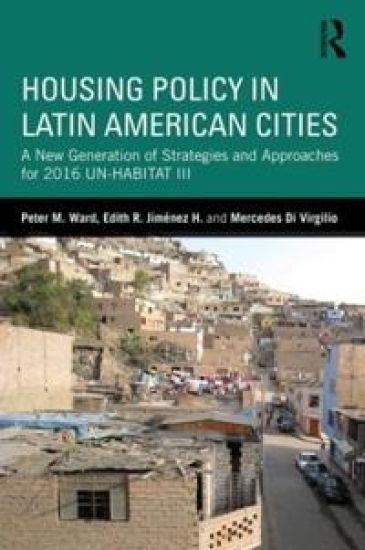
Housing Policy in Latin American Cities

Housing Policy in Latin American Cities

Peter M. Ward; Edith R. Jiménez Huerta; María Mercedes Di Virgilio

Routledge
2014
nidottu
After the 1960s, rapid urbanization in developing regions in Latin America, Africa, and Asia was marked by the expansion of low-income "irregular" settlements that developed informally and which, by the 2000s, often constituted between 20-60 percent of the built-up area of metropolitan areas and other large cities. There has been a variety of research directed at the housing policies involved with these informal settlements, yet apart from the activities of Latin American Housing Network (LAHN), there has been minimal attention directed at the earliest portion of settlements that formed some 25-40 years ago that now form a large part of the intermediate ring of the cities. This volume breaks new ground by opening up a new generation of housing policy in Latin America cities with broader application for other developing countries. Its editors bring unique perspectives: Peter Ward coordinates the LAHN, and Edith Jiménez and María Di Virgilio are founding members of the network who have led project teams in Guadalajara and Buenos Aires respectively. Developed as a coordinated collaborative research project, the volume encompasses nine Latin American countries and eleven cities. The editors and contributors offer original perspectives on the policy challenges facing much of the low income housing of Latin American cities; document the changing nature of the "first suburbs"; present comparative survey findings in order to better understand the types of consolidated settlements that exist today; describe the physical nature of the dwellings themselves; identify the reasons behind market dysfunction that impede the operation of consolidated housing informal markets in Latin American cities; and outline a new generation of housing policies that will support the processes of densification, rehabilitation, and regeneration of these settlements. This book is the first and only composite overview of the research findings and advocacy of the generic policy lines that the LAHN identifies as central to a new generation of housing strategies and approaches. Researchers and practitioners working on housing theory, housing policy, comparative spatial and sociological research, and urban development issues will find the book highly significant.
Governance in the Americas

Governance in the Americas

Robert H. Wilson; Peter M. Ward; Peter K. Spink; Victoria E. Rodriguez

University of Notre Dame Press
2008
nidottu
Governance in the Americas, a multidisciplinary volume, offers important new insights about decentralization, federalism, and democratic change in the three largest federal nations in the Americas: Brazil, Mexico, and the United States. Originating in a major research project conducted by teams in each of the three countries, this study contributes significantly to our understanding of how representative and participatory democracy is being constructed at state and local levels in the recently emerged democracies of Brazil and Mexico, and is being recast and sustained in the United States. The contributors evaluate the performance of subnational governments, as these societies become more genuinely decentralized, and as new actors and managerial routines create and implement public policy. The authors challenge the criticism of "exceptionalism" in the United States, seeking instead to understand the points of convergence and divergence among the three countries as each seeks to improve the effectiveness and public accountability of its policy-making processes. Collaborators include Marta Ferreira Santos Farah, Lawrence S. Graham, Pedro Jacobi, and Allison M. Rowland.
Colonias and Public Policy in Texas and Mexico

Colonias and Public Policy in Texas and Mexico

Peter M. Ward

University of Texas Press
1999
pokkari
Today in Texas, over 1500 colonias in the counties along the Mexican border are home to some 400,000 people. Often lacking basic services, such as electricity, water and sewerage, fire protection, policing, schools, and health care, these "irregular" subdivisions offer the only low-cost housing available to the mostly Hispanic working poor. This book presents the results of a major study of colonias in three transborder metropolitan areas and uncovers the reasons why colonias are spreading so rapidly. Peter Ward compares Texas colonias with their Mexican counterparts, many of which have developed into fully integrated working-class urban communities. He describes how Mexican governments have worked with colonia residents to make physical improvements and upgrade services-a model that Texas policymakers can learn from, Ward asserts. Finally, he concludes with a hard-hitting checklist of public policy initiatives that need to be considered as colonia housing policy enters its second decade in Texas.
Housng,Stte & the Por

Housng,Stte & the Por

Alan Gilbert; Peter M. Ward

Cambridge University Press
1985
sidottu
This book is concerned with the housing needs of the poor in Latin America and how they are articulated and satisfied. Based on the authors' research in Bogota, Mexico City and Valencia, it examines the aims and implementation of government policies towards low-income housing dwellers and relates those policies to the wider interests of the state. It discusses how the poor perceive the constraints on barrio servicing, their involvement in community organisations and the role of the community in influencing state action, and demonstrates how patterns of provision mirror the relationships between the poor and the wider urban society. Its main theme is thus the allocation of resources and the operation of political and administrative power at city level.