
Kirjailija
Peter Meier
Kirjat ja teokset yhdessä paikassa: 18 kirjaa, julkaisuja vuosilta 1993–2025, suosituimpiin kuuluu Deficiência de testosterona e tratamento. Vertaile teosten hintoja ja tarkista saatavuus suomalaisista kirjakaupoista.
18 kirjaa
Kirjojen julkaisuvuodet: 1993–2025.





This book discusses analytical methods for energy sector planning in developing countries. It addresses such topics as energy balances, the Reference Energy System, and approaches to the evaluation of macroeconomic impacts of energy sector decisions.

But it is possible to hone your concentration and focus in such a way that you can learn much faster, thus expanding your knowledge base and improving your comprehension on a much wider range of subjects. I believe that you can perform every one of these accomplishments - and more - far easier and faster than you've ever dreamed - because of this one simple fact: I believe that your mind is working today at only half of its true power - simply because no one has ever shown you the right way to make every book, every article, every subject you ever wish to learn half teach itself What are some benefits you can expect when you follow this programEffortlessly remember important dates, appointments, meetings and schedules weeks, months or even years ahead without missing a single one Make other people "hang on your every word "Develop a perfect, computer like memory in just 5 minutes a day Quickly and easily double or even triple your reading speedBreeze through any test or examDevelop unbreakable concentration and focusNever experience social awkwardness or anxiety againSkyrocket your vocabulary - in minutes The techniques and guidelines listed in this book are all based on extensive research in neuroscience and biology. They are not gimmicks but tried and tested strategies that anyone can apply to improve their ability to absorb new information faster and more efficiently. discover the secrets of accelerated learning and master a skill that will literally open up your mind to new things wherever you look.
Over the past decade almost all developing countries have established energy planning activities in response to the grave problems that have arisen as a result of the drastic increase in energy prices, of the burden of energy related investment debt service, and of the problems of deforestation. Although the insti tutional and organizational responses are quite varied, it is largely engineers and economists who have been called upon to provide the necessary analytical capability to support policy decisions in the energy area. However, as evidenced by the recent participants in the Energy Management Training Program (EMTP), many of the analytical techniques now regarded as appropriate go beyond the usual background of those who are now assigned to such tasks. Indeed, this monograph is based on the material presented in the first ·part of the course, whose purpose is to bring the often diverse group to some common ground. Some of the material, such as Chapter 4 on the basics of energy pricing, is intended primarily for engineers. Other sections, such as Chapter 2 on energy balances, is primarily a vehicle for a discussion of the problems of units and differences in approach by different international bodies. The intent, then, is to provide in a single work a primer on a large number of different analytical tools.


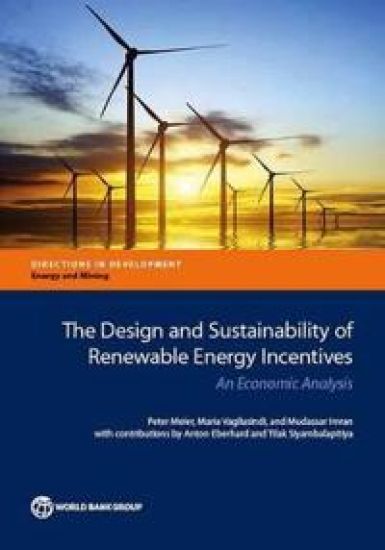
The Design and Sustainability of Renewable Energy Incentives
Peter Meier; Maria Vagliasindi; Mudassar Imran
World Bank Publications
2014
nidottu
The novelty of this work is the fact that it introduces a rigorous and objective economic perspective of current renewable energy support mechanisms and an empirical analysis of the strengths and weaknesses of these mechanisms, which is much needed in a debate often dominated by widespread misconceptions. The economic rationale for renewable energy is straightforward: the optimum amount of renewable energy for grid-connected generation is given by the intersection of the renewable energy supply curve with the avoided cost of thermal electricity generation. The proposed analytical framework: (i) differentiates and illustrates trade-offs-among local, regional, and national impacts, in the short and long run; (ii) captures distributional impacts; and (iii) captures externalities and compares alternative projects based on equivalent output and cost. Accordingly, the study advocates for the need to get the economic, financial, and institutional basics right for the deployment of renewable energy. The study's integration of renewable energy subsidies with fossil subsidies is another novel and important contribution. This allows important comparisons. For example, to reduce carbon intensity in developing country economies, is it more efficient to deploy renewable energy or implement alternative options, such as eliminating subsidies on fossil fuels? The work is based on case studies of Vietnam, Indonesia, Sri Lanka, South Africa, Tanzania, Egypt, Brazil, and Turkey, selected to provide a representative sample of countries with different energy endowments (coal, natural gas, and hydro-based systems) and policy incentives (from feed-in tariffs to auctions). Along the way, the incremental cost of renewable energy is compared with the average cost of generation. The selection and design of support mechanisms in turn determines the impacts on the budget and residential consumers. The main lessons emerging from the case studies are that successful renewable energy policies:Will only be effective once the state-owned utilities who are the buyers of grid-connected renewable energy are themselves in good financial healthNeed to be grounded in economic analysis and accompanied by the application of market principles to ensure economic efficiencyRequire a sustainable, equitable, and transparent recovery of incremental costs

Schon seit Jahrhunderten investiert der Mensch sein Kapital in werterhaltende Rohstoffe. Ein beliebtes Anlageobjekt war schon von jeher der Wald als Reservoir des nachhaltigen Rohstoffes Holz. In der Vergangenheit waren die Wälder eine Domäne des Adels. Heute besitzen nicht nur der Staat und v- mögende Privatpersonen Waldgrundstücke, sondern auch Grossanleger wie internationale Konzerne, Banken, Versicherungen, Pensionskassen, Stift- gen von Familien und Universitäten. Die Investoren sehen in der natürlichen Ressource Holz eine attraktive Möglichkeit, um grosse Kapitalmengen la- fristig sicher und rentabel anzulegen. Der Vorteil von Anlagen in Sachwerte liegt auf der Hand und ist gerade im heutigen Kontext aktuell. Während die Finanzmärkte immer wieder Phasen von Unsicherheit und Übertreibungen ausgesetzt und dabei teilweise von den realwirtschaftlichen Begebenheiten abgekoppelt sind, bieten Sachwerte eine stabile Einkommenskomponente. Es ist an der Zeit, diesen «begreifbaren Investments» wieder mehr Aufmerksamkeit zu schenken. Gerade das natür- che Wachstum von Bäumen hat seine eigene Dynamik und entzieht sich dem Geschehen an den Finanzmärkten. Als Anlageform zeichnet sich Holz – eine erneuerbare Ressource mit fester Nachfrage – als bemerkenswert stabiles Investment aus. Diese Stabilität ist zum Teil bedingt durch die lange Zeit, die Bäume zum Wachsen brauchen.
Energy Decisions and the Environment
Benjamin F. Hobbs; Peter Meier
Springer-Verlag New York Inc.
2012
nidottu
Planning, operating, and policy making in the electric utility and natural gas sectors involves important trade-offs among economic, social, and environmental criteria. These trade-offs figure prominently in ongoing debates about how to meet growing energy demands and how to restructure the world's power industry. Energy Decisions and the Environment: A Guide to the Use of Multicriteria Methods reviews practical tools for multicriteria (also called multiobjective) decision analysis that can be used to quantify trade-offs and contribute to more consistent, informed, and transparent decision making. These methods are designed to generate and effectively communicate information about trade-offs; to help people form, articulate, and apply value judgments in decision making; and to promote effective negotiation among stakeholders with competing interests. Energy Decisions and the Environment: A Guide to the Use of Multicriteria Methods includes explanations of a wide range of methods, tutorial applications that readers can duplicate, a detailed review of energy-environment applications, and three in-depth case studies.
Energy Policy Analysis and Modelling
Mohan Munasinghe; Peter Meier
Cambridge University Press
2008
pokkari
Energy plays a vital role in economic and social development. The analysis of energy issues and policy options is therefore a vital area of study. This book presents a hierarchical modelling scheme intended to support energy planning and policy analysis in developing countries. The authors introduce the concept of 'Integrated National energy Planning' (INEP), and examine the spreadsheet models, optimization models, and linear planning models which energy planners use. Environmental considerations are also introduced into the analysis. Techniques are then applied to two important energy subsectors, electricity and fuelwood, before problems of integration and policy implementation are discussed. Throughout the book, the authors examine actual practice in developing countries. Illustrative case material is drawn from Egypt, West Africa, Sudan, Pakistan, Colombia, India, Sri Lanka and Morocco. This book will be of interest to students and practitioners of energy planning, and to those concerned with the wider development implications of energy policy.
Sustainable Energy in Developing Countries
Peter Meier; Mohan Munasinghe
Edward Elgar Publishing Ltd
2005
sidottu
Using a multidisciplinary approach that draws on their in-depth experience in the fields of energy, environment, and economics, the authors develop a comprehensive analytical framework. They apply their methodology to four detailed studies of Sri Lanka's energy sector, illustrating how to address key energy and environmental policy issues found in many developing countries today. Supplementary case examples are presented which also draw on many other countries in Asia and Africa. The main energy-related areas discussed include electric power, new and renewable energy sources, transport and oil-based fuels, and greenhouse gas emissions. The methodological tools of energy and environmental economics provide a rational basis for identifying policy priorities, evaluating them, and developing more sustainable energy options. The results of the studies are presented in an integrated manner, and contribute to the practical resolution of many important public policy issues. How to deal with risk and uncertainty, and how to identify robust policy options, are major themes that run throughout the volume. Energy and environmental economists, and graduate students interested in an introduction to the analytical methods used in recent World Bank projects on renewable energy and sustainable development will find this book of great value, as will decision makers and policy analysts in developing countries.
Planning, operating, and policy making in the electric utility and natural gas sectors involves important trade-offs among economic, social, and environmental criteria. These trade-offs figure prominently in ongoing debates about how to meet growing energy demands and how to restructure the world's power industry. Energy Decisions and the Environment: A Guide to the Use of Multicriteria Methods reviews practical tools for multicriteria (also called multiobjective) decision analysis that can be used to quantify trade-offs and contribute to more consistent, informed, and transparent decision making. These methods are designed to generate and effectively communicate information about trade-offs; to help people form, articulate, and apply value judgments in decision making; and to promote effective negotiation among stakeholders with competing interests. Energy Decisions and the Environment: A Guide to the Use of Multicriteria Methods includes explanations of a wide range of methods, tutorial applications that readers can duplicate, a detailed review of energy-environment applications, and three in-depth case studies.
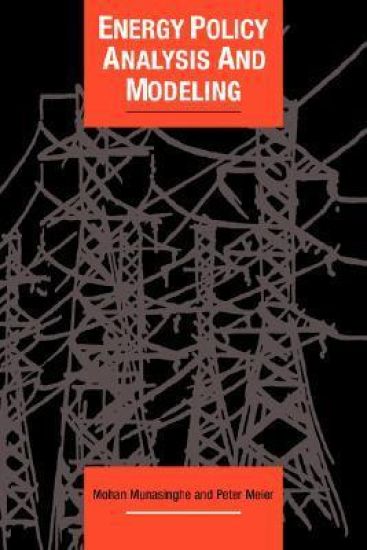
Energy Policy Analysis and Modelling
Mohan Munasinghe; Peter Meier
Cambridge University Press
1993
sidottu
Energy plays a vital role in economic and social development. The analysis of energy issues and policy options is therefore a vital area of study. This book presents a hierarchical modelling scheme intended to support energy planning and policy analysis in developing countries. The authors introduce the concept of 'Integrated National energy Planning' (INEP), and examine the spreadsheet models, optimization models, and linear planning models which energy planners use. Environmental considerations are also introduced into the analysis. Techniques are then applied to two important energy subsectors, electricity and fuelwood, before problems of integration and policy implementation are discussed. Throughout the book, the authors examine actual practice in developing countries. Illustrative case material is drawn from Egypt, West Africa, Sudan, Pakistan, Colombia, India, Sri Lanka and Morocco. This book will be of interest to students and practitioners of energy planning, and to those concerned with the wider development implications of energy policy.