Kirjailija
Peter Moss
Kirjat ja teokset yhdessä paikassa: 39 kirjaa, julkaisuja vuosilta 1996–2026, suosituimpiin kuuluu Beyond Quality in Early Childhood Education and Care. Vertaile teosten hintoja ja tarkista saatavuus suomalaisista kirjakaupoista.
39 kirjaa
Kirjojen julkaisuvuodet: 1996–2026.
What is education, what is it for and what are its fundamental values? How do we understand knowledge and learning? What is our image of the child and the school? How does the ever more pressing need to develop a more just, creative and sustainable democratic society affect our responses to these questions? Addressing these fundamental issues, Fielding and Moss contest the current mainstream dominated by markets and competition, instrumentality and standardisation, managerialism and technical practice. They argue instead for a radical education with democracy as a fundamental value, care as a central ethic, a person-centred education that is education in the broadest sense, and an image of a child rich in potential. Radical education, they say, should be practiced in the ‘common school’, a school for all children in its local catchment area, age-integrated, human scale, focused on depth of learning and based on team working. A school understood as a public space for all citizens, a collective workshop of many purposes and possibilities, and a person-centred learning community, working closely with other schools and with local authorities. The book concludes by examining how we might bring such transformation about. Written by two of the leading experts in the fields of early childhood and secondary education, the book covers a wide vista of education for children and young people. Vivid examples from different stages of education are used to explore the full meaning of radical democratic education and the common school and how they can work in practice. It connects rich thinking and experiences from the past and present to offer direction and hope for the future. It will be of interest and inspiration to all who care about education - teachers and students, academics and policy makers, parents and politicians.

Care Work in Europe provides a cross-national and cross-sectoral study of care work in Europe today, covering policy, provision and practice, as well as exploring how care work is conceptualized and understood. Drawing on a study which looks at care work across the life course in a number of European countries, this book: explores the context and emerging policy agendas provides an analysis of how different countries and sectors understand and structure care work examines key issues, such as the extreme gendering of the workforce, increasing problems of recruitment and turnover, what kinds of knowledge and education the work requires and what conditions are needed to ensure good quality employment considers possible future directions, including the option of a generic professional worker, educated to work across the life course and whether ‘care’ will, or should, remain a distinct field of policy and employment. This groundbreaking comparative study provokes much-needed new thinking about the current situation and future direction of care work, an area essential to the social and economic well-being of Europe.
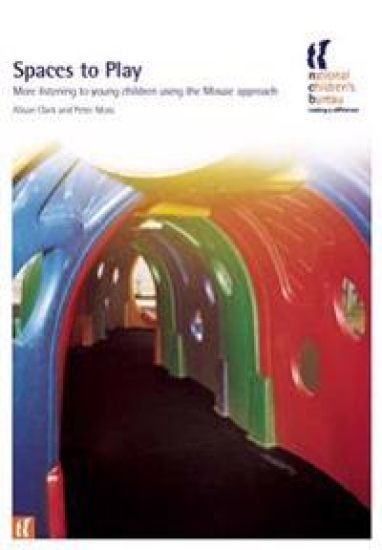
Spaces to Play explains how to use innovative Mosaic approach with young children to ensure their perspectives are the starting point when planning planning outdoor environments in early years provision. An ideal companion to the bestselling introduction, Listening to Young Children: The Mosaic approach, Spaces to Play draws on the findings of a pilot study which used the approach to listen to young children's views and experiences of their outdoor environment, and used the findings to to inform change. It describes how to adapt the Mosaic approach to work in outdoor spaces, demonstrates young children's competencies in expressing their perspectives and explores the links between listening and learning. The book also outlines the challenges and future directions for practitioners and researchers in listening to young children.
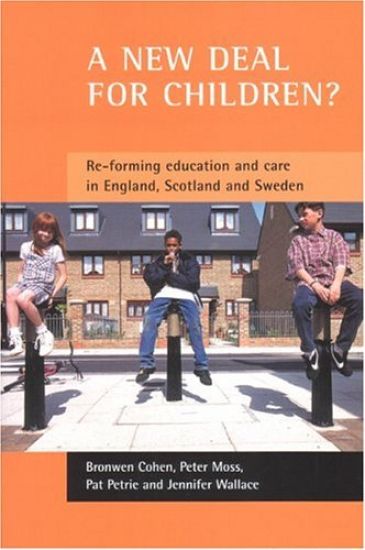
A new deal for children?
Bronwen Cohen; Peter Moss; Pat Petrie; Jennifer Wallace
Policy Press
2004
nidottu
Important reforms are taking place in children's services in the UK, with a move towards greater integration. In England, Scotland and Sweden, early childhood education and care, childcare for older children, and schools are now the responsibility of education departments. This book is the first to examine, cross-nationally, this major shift in policy. With case studies and practical examples to illustrate how changes have been implemented, this book is essential reading for practitioners, managers, politicians, trainers and researchers in children's services, including schools, early years, school-age childcare, leisure and recreation, child welfare and health.
More than ever before, children are apparently being recognised as social actors and citizens. Yet public policy often involves increased control and surveillance of children. This book explores the contradiction. It shows how different ways of thinking about children produce different childhoods, different public provisions for children (including schools) and different ways of working with children. It argues that how we understand children and make public provision for them involves political and ethical choices. Through case studies and the analysis of policy and practice drawn from a number of countries, the authors describe an approach to public provision for children which they term 'children's services'. They then propose an alternative approach named 'children's spaces', and go on to consider an alternative theory, practice and profession of work with children: pedagogy and the pedagogue. This ground breaking book will be essential reading for tutors and students on higher education or in-service courses in early childhood, education, play, social work and social policy, as well as practitioners and policy makers in these areas.
Highly Commended (Third prize) in the Standing Conference on Studies in Education book prize for books published in 1999. `It was a breath of fresh air to see 'contentious' issues dealt with in an enlightened and informative way. We are certain it will move the debate on years!' - Chrissie Meleady, Sheffield Childrens' Centre `Looks most interesting and will certainly be very useful' - Bronwen Cohen, Director, Children in Scotland `It's a challenging and exciting book and I hope it is widely used' - Margy Whalley, Director, Pen Green Research, Development and Training Base, Pen Green Centre for Under 5's and Their Families `An extremely interesting account. This book highlights some very important tensions and contradictions about the role of men in childcare work. The differing perceptions of women and men concerning men's involvement in childcare are particularly thoughtfully documented' - Peter Aggleton, Director, Thomas Coram Research Unit, University of London `An essential book for the debate on gender and childcare... the more academic childcare students will cope with it, will be good for Second year BTEC students, `A' Level students' - Robin Wright, Lecturer, Bournemouth and Poole College of Higher Education `Having been a lone male worker, this book has stimulate discussion on gender and how we need to wrestle and value difference. For that reason alone its worth buying' - Practical Parenting
`This is an important publication, which I urge colleagues to read and to consider carefully all the implications' - Early Years `... This provocative analysis with its clear examples is worth reading for its fresh look at where we could be headed come the 21st century'- Nursery Equipment Early childhood services in the UK have been badly neglected. The consequences are serious: chronic underfunding and increasing fragmentation; most staff poorly paid and trained; access often a matter of potluck and money; low aspirations and even lower expectations. Increasingly, young children are seen as important for what they may become rather than for what they are, and the case for early childhood services is made out in terms of later performance in school and adult life rather than the needs and rights of young children themselves. No current political vision redresses this undervaluing of early childhood or addresses the parlous state our early childhood services are in. Drawing on the rich early childhood tradition in the UK, going back to Robert Owen, and giving examples from current practice, Transforming Nursery Education offers a critique of the status quo, a vision of early childhood services and practical strategies for achieving it. The book covers a wide range of day care and education services and critical issues such as staffing, funding, curriculum, models of provision and the age at which children start compulsory schooling. Within this broad approach, the book focuses in particular on the history and current practice of nursery education. It argues that the present narrow approach to nursery education is neither appropriate to the needs of today nor inevitable. It answers a critical question: how can nursery education be transformed to play a leading role in the comprehensive, integrated and coherent early childhood service that today's families really need?