Kirjailija
Peter Petersen
Kirjat ja teokset yhdessä paikassa: 15 kirjaa, julkaisuja vuosilta 1924–2026, suosituimpiin kuuluu Elegy for Young Lovers. Vertaile teosten hintoja ja tarkista saatavuus suomalaisista kirjakaupoista.
15 kirjaa
Kirjojen julkaisuvuodet: 1924–2026.
Intended for a one year course, this text serves as a single source, introducing readers to the important techniques and theorems, while also containing enough background on advanced topics to appeal to those students wishing to specialize in Riemannian geometry. This is one of the few Works to combine both the geometric parts of Riemannian geometry and the analytic aspects of the theory. The book will appeal to a readership that have a basic knowledge of standard manifold theory, including tensors, forms, and Lie groups. Important revisions to the third edition include:a substantial addition of unique and enriching exercises scattered throughout the text;inclusion of an increased number of coordinate calculations of connection and curvature;addition of general formulas for curvature on Lie Groups and submersions;integration of variational calculus into the text allowing for an early treatment of the Sphere theorem using a proof by Berger;incorporation of several recent results about manifolds with positive curvature;presentation of a new simplifying approach to the Bochner technique for tensors with application to bound topological quantities with general lower curvature bounds. From reviews of the first edition:"The book can be highly recommended to all mathematicians who want to get a more profound idea about the most interesting achievements in Riemannian geometry. It is one of the few comprehensive sources of this type."-Bernd Wegner, ZbMATH
Riemannian Geometry
Peter Petersen
Springer International Publishing AG
2016
sidottu
Halvin toimitettuna 76,90 €
Intended for a one year course, this text serves as a single source, introducing readers to the important techniques and theorems, while also containing enough background on advanced topics to appeal to those students wishing to specialize in Riemannian geometry. This is one of the few Works to combine both the geometric parts of Riemannian geometry and the analytic aspects of the theory. The book will appeal to a readership that have a basic knowledge of standard manifold theory, including tensors, forms, and Lie groups. Important revisions to the third edition include:a substantial addition of unique and enriching exercises scattered throughout the text;inclusion of an increased number of coordinate calculations of connection and curvature;addition of general formulas for curvature on Lie Groups and submersions;integration of variational calculus into the text allowing for an early treatment of the Sphere theorem using a proof by Berger;incorporation of several recent results about manifolds with positive curvature;presentation of a new simplifying approach to the Bochner technique for tensors with application to bound topological quantities with general lower curvature bounds. From reviews of the first edition:"The book can be highly recommended to all mathematicians who want to get a more profound idea about the most interesting achievements in Riemannian geometry. It is one of the few comprehensive sources of this type."-Bernd Wegner, ZbMATH
This textbook on linear algebra includes the key topics of the subject that most advanced undergraduates need to learn before entering graduate school. All the usual topics, such as complex vector spaces, complex inner products, the Spectral theorem for normal operators, dual spaces, the minimal polynomial, the Jordan canonical form, and the rational canonical form, are covered, along with a chapter on determinants at the end of the book. In addition, there is material throughout the text on linear differential equations and how it integrates with all of the important concepts in linear algebra. This book has several distinguishing features that set it apart from other linear algebra texts. For example: Gaussian elimination is used as the key tool in getting at eigenvalues; it takes an essentially determinant-free approach to linear algebra; and systems of linear differential equations are used as frequent motivation for the reader. Another motivating aspect of the book isthe excellent and engaging exercises that abound in this text. This textbook is written for an upper-division undergraduate course on Linear Algebra. The prerequisites for this book are a familiarity with basic matrix algebra and elementary calculus, although any student who is willing to think abstractly should not have too much difficulty in understanding this text.
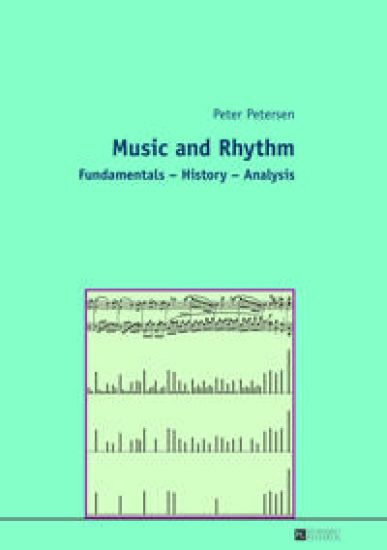
This book sets forth the first really novel theory of rhythm since Hugo Riemann: the components theory. Its approach will be of interest to musicologists and music theoreticians alike as well as to music performers, since it will enable them to describe and understand the rhythmic shape of music better and more fully than was previously possible. Instead of conceiving rhythm simply as interplay of short and long, of accents and meters, the present analysis takes its departure from secondary rhythms that are not notated but depend on specific qualities of a given sound or sound formation. Together with the basic rhythms, these components rhythms form a total rhythmic texture, whose temporal and weight structure allows a novel way of perceiving musical meter as not being primarily prescriptive but above all as the product of an overall compositional calculation of component rhythms.
This textbook on linear algebra includes the key topics of the subject that most advanced undergraduates need to learn before entering graduate school. All the usual topics, such as complex vector spaces, complex inner products, the Spectral theorem for normal operators, dual spaces, the minimal polynomial, the Jordan canonical form, and the rational canonical form, are covered, along with a chapter on determinants at the end of the book. In addition, there is material throughout the text on linear differential equations and how it integrates with all of the important concepts in linear algebra. This book has several distinguishing features that set it apart from other linear algebra texts. For example: Gaussian elimination is used as the key tool in getting at eigenvalues; it takes an essentially determinant-free approach to linear algebra; and systems of linear differential equations are used as frequent motivation for the reader. Another motivating aspect of the book isthe excellent and engaging exercises that abound in this text. This textbook is written for an upper-division undergraduate course on Linear Algebra. The prerequisites for this book are a familiarity with basic matrix algebra and elementary calculus, although any student who is willing to think abstractly should not have too much difficulty in understanding this text.
Intended for a one year course, this volume serves as a single source, introducing students to the important techniques and theorems, while also containing enough background on advanced topics to appeal to those students wishing to specialize in Riemannian geometry. This is one of the few works to combine both the geometric parts of Riemannian geometry and the analytic aspects of the theory, while also presenting the most up-to-date research. Important additions to this new edition include: - A completely new coordinate free formula that is easily remembered, and is, in fact, the Koszul formula in disguise - An increased number of coordinate calculations of connection and curvature - General fomulas for curvature on Lie Groups and submersions - Variational calculus has been integrated into the text, which allows for an early treatment of the Sphere theorem using a forgottten proof by Berger - Several recent results about manifolds with positive curvature

Cursus Brevis. Texte und Übungen
Andreas Müller; Peter Petersen; Hans Dietrich Unger
Buchner, C.C. Verlag
2000
nidottu
Der ? Cursus Brevis? ist für den kürzer angelegten Lateinunterricht konzipiert.
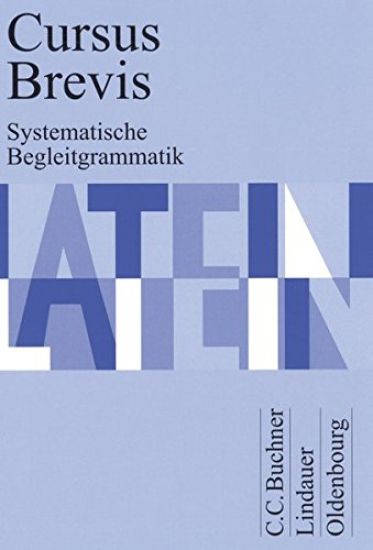
Cursus Brevis Begleitgrammatik
Peter Petersen; Hans Dietrich Unger; Andrea Wilhelm
Buchner, C.C. Verlag
2000
lehtivihko, moniste
Der ? Cursus Brevis? ist für den kürzer angelegten Lateinunterricht konzipiert.