Kirjojen hintavertailu – 12 903 725 kirjaa ja 27 kauppaa
Kirjailija
Peter Turchin
Kirjat ja teokset yhdessä paikassa: 10 kirjaa, julkaisuja vuosilta 2003–2025, suosituimpiin kuuluu Lopun ajat. Vertaile teosten hintoja ja tarkista saatavuus suomalaisista kirjakaupoista.
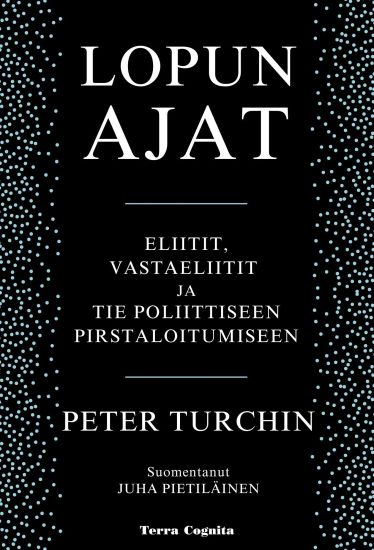
Lopun ajat tarjoaa ensimmäisen laajaan kvantitatiiviseen aineistoon perustuvan teorian yhteiskunnan sisäisistä kriiseistä. Maineikas kompleksisuustieteilijä Peter Turchin on koonnut yhteistyökumppaneineen valtavan SESHAT-tietokannan, johon on koodattu erilaisten historiallisten ja nykyisten yhteiskuntien keskeiset tunnusluvut kymmenentuhannen viime vuoden ajalta. Näin saatu kvantitatiivinen suuraineisto on mahdollistanut uuden, kliodynamiikaksi kutsutun eksaktin historiatieteen. Sen avulla historian tutkimus voidaan laajentaa yksittäistapauksista yleiseen ja paljastaa historiasta hätkähdyttäviä hahmoja, jotka ovat yhteisiä kaikille sisäisiin kriiseihin ajautuneille yhteiskunnille. Turchin soveltaa näkökulmaansa erityisesti Yhdysvaltojen nykytilaan. Hän tunnistaa Yhdysvalloista kaikki tietokantansa aiemmat yhteiskunnat eripuran aikaan suistaneet tekijät. Mikä huolestuttavampaa, kliodynamiikan mallit ennustavat, että Yhdysvallat on sisäisille kriiseille tunnusomaisen väkivaltaisen purkauksen vaiheessa. Turchin kuvaa, mitkä nämä historialliset hahmot ja tekijät ovat ja mitä voimme niistä oppia välttääksemme ja pehmentääksemme nykyisiä ja tulevia kriisejämme.
THE THOUGHT BOOK OF THE YEAR, THE TIMESA GUARDIAN BOOK OF THE YEAR'Game of Thrones-style intra-elite conflict meets big data' TLS'Extraordinary. . . the culmination of many years of highly original and innovative work' BloombergOne of the most iconoclastic thinkers of our time offers a brilliant new theory of how society works What leads to political turbulence and social breakdown? How do elites maintain their dominant position? And why do ruling classes sometimes suddenly lose their grip on power? For decades, complexity scientist Peter Turchin has been studying world history like no-one else. Assembling vast databases mined from 10,000 years of human activity, and then developing new models, he has transformed the way we learn from the past. End Times is the result: a ground-breaking account of how society works. The lessons, he argues, are clear. When the balance of power between the ruling class and the majority tips too far in favour of elites, income inequality surges. The rich get richer, the poor further impoverished. As more people try to join the elite, frustration with the establishment brims over, often with disastrous consequences. Elite overproduction led to state breakdown in imperial China, in medieval France, in the American Civil War - and it is happening now. But while we are far along the path toward violent political rupture, Turchin's models also light the way to a brighter future. Drawing insight from those occasions in history where the balance was restored, End Times also points towards a different future: an escape from the patterns of the past. BEST BOOKS OF SUMMER 2023: THE GUARDIAN * THE TIMES * SUNDAY TIMES
"Peter Turchin brings science to history. Some like it and some prefer their history plain. But everyone needs to pay attention to the well-informed, convincing and terrifying analysis in this book." --Angus Deaton, winner of the Nobel Prize in Economics From the pioneering co-founder of cliodynamics, the groundbreaking new interdisciplinary science of history, a big-picture explanation for America's civil strife and its possible endgames Peter Turchin, one of the most interesting social scientists of our age, has infused the study of history with approaches and insights from other fields for more than a quarter century. End Times is the culmination of his work to understand what causes political communities to cohere and what causes them to fall apart, as applied to the current turmoil within the United States. Back in 2010, when Nature magazine asked leading scientists to provide a ten-year forecast, Turchin used his models to predict that America was in a spiral of social disintegration that would lead to a breakdown in the political order circa 2020. The years since have proved his prediction more and more accurate, and End Times reveals why. The lessons of world history are clear, Turchin argues: When the equilibrium between ruling elites and the majority tips too far in favor of elites, political instability is all but inevitable. As income inequality surges and prosperity flows disproportionately into the hands of the elites, the common people suffer, and society-wide efforts to become an elite grow ever more frenzied. He calls this process the wealth pump; it's a world of the damned and the saved. And since the number of such positions remains relatively fixed, the overproduction of elites inevitably leads to frustrated elite aspirants, who harness popular resentment to turn against the established order. Turchin's models show that when this state has been reached, societies become locked in a death spiral it's very hard to exit. In America, the wealth pump has been operating full blast for two generations. As cliodynamics shows us, our current cycle of elite overproduction and popular immiseration is far along the path to violent political rupture. That is only one possible end time, and the choice is up to us, but the hour grows late.
The numbers that tell the story of humanity 'Vital ... If you're thinking about setting up a giant land empire in Asia, you cannot do so without this book ... If only the last Song emperor had had this book by his side, he might have avoided his appalling fate' Dan Snow What was history's biggest empire? Or the tallest building of the ancient world? What was the average life expectancy in medieval Byzantium? The average wage in Old Kingdom Egypt? Where did scientific writing first emerge? What was the bloodiest ritual human sacrifice ever? We are used to thinking about history in terms of stories. Yet we understand our own world through data: vast arrays of statistics that reveal the workings of our societies. So, join the radical historians Peter Turchin and Dan Hoyer for a dive into the numbers that reveal the true shape of the past. Drawing on their own Seshat project, a staggeringly ambitious attempt to log each piece of demographic and econometric information that can be reliably estimated for every society that has ever existed, Figuring Out The Past does more than tell the story of the past: it shows you the large-scale patterns.
Many historical processes are dynamic. Populations grow and decline. Empires expand and collapse. Religions spread and wither. Natural scientists have made great strides in understanding dynamical processes in the physical and biological worlds using a synthetic approach that combines mathematical modeling with statistical analyses. Taking up the problem of territorial dynamics--why some polities at certain times expand and at other times contract--this book shows that a similar research program can advance our understanding of dynamical processes in history. Peter Turchin develops hypotheses from a wide range of social, political, economic, and demographic factors: geopolitics, factors affecting collective solidarity, dynamics of ethnic assimilation/religious conversion, and the interaction between population dynamics and sociopolitical stability. He then translates these into a spectrum of mathematical models, investigates the dynamics predicted by the models, and contrasts model predictions with empirical patterns. Turchin's highly instructive empirical tests demonstrate that certain models predict empirical patterns with a very high degree of accuracy. For instance, one model accounts for the recurrent waves of state breakdown in medieval and early modern Europe. And historical data confirm that ethno-nationalist solidarity produces an aggressively expansive state under certain conditions (such as in locations where imperial frontiers coincide with religious divides). The strength of Turchin's results suggests that the synthetic approach he advocates can significantly improve our understanding of historical dynamics.
WE ARE ON THE WRONG TRACK Seventy percent of Americans (and counting) think so. The real wage of a US worker today is less than it was 40 years ago-but there are four times as many multimillionaires. As inequality grows, the politics become more poisonous. Every year, more and more Americans go on shooting sprees, killing strangers and passers-by-and now, increasingly, representatives of the state. Troubling trends of this kind are endlessly discussed by public intellectuals and social scientists. But mostly, they talk about only a small slice of the overall problem. After all, how on earth can yet another murderous rampage have anything to do with polarization in Congress? And is there really a connection between too many multimillionaires and government gridlock? Historical analysis shows that long spells of equitable prosperity and internal peace are succeeded by protracted periods of inequity, increasing misery, and political instability. These crisis periods-"Ages of Discord"-have recurred in societies throughout history. Modern Americans may be disconcerted to learn that the US right now has much in common with the Antebellum 1850s and, more surprisingly, with ancien r gime France on the eve of the French Revolution. Can it really be true that there is nothing new about our troubled time, and that similar ages arise periodically for similar underlying reasons? Ages of Discord marshals Structural-Demograpic Theory and detailed historical data to show that this is, indeed, the case. The book takes the reader on a roller-coaster ride through American history, from the Era of Good Feelings of the 1820s to our first Age of Discord, which culminated in the American Civil War, to post-WW2 prosperity and, finally, to our present, second Age of Discord.
Many historical processes exhibit recurrent patterns of change. Century-long periods of population expansion come before long periods of stagnation and decline; the dynamics of prices mirror population oscillations; and states go through strong expansionist phases followed by periods of state failure, endemic sociopolitical instability, and territorial loss. Peter Turchin and Sergey Nefedov explore the dynamics and causal connections between such demographic, economic, and political variables in agrarian societies and offer detailed explanations for these long-term oscillations--what the authors call secular cycles. Secular Cycles elaborates and expands upon the demographic-structural theory first advanced by Jack Goldstone, which provides an explanation of long-term oscillations. This book tests that theory's specific and quantitative predictions by tracing the dynamics of population numbers, prices and real wages, elite numbers and incomes, state finances, and sociopolitical instability. Turchin and Nefedov study societies in England, France, and Russia during the medieval and early modern periods, and look back at the Roman Republic and Empire. Incorporating theoretical and quantitative history, the authors examine a specific model of historical change and, more generally, investigate the utility of the dynamical systems approach in historical applications. An indispensable and groundbreaking resource for a wide variety of social scientists, Secular Cycles will interest practitioners of economic history, historical sociology, complexity studies, and demography.
Many historical processes are dynamic. Populations grow and decline. Empires expand and collapse. Religions spread and wither. Natural scientists have made great strides in understanding dynamical processes in the physical and biological worlds using a synthetic approach that combines mathematical modeling with statistical analyses. Taking up the problem of territorial dynamics--why some polities at certain times expand and at other times contract--this book shows that a similar research program can advance our understanding of dynamical processes in history. Peter Turchin develops hypotheses from a wide range of social, political, economic, and demographic factors: geopolitics, factors affecting collective solidarity, dynamics of ethnic assimilation/religious conversion, and the interaction between population dynamics and sociopolitical stability. He then translates these into a spectrum of mathematical models, investigates the dynamics predicted by the models, and contrasts model predictions with empirical patterns. Turchin's highly instructive empirical tests demonstrate that certain models predict empirical patterns with a very high degree of accuracy. For instance, one model accounts for the recurrent waves of state breakdown in medieval and early modern Europe. And historical data confirm that ethno-nationalist solidarity produces an aggressively expansive state under certain conditions (such as in locations where imperial frontiers coincide with religious divides). The strength of Turchin's results suggests that the synthetic approach he advocates can significantly improve our understanding of historical dynamics.
Why do organisms become extremely abundant one year and then seem to disappear a few years later? Why do population outbreaks in particular species happen more or less regularly in certain locations, but only irregularly (or never at all) in other locations? Complex population dynamics have fascinated biologists for decades. By bringing together mathematical models, statistical analyses, and field experiments, this book offers a comprehensive new synthesis of the theory of population oscillations. Peter Turchin first reviews the conceptual tools that ecologists use to investigate population oscillations, introducing population modeling and the statistical analysis of time series data. He then provides an in-depth discussion of several case studies--including the larch budmoth, southern pine beetle, red grouse, voles and lemmings, snowshoe hare, and ungulates--to develop a new analysis of the mechanisms that drive population oscillations in nature. Through such work, the author argues, ecologists can develop general laws of population dynamics that will help turn ecology into a truly quantitative and predictive science. Complex Population Dynamics integrates theoretical and empirical studies into a major new synthesis of current knowledge about population dynamics. It is also a pioneering work that sets the course for ecology's future as a predictive science.