Kirjojen hintavertailu – 12 859 828 kirjaa ja 27 kauppaa

Kirjailija

Peter W.B. Phillips

Kirjat ja teokset yhdessä paikassa: 6 kirjaa, julkaisuja vuosilta 2001–2018, suosituimpiin kuuluu Biotechnology Regulation and Trade. Vertaile teosten hintoja ja tarkista saatavuus suomalaisista kirjakaupoista.

Nimi esiintyy myös muodoissa: Peter W. B Phillips

6 kirjaa

Kirjojen julkaisuvuodet: 2001–2018.

Biotechnology Regulation and Trade

Biotechnology Regulation and Trade

Stuart J. Smyth; William A. Kerr; Peter W. B Phillips

Springer International Publishing AG
2018
nidottu
This book discusses the regulatory and trade challenges facing the global adoption of biotechnological products and offers strategies for overcoming these obstacles and moving towards greater global food security. The first section of the book establishes the context of the conflict, discussing the challenges of global governance, international trade, and the history of regulation of genetically modified (GM) crops. In this section, the authors emphasize the shift from exclusively science-based regulation to the more socio-economically focused framework established by the Cartagena Protocol on Biosafety, which was adopted in 2000. The second section of the book provides a snapshot of the current state of international GM crop adoption and regulation, highlighting the US, Canada, and the EU. The final section of the book identifies options for breaking the gridlock of regulation and trade that presently exist. This book adds to the current literature by providing new information about innovative agricultural technologies and encouraging debate by providing an alternative to the narratives espoused by environmental non-governmental organizations. This book will appeal to students of economics, political science, and policy analysis, as well as members of regulatory agencies and agricultural industry firms.
Biotechnology Regulation and Trade

Biotechnology Regulation and Trade

Stuart J. Smyth; William A. Kerr; Peter W. B Phillips

Springer International Publishing AG
2017
sidottu
This book discusses the regulatory and trade challenges facing the global adoption of biotechnological products and offers strategies for overcoming these obstacles and moving towards greater global food security. The first section of the book establishes the context of the conflict, discussing the challenges of global governance, international trade, and the history of regulation of genetically modified (GM) crops. In this section, the authors emphasize the shift from exclusively science-based regulation to the more socio-economically focused framework established by the Cartagena Protocol on Biosafety, which was adopted in 2000. The second section of the book provides a snapshot of the current state of international GM crop adoption and regulation, highlighting the US, Canada, and the EU. The final section of the book identifies options for breaking the gridlock of regulation and trade that presently exist. This book adds to the current literature by providing new information about innovative agricultural technologies and encouraging debate by providing an alternative to the narratives espoused by environmental non-governmental organizations. This book will appeal to students of economics, political science, and policy analysis, as well as members of regulatory agencies and agricultural industry firms.
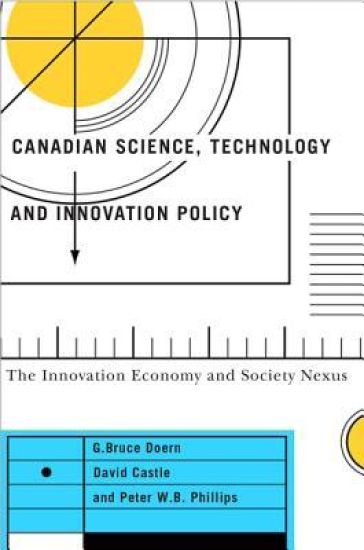
Canadian Science, Technology, and Innovation Policy

Canadian Science, Technology, and Innovation Policy

G. Bruce Doern; David Castle; Peter W.B. Phillips

McGill-Queen's University Press
2016
sidottu
Canadian Science, Technology, and Innovation Policy presents new critical analysis about related developments in the field such as significantly changed concepts of peer review, merit review, the emergence of big data in the digital age, and the rise of an economy and society dominated by the internet and information. The authors scrutinize the different ways in which federal and provincial policies have impacted both levels of government, including how such policies impact on Canada's natural resources. They also study key government departments and agencies involved with science, technology, and innovation to show how these organizations function increasingly in networks and partnerships, as Canada seeks to keep up and lead in a highly competitive global system. The book also looks at numerous realms of technology across Canada in universities, business, and government and various efforts to analyze biotechnology, genomics, and the Internet, as well as earlier technologies such as nuclear reactors, and satellite technology. The authors assess whether a science-and-technology-centred innovation economy and society has been established in Canada - one that achieves a balance between commercial and social objectives, including the delivery of public goods and supporting values related to redistribution, fairness, and community and citizen empowerment. Probing the nature of science advice across prime ministerial eras, including recent concerns over the Harper government's claimed muzzling of scientists in an age of attack politics, Canadian Science, Technology, and Innovation Policy provides essential information for academics and practitioners in business and government in this crucial and complex field.
Canadian Science, Technology, and Innovation Policy

Canadian Science, Technology, and Innovation Policy

G. Bruce Doern; David Castle; Peter W.B. Phillips

McGill-Queen's University Press
2016
nidottu
Canadian Science, Technology, and Innovation Policy presents new critical analysis about related developments in the field such as significantly changed concepts of peer review, merit review, the emergence of big data in the digital age, and the rise of an economy and society dominated by the internet and information. The authors scrutinize the different ways in which federal and provincial policies have impacted both levels of government, including how such policies impact on Canada's natural resources. They also study key government departments and agencies involved with science, technology, and innovation to show how these organizations function increasingly in networks and partnerships, as Canada seeks to keep up and lead in a highly competitive global system. The book also looks at numerous realms of technology across Canada in universities, business, and government and various efforts to analyze biotechnology, genomics, and the Internet, as well as earlier technologies such as nuclear reactors, and satellite technology. The authors assess whether a science-and-technology-centred innovation economy and society has been established in Canada - one that achieves a balance between commercial and social objectives, including the delivery of public goods and supporting values related to redistribution, fairness, and community and citizen empowerment. Probing the nature of science advice across prime ministerial eras, including recent concerns over the Harper government's claimed muzzling of scientists in an age of attack politics, Canadian Science, Technology, and Innovation Policy provides essential information for academics and practitioners in business and government in this crucial and complex field.
Governing Transformative Technological Innovation

Governing Transformative Technological Innovation

Peter W.B. Phillips

Edward Elgar Publishing Ltd
2007
sidottu
New technologies often appear to be beyond the control of any existing governing systems. This is especially true for transformative technologies such as information technologies, biotechnologies and nanotechnologies. Peter Phillips examines in this book the deep governing structures of transformative technology and innovation in an effort to identify which actors can be expected to act when, under what conditions and to what effect. He analyzes the life cycles of an array of examples where converging technologies have created transformations and supervisory challenges. The author begins by providing assessments of the concepts of transformative technology, innovation, and related regulatory difficulties. He then evaluates the various tools commonly used to examine governing systems, including overarching paradigms for managing transformative innovation and the models and taxonomies used to investigate governing via the state, the market, and civil authorities. By applying the paradigms, tools and methodologies to current transformative changes, he investigates the challenges of governing in practice: first, the systems and authorities that define knowledge; second, the structures that regulate discovery, invention and ingenuity; third, the public, private and collective processes that engage in gestating new ideas; and, finally, the distributed governing networks underlying the production and marketing of new products. The book concludes with the author's observations on the implications of using deep governing systems and an appraisal of the strengths and weaknesses of our tools of analysis. Academic specialists, practitioners and professionals in the areas of economics, management, political science, sociology, public policy and science-technology-society studies will appreciate the author's broad theoretical approach. The methodological insights will interest those policymakers working on technological change and innovation policies in regional, national and international institutions.
Governing Food

Governing Food

Peter W.B. Phillips; Robert Wolfe

Queen's University
2001
nidottu
Governing food creates friction in transatlantic relations, complicates Britain's relations with its EU partners, and poses challenges to Canada's relations with the United States. The essays in Governing Food, written by distinguished public officials, academics, and industry and civil society commentators, examine the three pillars of food safety - science, regulation, and industry - to highlight the pressures on government. Contributors include Charles Cockbill, chairman of the European Food Law Association of the UK; Neville Craddock, group regulatory affairs manager, Nestle UK; Lorne Hepworth, president, Crop Protection Institute (Canada); Catherine Humphries, director of Scientific Services, Co-operative Wholesale Society (UK); Anne A. MacKenzie, associate vice-president of Science Evaluation, Canadian Food Inspection Agency; Peter Phillips, University of Saskatchewan; Robert Wolfe, Queen's University; William Leiss, president, Royal Society of Canada.