Kirjojen hintavertailu – 12 903 735 kirjaa ja 27 kauppaa
Kirjailija
Peter Williamson
Kirjat ja teokset yhdessä paikassa: 43 kirjaa, julkaisuja vuosilta 1999–2021, suosituimpiin kuuluu James, First, Second, and Third John. Vertaile teosten hintoja ja tarkista saatavuus suomalaisista kirjakaupoista.
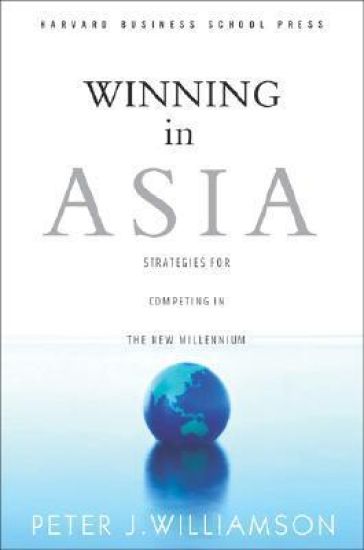
This is the first book to spell out exactly what multinational and local Asian firms must do to compete successfully in post-crisis Asia. While the Asian economy used to depend primarily on exports, today the local Asian market is demanding and consuming more goods. The make-up of competition locally is shifting from national fiefdoms to cross-border competition. And China's rapid development is changing how competition is played altogether. "Winning in Asia" explores these new business realities in Asia, and explains why there will be no going back to the "Asian norm" of the 80s and 90s. Most importantly, it tackles head-on the critical issue of what companies - both local Asian businesses and multinational corporations operating in Asia - must do and how they must change in order to compete successfully in the next round of Asian competition.
Becoming a global company once meant penetrating markets around the world. But the demands of the knowledge economy are turning this strategy on its head. Today, the challenge is to innovate by learning from the world . This book provides a blueprint for companies ready to embrace this new globalization challenge. In From Global to Metanational, international business and strategy experts Yves Doz, Jose Santos, and Peter Williamson introduce a radically different kind of company--the metanational--defined by three core capabilities: being the first to identify and capture new knowledge emerging all over the world; mobilizing this globally scattered knowledge to out-innovate competitors; and, turning this innovation into value by producing, marketing, and delivering efficiently on a global scale. The authors explain why traditional global strategies are no longer sufficient to differentiate leading competitors, what the knowledge economy means for managers, and why opportunities to leverage globally dispersed knowledge are growing. Most important, they outline exactly how managers can build a metanational advantage for their own organizations by: prospecting for and accessing untapped pockets of technology and emerging consumer trends from around the world; leveraging knowledge imprisoned in a multinational's local subsidiaries; and, mobilizing this fragmented knowledge to generate innovations, profits, and shareholder value. Drawing from the experiences of pioneering metanationals including STMicroelectronics, ARM, Acer, Nokia, Shiseido, and PolyGram, the book shows how today's multinationals can use their existing global networks to gain an important head start in the global game--and how newcomers can leapfrog traditional competitors by rapidly building a new-style metanational corporation. Must-reading for every leader--from the CEO of a new global venture, to the executive of a currently successful multinational, to the founder of an e-business startup getting ready to 'go global'--this pathbreaking book shows how to reshape strategies to compete and win in the global knowledge economy.
With recent social trends and developments in health care policy, the health of men is high on the political agenda. Men's Health: Perspectives, Diversity and Paradox examines and clarifies what is known about the socialisation of boys and men. The book shows how this influences the ways in which they maintain their health, how they respond to illness, and why they do or do not seek help. It also includes personal stories and poems by men. The text reviews research on health, gender and masculinity, and describes recent research on the health of men at work. The research forms the basis for exploring how national, regional and local strategies can be developed to improve men's health. The book is intended for medical, nursing and social science students, and health service managers and professionals. It is relevant for academic departments of public health, social medicine, general practice, nursing, health sciences, women's studies, gender studies, public policy and administration, and sociology. It is also intended for those working in public health, community and mental health, primary health, and social services.