Kirjojen hintavertailu – 12 903 724 kirjaa ja 27 kauppaa

Kirjailija

Petraq Papajorgji

Kirjat ja teokset yhdessä paikassa: 8 kirjaa, julkaisuja vuosilta 2009–2025, suosituimpiin kuuluu The Mind of Everyday. Vertaile teosten hintoja ja tarkista saatavuus suomalaisista kirjakaupoista.

8 kirjaa

Kirjojen julkaisuvuodet: 2009–2025.

The Mind of Everyday

The Mind of Everyday

Petraq Papajorgji; Howard Moskowitz

Springer International Publishing AG
2025
Nidottu
The advent of artificial intelligence (AI) is associated with relevant changes in how we live today. AI has the potential to significantly enhance daily decision-making by providing tailored, data-dependent insights and aiding in intricate analysis. AI-based systems will be around us, helping and advising us in our everyday tasks. However, how well do these systems perform in their quest to "replace" the human brain? A "meter," a procedure for comparing the outcomes obtained by artificial intelligence systems with those obtained by human systems, is necessary to address this issue. This "meter" is Mind Genomics, a new emerging science that delves into the science of how we, as humans, organize and respond to information. To evaluate whether there are differences in the results obtained by AI-based systems and human-based experiments based on 'Outer Psychophysics' were designed and implemented. Thus, four experiments in crucial areas of our lives are selected and cover education, family stress, and environmental and governmental policies. For each area, a Mind Genomic experiment is designed, defining four topics (silos). Then, the elements contained in each of the silos were generated twice, once by humans and then by an AI-based system. Evaluating both systems' performance requires comparing the results obtained by both experiments. The analysis of the study cases is disciplined, rich in scientific tools, and presented with methods. Through a blend of theoretical exploration, case studies, and practical applications, this book aims to inspire readers with the potential of the fusion of Mind Genomics and AI to empower innovation, enhance user experiences, and bring forth a more nuanced understanding of human thought. Whether the reader is a student, a researcher in the field of social and political sciences, or simply curious about the evolving landscape of science and technology, we hope this book will serve as an invitation to explore how we can harmonize human and machine intelligence to better navigate the complex world around us.
The Mind of Everyday

The Mind of Everyday

Petraq Papajorgji; Howard Moskowitz

Springer International Publishing AG
2024
sidottu
The advent of artificial intelligence (AI) is associated with relevant changes in how we live today. AI has the potential to significantly enhance daily decision-making by providing tailored, data-dependent insights and aiding in intricate analysis. AI-based systems will be around us, helping and advising us in our everyday tasks. However, how well do these systems perform in their quest to "replace" the human brain? A "meter," a procedure for comparing the outcomes obtained by artificial intelligence systems with those obtained by human systems, is necessary to address this issue. This "meter" is Mind Genomics, a new emerging science that delves into the science of how we, as humans, organize and respond to information. To evaluate whether there are differences in the results obtained by AI-based systems and human-based experiments based on 'Outer Psychophysics' were designed and implemented. Thus, four experiments in crucial areas of our lives are selected and cover education, family stress, and environmental and governmental policies. For each area, a Mind Genomic experiment is designed, defining four topics (silos). Then, the elements contained in each of the silos were generated twice, once by humans and then by an AI-based system. Evaluating both systems' performance requires comparing the results obtained by both experiments. The analysis of the study cases is disciplined, rich in scientific tools, and presented with methods. Through a blend of theoretical exploration, case studies, and practical applications, this book aims to inspire readers with the potential of the fusion of Mind Genomics and AI to empower innovation, enhance user experiences, and bring forth a more nuanced understanding of human thought. Whether the reader is a student, a researcher in the field of social and political sciences, or simply curious about the evolving landscape of science and technology, we hope this book will serve as an invitation to explore how we can harmonize human and machine intelligence to better navigate the complex world around us.
Applying Mind Genomics to Social Sciences

Applying Mind Genomics to Social Sciences

Arthur Kover; Petraq Papajorgji; Howard Moskowitz

Igi Global
2022
nidottu
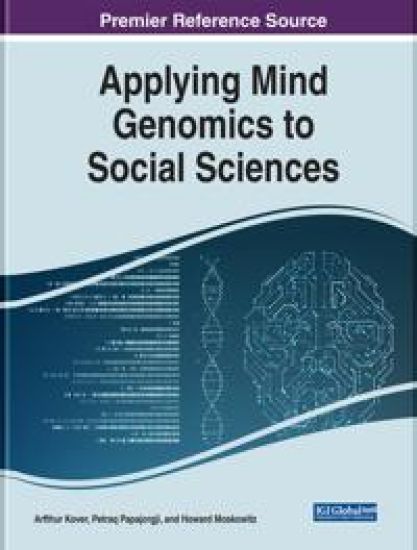
Mind genomics is the next level of apprehension of human behavior. It seeks to comprehend what drives consumers and people in general in their day-to-day decision making. It reaches out where surveys and focus groups are inadequate tools to help us better understand how people feel and how they will behave in a particular situation. While allowing for a more encapsulating method that works well with big data, mind genomics offers a more nuanced view of the complex societal and political reality. Applying Mind Genomics to Social Sciences presents an overview of mind genomics as applied to the food industry, commerce, business services, tourism, healthcare, and even legal service. Its focus, however, explores the new avenues of mind genomics in social and political sciences. The book offers a combination of rich data combined with a new methodological approach and fresh analytical insights, which helps us better grasp and understand the complex reality of society. Covering topics such as human thought, decision making, and cognitive science, this premier reference source is a dynamic resource for political scientists, sociologists, psychologists, business leaders, marketers, government officials, journalists, students and faculty of higher education, libraries, doctoral and postdoctoral candidates, researchers, and academicians.
Applying Mind Genomics to Social Sciences

Applying Mind Genomics to Social Sciences

Arthur Kover; Petraq Papajorgji; Howard Moskowitz

Igi Global
2022
sidottu
Mind genomics is the next level of apprehension of human behavior. It seeks to comprehend what drives consumers and people in general in their day-to-day decision making. It reaches out where surveys and focus groups are inadequate tools to help us better understand how people feel and how they will behave in a particular situation. While allowing for a more encapsulating method that works well with big data, mind genomics offers a more nuanced view of the complex societal and political reality. Applying Mind Genomics to Social Sciences presents an overview of mind genomics as applied to the food industry, commerce, business services, tourism, healthcare, and even legal service. Its focus, however, explores the new avenues of mind genomics in social and political sciences. The book offers a combination of rich data combined with a new methodological approach and fresh analytical insights, which helps us better grasp and understand the complex reality of society. Covering topics such as human thought, decision making, and cognitive science, this premier reference source is a dynamic resource for political scientists, sociologists, psychologists, business leaders, marketers, government officials, journalists, students and faculty of higher education, libraries, doctoral and postdoctoral candidates, researchers, and academicians.
Data Mining in Agriculture

Data Mining in Agriculture

Antonio Mucherino; Petraq Papajorgji; Panos M. Pardalos

Springer-Verlag New York Inc.
2012
nidottu
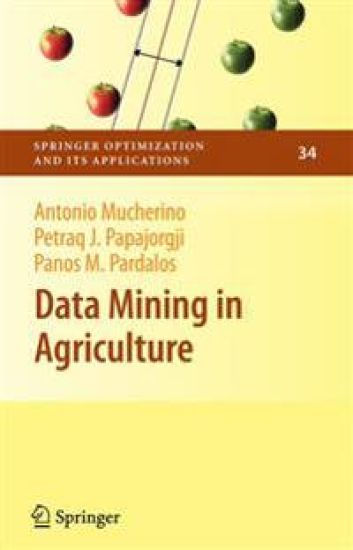
Data Mining in Agriculture represents a comprehensive effort to provide graduate students and researchers with an analytical text on data mining techniques applied to agriculture and environmental related fields. This book presents both theoretical and practical insights with a focus on presenting the context of each data mining technique rather intuitively with ample concrete examples represented graphically and with algorithms written in Matlab®. Examples and exercises with solutions are provided at the end of each chapter to facilitate the comprehension of the material. For each data mining technique described in the book variants and improvements of the basic algorithm are also given.
Software Engineering Techniques Applied to Agricultural Systems

Software Engineering Techniques Applied to Agricultural Systems

Petraq Papajorgji; Panos M. Pardalos

Springer-Verlag New York Inc.
2010
nidottu
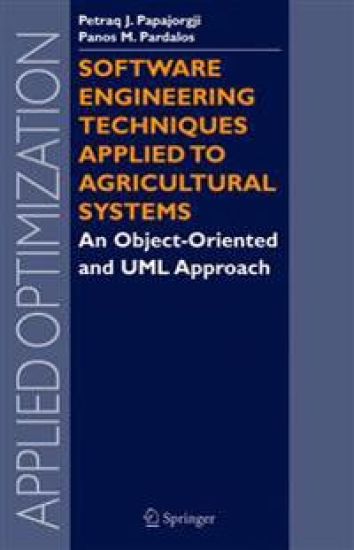
Software Engineering Techniques Applied to Agricultural Systems presents cutting-edge software engineering techniques for designing and implementing better agricultural software systems based on the object-oriented paradigm and the Unified Modeling Language (UML). The book is divided in two parts: the first part presents concepts of the object-oriented paradigm and the UML notation of these concepts, and the second part provides a number of examples of applications that use the material presented in the first part. The examples presented illustrate the techniques discussed, focusing on how to construct better models using objects and UML diagrams. More advanced concepts such as distributed systems and examples of how to build these systems are presented in the last chapter of the book. The book presents a step-by-step approach for modeling agricultural systems, starting with a conceptual diagram representing elements of the system and their relationships. Furthermore, diagrams such as sequential and collaboration diagrams are used to explain the dynamic and static aspects of the software system.
Data Mining in Agriculture

Data Mining in Agriculture

Antonio Mucherino; Petraq Papajorgji; Panos M. Pardalos

Springer-Verlag New York Inc.
2009
sidottu
Data Mining in Agriculture represents a comprehensive effort to provide graduate students and researchers with an analytical text on data mining techniques applied to agriculture and environmental related fields. This book presents both theoretical and practical insights with a focus on presenting the context of each data mining technique rather intuitively with ample concrete examples represented graphically and with algorithms written in Matlab®. Examples and exercises with solutions are provided at the end of each chapter to facilitate the comprehension of the material. For each data mining technique described in the book variants and improvements of the basic algorithm are also given.