Kirjojen hintavertailu – 12 903 724 kirjaa ja 27 kauppaa

Kirjailija

Petre Stoica

Kirjat ja teokset yhdessä paikassa: 7 kirjaa, julkaisuja vuosilta 2003–2024, suosituimpiin kuuluu Min-Max Framework for Majorization-Minimization Algorithms in Signal Processing Applications. Vertaile teosten hintoja ja tarkista saatavuus suomalaisista kirjakaupoista.

7 kirjaa

Kirjojen julkaisuvuodet: 2003–2024.

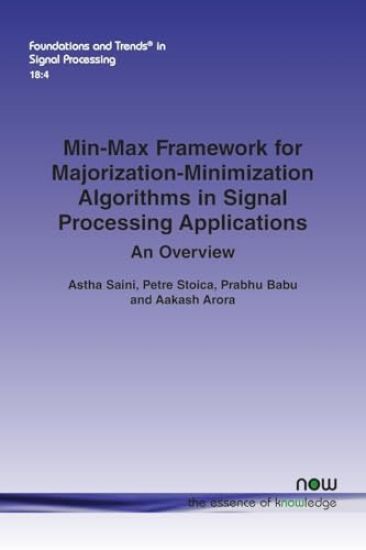
Min-Max Framework for Majorization-Minimization Algorithms in Signal Processing Applications

Min-Max Framework for Majorization-Minimization Algorithms in Signal Processing Applications

Astha Saini; Petre Stoica; Prabhu Babu; Aakash Arora

Now Publishers Inc
2024
nidottu
This monograph presents a theoretical background and a broad introduction to the Min-Max Framework for Majorization-Minimization (MM4MM), an algorithmic methodology for solving minimization problems by formulating them as min-max problems and then employing majorization-minimization. The monograph lays out the mathematical basis of the approach used to reformulate a minimization problem as a min-max problem. With the prerequisites covered, including multiple illustrations of the formulations for convex and non-convex functions, this work serves as a guide for developing MM4MM-based algorithms for solving non-convex optimization problems in various areas of signal processing. As special cases, the majorization-minimization technique is discussed to solve min-max problems encountered in signal processing applications and min-max problems formulated using the Lagrangian. Detailed examples of using MM4MM in ten signal processing applications such as phase retrieval, source localization, independent vector analysis, beamforming, and optimal sensor placement in wireless sensor networks are presented. The devised MM4MM algorithms are free of hyper-parameters and enjoy the advantages inherited from the use of the majorization-minimization technique such as monotonicity.
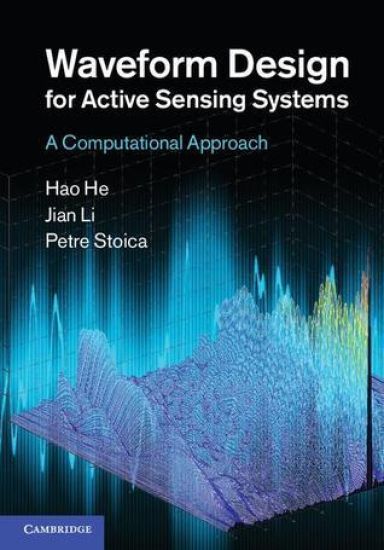
Waveform Design for Active Sensing Systems

Waveform Design for Active Sensing Systems

Hao He; Jian Li; Petre Stoica

Cambridge University Press
2012
sidottu
With a focus on developing computational algorithms for examining waveform design in diverse active sensing applications, this guide is ideal for researchers and practitioners in the field. The three parts conveniently correspond to the three categories of desirable waveform properties: good aperiodic correlations, good periodic correlations and beampattern matching. The book features various application examples of using the newly designed waveforms, including radar imaging, channel estimation for communications, an ultrasound system for breast cancer treatment and covert underwater communications. In addition to numerical results, the authors present theoretical analyses describing lower bounds or limitations of performance. Focusing on formulating practical problems mathematically and solving the mathematical problems using efficient and effective optimization techniques, the text pays particular attention to developing easy-to-use computational approaches. Most algorithms are accompanied by a table clearly detailing iteration steps and corresponding MATLAB codes are available on the companion website.
MIMO Radar Signal Processing

MIMO Radar Signal Processing

Jian Li; Petre Stoica

John Wiley Sons Inc
2008
sidottu

Halvin toimitettuna 189,70 €

The first book to present a systematic and coherent picture of MIMO radars Due to its potential to improve target detection and discrimination capability, Multiple-Input and Multiple-Output (MIMO) radar has generated significant attention and widespread interest in academia, industry, government labs, and funding agencies. This important new work fills the need for a comprehensive treatment of this emerging field. Edited and authored by leading researchers in the field of MIMO radar research, this book introduces recent developments in the area of MIMO radar to stimulate new concepts, theories, and applications of the topic, and to foster further cross-fertilization of ideas with MIMO communications. Topical coverage includes: Adaptive MIMO radar Beampattern analysis and optimization for MIMO radar MIMO radar for target detection, parameter estimation, tracking,association, and recognition MIMO radar prototypes and measurements Space-time codes for MIMO radar Statistical MIMO radar Waveform design for MIMO radar Written in an easy-to-follow tutorial style, MIMO Radar Signal Processing serves as an excellent course book for graduate students and a valuable reference for researchers in academia and industry.
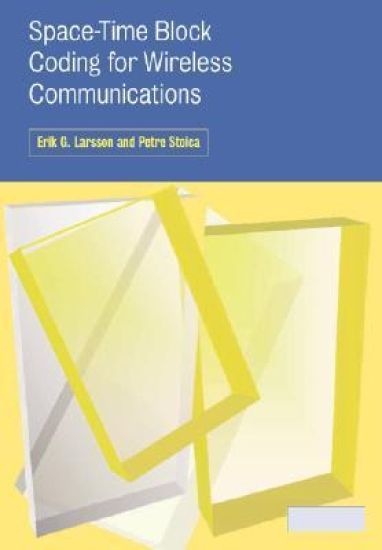
Space-Time Block Coding for Wireless Communications

Space-Time Block Coding for Wireless Communications

Erik G. Larsson; Petre Stoica

Cambridge University Press
2008
pokkari
Space-time coding is a technique that promises greatly improved performance in wireless networks by using multiple antennas at the transmitter and receiver. Space-Time Block Coding for Wireless Communications, first published in 2003, is an introduction to the theory of this technology. The authors develop the topic using a unified framework and cover a variety of topics ranging from information theory to performance analysis and space-time coding methods for both flat and frequency-selective fading multiple-antenna channels. The authors concentrate on key principles rather than specific practical applications, and present the material in a concise and accessible manner. Their treatment reviews the fundamental aspects of multiple-input, multiple-output communication theory, and guides the reader through a number of topics at the forefront of research and development. The book includes homework exercises and is aimed at graduate students and researchers working on wireless communications, as well as practitioners in the wireless industry.
Spectral Analysis of Signals

Spectral Analysis of Signals

Yanwei Wang; Jian Li; Petre Stoica

Springer International Publishing AG
2007
nidottu
Spectral estimation is important in many fields including astronomy, meteorology, seismology, communications, economics, speech analysis, medical imaging, radar, sonar, and underwater acoustics. Most existing spectral estimation algorithms are devised for uniformly sampled complete-data sequences. However, the spectral estimation for data sequences with missing samples is also important in many applications ranging from astronomical time series analysis to synthetic aperture radar imaging with angular diversity. For spectral estimation in the missing-data case, the challenge is how to extend the existing spectral estimation techniques to deal with these missing-data samples. Recently, nonparametric adaptive filtering based techniques have been developed successfully for various missing-data problems. Collectively, these algorithms provide a comprehensive toolset for the missing-data problem based exclusively on the nonparametric adaptive filter-bank approaches, which are robust and accurate, and can provide high resolution and low sidelobes. In this book, we present these algorithms for both one-dimensional and two-dimensional spectral estimation problems.
Robust Adaptive Beamforming

Robust Adaptive Beamforming

Jian Li; Petre Stoica

John Wiley Sons Inc
2005
sidottu
The latest research and developments in robust adaptive beamforming Recent work has made great strides toward devising robust adaptive beamformers that vastly improve signal strength against background noise and directional interference. This dynamic technology has diverse applications, including radar, sonar, acoustics, astronomy, seismology, communications, and medical imaging. There are also exciting emerging applications such as smart antennas for wireless communications, handheld ultrasound imaging systems, and directional hearing aids. Robust Adaptive Beamforming compiles the theories and work of leading researchers investigating various approaches in one comprehensive volume. Unlike previous efforts, these pioneering studies are based on theories that use an uncertainty set of the array steering vector. The researchers define their theories, explain their methodologies, and present their conclusions. Methods presented include: * Coupling the standard Capon beamformers with a spherical or ellipsoidal uncertainty set of the array steering vector * Diagonal loading for finite sample size beamforming * Mean-squared error beamforming for signal estimation * Constant modulus beamforming * Robust wideband beamforming using a steered adaptive beamformer to adapt the weight vector within a generalized sidelobe canceller formulation Robust Adaptive Beamforming provides a truly up-to-date resource and reference for engineers, researchers, and graduate students in this promising, rapidly expanding field.
Space-Time Block Coding for Wireless Communications

Space-Time Block Coding for Wireless Communications

Erik G. Larsson; Petre Stoica

Cambridge University Press
2003
sidottu
Space-time coding is a technique that promises greatly improved performance in wireless networks by using multiple antennas at the transmitter and receiver. Space-Time Block Coding for Wireless Communications is an introduction to the theory of this technology. The authors develop the topic using a unified framework and cover a variety of topics ranging from information theory to performance analysis and state-of-the-art space-time coding methods for both flat and frequency-selective fading multiple-antenna channels. The authors concentrate on key principles rather than specific practical applications, and present the material in a concise and accessible manner. Their treatment reviews the fundamental aspects of multiple-input, multiple output communication theory, and guides the reader through a number of topics at the forefront of current research and development. The book includes homework exercises and is aimed at graduate students and researchers working on wireless communications, as well as practitioners in the wireless industry.