Kirjojen hintavertailu – 12 859 818 kirjaa ja 27 kauppaa

Kirjailija

Philip Andrews-Speed

Kirjat ja teokset yhdessä paikassa: 8 kirjaa, julkaisuja vuosilta 2004–2019, suosituimpiin kuuluu Want, Waste or War?. Vertaile teosten hintoja ja tarkista saatavuus suomalaisista kirjakaupoista.

8 kirjaa

Kirjojen julkaisuvuodet: 2004–2019.

Want, Waste or War?

Want, Waste or War?

Philip Andrews-Speed; Raimund Bleischwitz; Tim Boersma; Corey Johnson; Geoffrey Kemp; Stacy D. VanDeveer

Routledge
2014
sidottu
In addition to environmental change, the structure and trends of global politics and the economy are also changing as more countries join the ranks of the world’s largest economies with their resource-intensive patterns. The nexus approach, conceptualized as attention to resource connections and their governance ramifications, calls attention to the sustainability of contemporary consumer resource use, lifestyles and supply chains. This book sets out an analytical framework for understanding these nexus issues and the related governance challenges and opportunities. It sheds light on the resource nexus in three realms: markets, interstate relations and local human security. These three realms are the organizing principle of three chapters, before the analysis turns to crosscutting case studies including shale gas, migration, lifestyle changes and resource efficiency, nitrogen fertilizer and food systems, water and the Nile Basin, climate change and security and defense spending. The key issues revolve around competition and conflict over finite natural resources. The authors highlight opportunities to improve both the understanding of nexus challenges and their governance. They critically discuss a global governance approach versus polycentric and multilevel approaches and the lack of those dimensions in many theories of international relations.
Want, Waste or War?

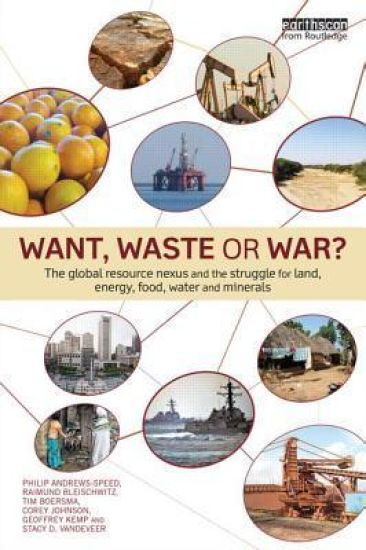
Want, Waste or War?

Philip Andrews-Speed; Raimund Bleischwitz; Tim Boersma; Corey Johnson; Geoffrey Kemp; Stacy D. VanDeveer

Routledge
2014
nidottu
In addition to environmental change, the structure and trends of global politics and the economy are also changing as more countries join the ranks of the world’s largest economies with their resource-intensive patterns. The nexus approach, conceptualized as attention to resource connections and their governance ramifications, calls attention to the sustainability of contemporary consumer resource use, lifestyles and supply chains. This book sets out an analytical framework for understanding these nexus issues and the related governance challenges and opportunities. It sheds light on the resource nexus in three realms: markets, interstate relations and local human security. These three realms are the organizing principle of three chapters, before the analysis turns to crosscutting case studies including shale gas, migration, lifestyle changes and resource efficiency, nitrogen fertilizer and food systems, water and the Nile Basin, climate change and security and defense spending. The key issues revolve around competition and conflict over finite natural resources. The authors highlight opportunities to improve both the understanding of nexus challenges and their governance. They critically discuss a global governance approach versus polycentric and multilevel approaches and the lack of those dimensions in many theories of international relations.
China as a Global Clean Energy Champion

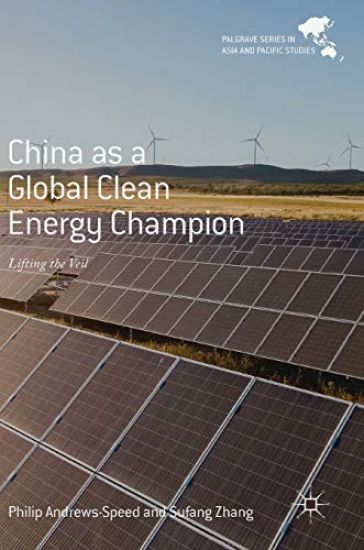
China as a Global Clean Energy Champion

Philip Andrews-Speed; Sufang Zhang

Springer Verlag, Singapore
2019
sidottu
This book assesses China’s reputation as a global clean energy champion, and applies institutional and public policy theories to explain how the country has achieved so much and why there continue to be so many unintended consequences and constraints to progress. It considers the extent to which the government has successfully boosted the manufacture and deployment of low-carbon electricity generating infrastructure, cleaned up thermal power generation, and enhanced energy efficiency, dramatically constraining China’s rising carbon dioxide emissions, but also examines the substantial political and financial capital required to reinforce the predominantly administrative policy instruments and the mix of special interests and poor coordination that are endemic to the energy sector. Arguing that the current approach seems to be encountering ever diminishing returns, the book considers whether ongoing sector reforms and the new national emissions trading scheme can reinvigorate the nation’s clean energy trajectory.
The Strategic Implications of China's Energy Needs

The Strategic Implications of China's Energy Needs

Philip Andrews-Speed; Xuanli Liao; Roland Dannreuther

Routledge
2017
sidottu
China is frequently described as a threat to regional and global stability and its rapidly rising demand for imported energy is seens as one cause of this threat. This book shows that domestic politics and foreign policy have both played a part in China's recent major energy policy decisions. However, China's increasing involvement in the global energy markets can be seen as an opportunity to enhance cooperation and interdependence rather than as a threat.
China, Oil and Global Politics

China, Oil and Global Politics

Philip Andrews-Speed; Roland Dannreuther

Routledge
2013
nidottu
China’s rapid economic growth has led to a huge increase in its domestic energy needs. This book provides a critical overview of how China’s growing need for oil imports is shaping its international economic and diplomatic strategy and how this affects global political relations and behaviour. Part One is focused on the domestic drivers of energy policy: it provides a systematic account of recent trends in China’s energy sector and assesses the context and processes of energy policy making, and concludes by showing how and why China’s oil industry has spread across the world in the last fifteen years. Part Two analyses the political and foreign policy implications of this energy-driven expansion and the challenges this potentially poses for China’s integration into the international system. It examines a number of factors linked to this integration in the energy field, including the unpredictabilities of internal policymaking; China’s determination to promote its own critical national interests, and the general ambition of the Chinese leadership to integrate with the international system on its own terms and at its own speed. The highly topical book draws together the various dimensions of China’s international energy strategy, and provides insights into the impact of this on China’s growing international presence in various parts of the world.
China, Oil and Global Politics

China, Oil and Global Politics

Philip Andrews-Speed; Roland Dannreuther

Routledge
2011
sidottu
China’s rapid economic growth has led to a huge increase in its domestic energy needs. This book provides a critical overview of how China’s growing need for oil imports is shaping its international economic and diplomatic strategy and how this affects global political relations and behaviour. Part One is focused on the domestic drivers of energy policy: it provides a systematic account of recent trends in China’s energy sector and assesses the context and processes of energy policy making, and concludes by showing how and why China’s oil industry has spread across the world in the last fifteen years. Part Two analyses the political and foreign policy implications of this energy-driven expansion and the challenges this potentially poses for China’s integration into the international system. It examines a number of factors linked to this integration in the energy field, including the unpredictabilities of internal policymaking; China’s determination to promote its own critical national interests, and the general ambition of the Chinese leadership to integrate with the international system on its own terms and at its own speed. The highly topical book draws together the various dimensions of China’s international energy strategy, and provides insights into the impact of this on China’s growing international presence in various parts of the world.
The Strategic Implications of China's Energy Needs

The Strategic Implications of China's Energy Needs

Philip Andrews-Speed; Xuanli Liao; Roland Dannreuther

Oxford University Press Inc
2005
nidottu
China is frequently described as a threat to regional and global stability and its rapidly rising demand for imported energy is seens as one cause of this threat. This book shows that domestic politics and foreign policy have both played a part in China's recent major energy policy decisions. However, China's increasing involvement in the global energy markets can be seen as an opportunity to enhance cooperation and interdependence rather than as a threat.