Kirjojen hintavertailu – 12 859 819 kirjaa ja 27 kauppaa
Kirjailija
Philip Brenner
Kirjat ja teokset yhdessä paikassa: 6 kirjaa, julkaisuja vuosilta 2002–2020, suosituimpiin kuuluu From Confrontation to Negotiation. Vertaile teosten hintoja ja tarkista saatavuus suomalaisista kirjakaupoista.
This book provides an overview of U. S.-Cuban relations since 1898, with an emphasis on the past ten years. It highlights assumptions, goals, and continuities in U. S. policy and outlines an alternative U. S. policy toward Cuba that could move the two countries from confrontation to negotiation.
Nearly thirty years have passed since the United States first attempted to overthrow the fledgling Castro government. Despite enormous changes in the hemisphere, significant developments in the nature of Cuba's international relations, and an end to the cold war consensus in the United States that quietly sanctioned interference in and obstruction of Third World politics, U. S. policy toward Cuba has changed very little: It still embodies the failed dream of isolating Cuba and destroying the Cuban revolution. In From Confrontation to Negotiation: U. S. Relations with Cuba, Philip Brenner provides a thoughtful overview of U. S.-Cuban relations since 1898, with an emphasis on the past ten years. Assumptions, goals, and continuities in U. S. policy are highlighted. He then offers a clear picture of the issues that divide the two countries and around which any discussions for a normalization of relations would likely turn. Could discussions occur? Is a call for a less hostile relationship between the United States and Cuba politically feasible? What are the chances that Cuba and the United States can actually work out an accommodation? Dr. Brenner analyzes the domestic political factors in each country that shape policy and that might present possibilities for serious discussion. He then proposes a workable alternative Cuban policy for the United States that takes into account the fundamental concerns of both countries. The policy proposal is related to the framework adopted by Policy Alternatives for the Caribbean and Central America (PACCA).
This timely book provides a balanced and deeply knowledgeable introduction to Cuba since Christopher Columbus’s first arrival in 1492. With decades of experience studying and reporting on the island, Philip Brenner and Peter Eisner provide an incisive overview for all readers seeking to go beyond stereotypes in their exploration of Cuba’s politics, economy, and culture. As Cuba and the United States open their doors to each other, Cuba Libre gives travelers, policy makers, businesspeople, students, and those with an interest in world affairs an opportunity to understand Cuba from a Cuban perspective; to appreciate how Cubans’ quest for independence and sovereignty animates their spirit and shapes their worldview and even their identity. In a world ever more closely linked, Cuba Libre provides a compelling model for US citizens and policy makers to empathize with viewpoints far from their own experiences.
This timely book provides a balanced and deeply knowledgeable introduction to Cuba since Christopher Columbus’s first arrival in 1492. With decades of experience studying and reporting on the island, Philip Brenner and Peter Eisner provide an incisive overview for all readers seeking to go beyond stereotypes in their exploration of Cuba’s politics, economy, and culture. As Cuba and the United States open their doors to each other, Cuba Libre gives travelers, policy makers, businesspeople, students, and those with an interest in world affairs an opportunity to understand Cuba from a Cuban perspective; to appreciate how Cubans’ quest for independence and sovereignty animates their spirit and shapes their worldview and even their identity. In a world ever more closely linked, Cuba Libre provides a compelling model for US citizens and policy makers to empathize with viewpoints far from their own experiences.
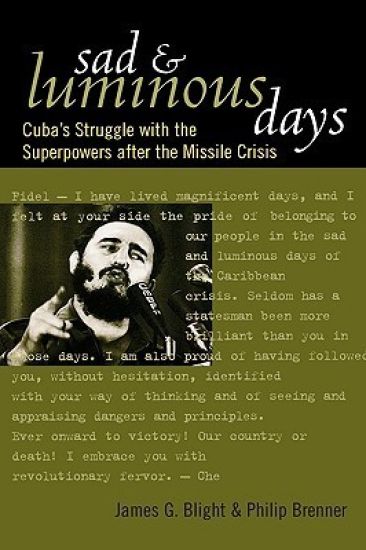
In October 1962 school children huddled under their desks and diplomats feverishly negotiated as the world sat on the brink of nuclear war. The Cuban Missile Crisis was the most dangerous moment in modern history and resulted in a changed worldview for the United States, the Soviet Union, and Cuba. In tracing the developments of the missile crisis and beyond, Sad and Luminous Days presents and interprets a heretofore unavailable (and largely unknown) secret speech that Castro delivered to the Cuban leadership in 1968. In it, Castro reflects on the crisis and reveals the distrust and bitterness that characterized Cuban-Soviet relations in 1968. Blight and Brenner frame the annotated speech with an examination of the missile crisis itself, and an analysis of Cuban-Soviet relations between 1962–1968, ending with an epilogue that highlights the lessons the missile crisis offers us in the current search for security and a stable world order. Sad and Luminous Days sheds new light on Cuban-Soviet relations and should be required reading not only for Cold-War scholars and historians, but also for anyone intrigued by the drama of the thirteen momentous days in October 1962.
In October 1962 school children huddled under their desks and diplomats feverishly negotiated as the world sat on the brink of nuclear war. The Cuban Missile Crisis was the most dangerous moment in modern history and resulted in a changed worldview for the United States, the Soviet Union, and Cuba. In tracing the developments of the missile crisis and beyond, Sad and Luminous Days presents and interprets a heretofore unavailable (and largely unknown) secret speech that Castro delivered to the Cuban leadership in 1968. In it, Castro reflects on the crisis and reveals the distrust and bitterness that characterized Cuban-Soviet relations in 1968. Blight and Brenner frame the annotated speech with an examination of the missile crisis itself, and an analysis of Cuban-Soviet relations between 1962–1968, ending with an epilogue that highlights the lessons the missile crisis offers us in the current search for security and a stable world order. Sad and Luminous Days sheds new light on Cuban-Soviet relations and should be required reading not only for Cold-War scholars and historians, but also for anyone intrigued by the drama of the thirteen momentous days in October 1962.