Kirjojen hintavertailu – 12 903 725 kirjaa ja 27 kauppaa

Kirjailija

Philip G. Joyce

Kirjat ja teokset yhdessä paikassa: 4 kirjaa, julkaisuja vuosilta 2003–2020, suosituimpiin kuuluu The Congressional Budget Office. Vertaile teosten hintoja ja tarkista saatavuus suomalaisista kirjakaupoista.

4 kirjaa

Kirjojen julkaisuvuodet: 2003–2020.

Public Budgeting Systems

Public Budgeting Systems

Robert D. Lee Jr.; Ronald W. Johnson; Philip G. Joyce

Jones and Bartlett Publishers, Inc
2020
nidottu
Public Budgeting Systems, Tenth Edition is the most comprehensive and balanced treatment of the current state of budgeting throughout all levels of the United States government. Current and prospective public managers, accordingly, often succeed or fail in their careers based in large part on whether they are intelligent consumers of financial data and have an adequate understanding of the budget process. By providing a detailed overview of all budgeting and financial management, the book enables students to gain an appropriate understanding of a complex topic. Significantly updated, the Tenth Edition has been revised to include:- Updated data, references and more timely examples throughout- An expansive discussion of the COVID- 9 recession, and a special appendix discussing the fiscal effects of the pandemic- Up to date information on tax revenues, including the 2 7 Tax Cuts and Jobs Act, sales taxes on online purchases, cannabis sales, and legalization of sports betting in some states- Significantly revised chapter on the Congressional budget process - Recent developments in information technology security, including both security breaches and new cybersecurity protocols- Each new print copy includes Navigate 2 eBook Access to read your digital textbook online or offline, on computers, tablets, and mobile devices.
Public Budgeting Systems

Public Budgeting Systems

Robert D. Lee Jr.; Ronald W. Johnson; Philip G. Joyce

Jones and Bartlett Publishers, Inc
2012
nidottu
Now in its Ninth Edition, Public Budgeting Systems is a complete and balanced reference that surveys the current state of budgeting throughout all levels of the United States government. The text emphasizes methods by which financial decisions are reached within a system as well as ways in which different types of information are used in budgetary decision-making. It also stresses the use of program information, since, for decades, budget reforms have sought to introduce greater program considerations into financial decisions. The Ninth Edition has been updated to give particular attention to several recent developments in public budgeting and finance including: • Steps that have been taken by governments to battle the effects of the “Great Recession” and to enhance economic recovery. In the US, this includes the actions of the Federal Reserve as well as legislative efforts, such as the American Recovery and Reinvestment Act. • Significant increase in use of fiscal policy tools to stimulate economic recovery, in contrast to most recent previous 20 year period. • The federal government’s direct role in the operations of the private sector will be explored. The government has become a major stockholder and therefore has a financial stake in seeing that corporations succeed. • Unprecedented federal deficits, as well as extreme budgetary challenges at the state and local level, including a discussion of causes and possible solutions. • Other changes during the Obama presidency, including the passage of comprehensive health care reform and changes in the management agenda. • Continued developments in financial and debt management, including additional GASB requirements and the effects of the recent economic contraction on the borrowing prospects for state and local governments. • Additional recognition of the effects of the global economy, resulting in an increase in the pages devoted to discussing international examples.
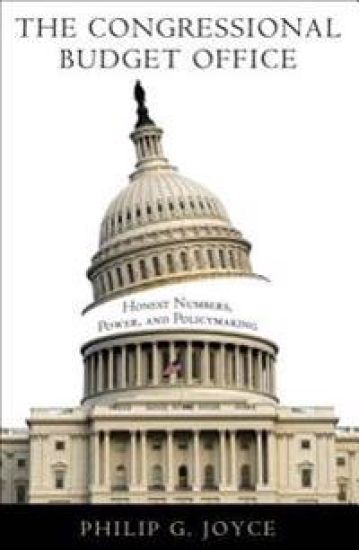
The Congressional Budget Office

The Congressional Budget Office

Philip G. Joyce

Georgetown University Press
2011
pokkari
Created in 1974, the U. S. Congressional Budget Office (CBO) has become one of the most influential forces in national policymaking. A critical component of our system of checks and balances, the CBO has given Congress the analytical capacity to challenge the president on budget issues while it protects the public interest, providing honest numbers about Congress' own budget proposals. The book discusses the CBO's role in larger budget policy and the more narrow 'scoring' of individual legislation, such as its role in the 2009-2010 Obama health care reform. It also describes how the first director, Alice Rivlin, and seven successors managed to create and sustain a nonpartisan, highly credible agency in the middle of one of the most partisan institutions imaginable. The Congressional Budget Office: Honest Numbers, Power, and Policy draws on interviews with high-level participants in the budget debates of the last 35 years to tell the story of the CBO. A combination of political history, economic history, and organizational development, "The Congressional Budget Office" offers an important, first book-length history of this influential agency.
Government Performance

Government Performance

Patricia W. Ingraham; Philip G. Joyce; Amy Kneedler Donahue

Johns Hopkins University Press
2003
pokkari
Scholars and practitioners of public management have stressed the importance of such varied concepts as efficiency, process, systems, and capacity as key to running effective government programs. While acknowledging the usefulness of each of these criteria, the authors of Government Performance argue that one quality above all is crucial to the overall performance of government: effective management. Examining government performance at the federal, state, and local levels, the authors present analyses of public management systems in all fifty states, the thirty-five largest cities, forty large counties, and a number of federal agencies. They examine systems for financial management, human resources management, information technology management, capital management, and systems for managing results. While acknowledging the political context of all public administration systems, they argue that effective management of these systems nevertheless provides the key to good government performance.