

Kirjailija
Philip Thomas
Kirjat ja teokset yhdessä paikassa: 16 kirjaa, julkaisuja vuosilta 1997–2023, suosituimpiin kuuluu Psychiatry in Context. Vertaile teosten hintoja ja tarkista saatavuus suomalaisista kirjakaupoista.
16 kirjaa
Kirjojen julkaisuvuodet: 1997–2023.

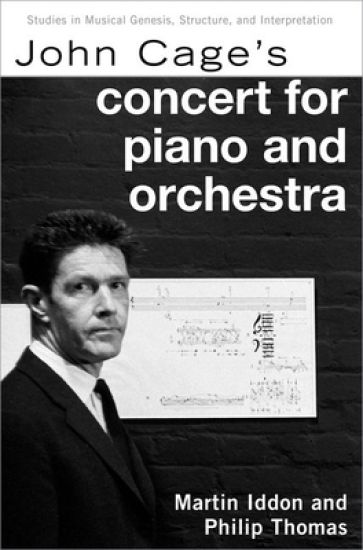
John Cage's Concert for Piano and Orchestra
Martin Iddon; Philip Thomas
Oxford University Press Inc
2020
sidottu
John Cage's Concert for Piano and Orchestra is one of the seminal works of the second half of the twentieth century, and the centerpiece of the middle period of Cage's output. It is a culmination of Cage's work up to that point, incorporating notation techniques he had spent the past decade developing - techniques which remain radical to this day. But despite Cage's vitality to the musical development of the twentieth century, and the Concert's centrality to his career, the work is still rarely performed and even more rarely examined in detail. In this volume, Martin Iddon and Philip Thomas provide a rich and critical examination of this enormously significant piece, tracing its many contexts and influences - particularly Schoenberg, jazz, and Cage's own compositional practice - through a wide and previously untapped range of archival sources. Iddon and Thomas explain the Concert through a reading of its many histories, especially in performance - from the legendary performer disobedience and audience disorder of its 1958 New York premiere to a no less disastrous European premiere later the same year. They also highlight the importance of the piano soloist who premiered the piece, David Tudor, and its use alongside choreographer Merce Cunningham's Antic Meet. A careful examination of an apparently bewildering piece, the book explores the critical response to the Concert's performances, re-interrogates the mythology surrounding it, and finally turns to the music itself, in all its component parts, to see what it truly asks of performers and listeners.

Sharp Teeth and Cruel Claws: Yealmpton Dogs Meet a Big Cat
Philip Thomas
Createspace Independent Publishing Platform
2017
nidottu
Fundamental Legal Conceptions As Applied in Judicial Reasoning by Wesley Newcomb Hohfeld
David Campbell; Philip Thomas
Routledge
2016
nidottu
Wesley Newcomb Hohfeld, born in 1879, died prematurely in 1918. He left only a few law journal articles as his published work. His 'Fundamental Legal Conceptions', originally published as two articles in the 'Yale Law Journal' for 1913 and 1917 and left incompletely revised at his death is, however, one of the principal foundations of analytic jurisprudence. The analysis of rights that Hohfeld offers is still regularly cited and relied upon by both lawyers and philosophers, and it is treated as a source of insight into the nature of moral rights as well as the legal rights that were Hohfeld’s own focus of concern. Although some of his analytical distinctions were anticipated by earlier jurists, their insights were fragmentary and imperfect by comparison. Hohfeld’s systematic and exhaustive (yet concise) treatment is generally regarded as unsurpassed. This is not to say that he has not been criticized, but his book forms the essential starting point for any discussion of the nature and structure of rights. 'Fundamental Legal Conceptions' has long been difficult to obtain. This new edition makes this classic of analytic jurisprudence available with a comprehensive introduction by Dr. N. E. Simmonds of Corpus Christi, University of Cambridge, UK.

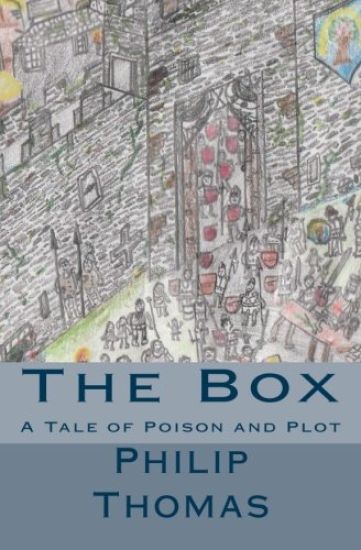

Sylrac: Another tale from Dehrmacht
Philip Thomas
Createspace Independent Publishing Platform
2015
nidottu

If Only...: A Story about a School
Philip Thomas
Createspace Independent Publishing Platform
2014
nidottu
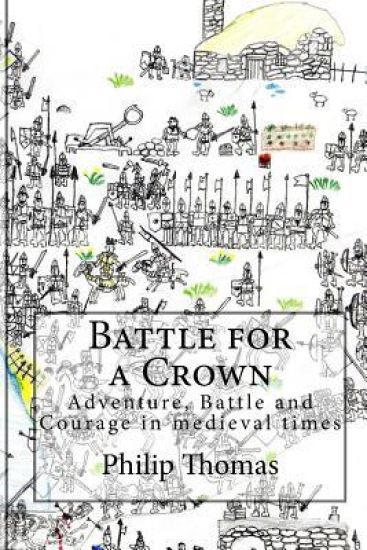
Battle for a Crown: Adventure, Battle and Courage in medieval times
Philip Thomas
Createspace Independent Publishing Platform
2014
nidottu
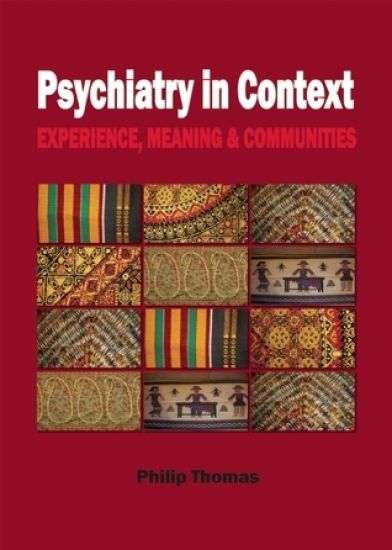
This book examines the central role of contexts in understanding psychosis and distress. The contexts in which we all exist, historical, cultural, social, political, economic and interpersonal, shape and give meaning to our lives for good or for bad. Scientific research confirms how contexts of adversity such as trauma, abuse, and racism can lead to psychosis. Thomas argues that if we are to prioritise the role of values and ethics in mental health care we must engage actively with the contexts of patients' lives rather than focus on the endlessly fruitless search for the biological origins of distress and increasingly technological approaches to its management. After careful examination of the problems of psychiatric diagnosis, treatments, scientific models of madness, and neuroscience, Thomas goes on to demonstrate how contextual factors are central to mental distress. He proposes that the opportunities we have through narrative, to talk about our experiences and the contexts in which they are embedded, play a vital role in the task of making sense of our lives, in health, when distressed, or when overwhelmed by psychosis.
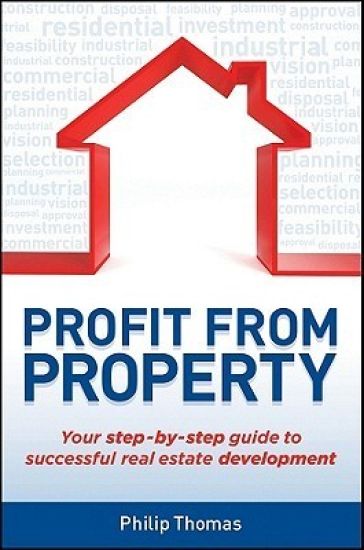
Profit from Property is the must-have guide for anyone who wants to make money out of property development. Expert author Philip Thomas will show you step by step how to develop property the smart way—from purchasing the best development opportunity, to financing the development, through to completion and disposal of the property. His fool-proof system will have you buying, managing, developing and selling property like an expert, whether you're a first-time developer or an experienced investor wanting to make more out of your portfolio. Inside you’ll discover: money-making strategies for residential, commercial and industrial propertieshandy tips and case studies that will save you time, cash and stressa proven development model that you can start using immediately with resultshow to become a successful property developer without a huge amount of cash behind you. The best time to get into property is now. Read this book today and start profiting from property tomorrow!
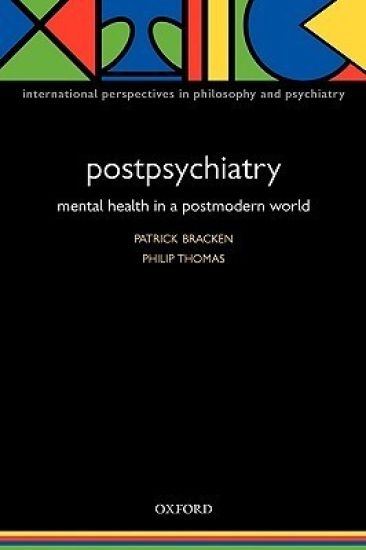
How are we to make sense of madness and psychosis? For most of us the words conjure up images from television and newspapers of seemingly random, meaningless violence. It is something to be feared, something to be left to the experts. But is madness best thought of as a medical condition? Psychiatrists and the drug industry maintain that psychoses are brain disorders amenable to treatment with drugs, but is this actually so? There is no convincing evidence that the brain is disordered in psychosis, yet governments across the world are investing huge sums of money on mental health services that take for granted the idea that psychosis is an illness to be treated with medication. Although some people who use mental health services find medication helpful, many do not, and resist the idea that their experiences are symptoms of illnesses like schizophrenia. Consequently they are forced into having treatment against their wishes. So, how do we make sense of this situation? Postpsychiatry addresses these questions. It involves an attempt to rethink some of the fundamental assumptions of mental health work, showing how recent developments in philosophy and ethics can help us to clarify some of the dilemmas and conflicts around different understandings of madness. Throughout, the authors examine the conflicting ways in which politicians, academics, and mental health professionals appear to understand madness, and contrast this with voices and experiences that are usually excluded - those of the people who use mental health services. They then examine the power of psychiatry to shape how we understand ourselves and our emotions, before considering some of the basic limitations of psychiatry as science to make madness meaningful. In the final section of the book they draw on evidence from service users and survivors, the humanities and anthropology, to point out a new direction for mental health practice. This new direction emphasises the importance of cultural contexts in understanding madness, placing ethics before technology in responding to madness, and minimising 'therapeutic' coercion.
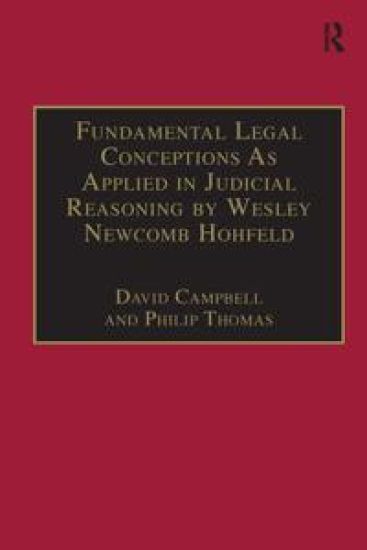
Fundamental Legal Conceptions As Applied in Judicial Reasoning by Wesley Newcomb Hohfeld
David Campbell; Philip Thomas
Dartmouth Publishing Co Ltd
2001
sidottu
Wesley Newcomb Hohfeld, born in 1879, died prematurely in 1918. He left only a few law journal articles as his published work. His 'Fundamental Legal Conceptions', originally published as two articles in the 'Yale Law Journal' for 1913 and 1917 and left incompletely revised at his death is, however, one of the principal foundations of analytic jurisprudence. The analysis of rights that Hohfeld offers is still regularly cited and relied upon by both lawyers and philosophers, and it is treated as a source of insight into the nature of moral rights as well as the legal rights that were Hohfeld’s own focus of concern. Although some of his analytical distinctions were anticipated by earlier jurists, their insights were fragmentary and imperfect by comparison. Hohfeld’s systematic and exhaustive (yet concise) treatment is generally regarded as unsurpassed. This is not to say that he has not been criticized, but his book forms the essential starting point for any discussion of the nature and structure of rights. 'Fundamental Legal Conceptions' has long been difficult to obtain. This new edition makes this classic of analytic jurisprudence available with a comprehensive introduction by Dr. N. E. Simmonds of Corpus Christi, University of Cambridge, UK.
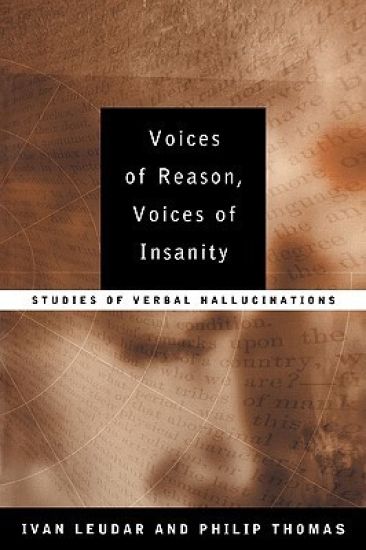
Records of people experiencing verbal hallucinations or 'hearing voices' can be found throughout history. Voices of Reason, Voices of Insanity examines almost 2,800 years of these reports including Socrates, Schreber and Pierre Janet's "Marcelle", to provide a clear understanding of the experience and how it may have changed over the millenia. Through six cases of historical and contemporary voice hearers, Leudar and Thomas demonstrate how the experience has metamorphosed from being a sign of virtue to a sign of insanity, signalling such illnesses as schizophrenia or dissociation. They argue that the experience is interpreted by the voice hearer according to social categories conveyed through language, and is therefore best studied as a matter of language use. Controversially, they conclude that 'hearing voices' is an ordinary human experience which is unfortunately either mystified or pathologised. Voices of Reason, Voices of Insanity offers a fresh perspective on this enigmatic experience and will be of interest to students, researchers and clinicians alike.
Summarizes various approaches to schizophrenia and points to their weaknesses and strengths. To gain a better understanding of the condition, the text considers factors including deprivation, cultural influences and brain function. It also challenges over-reliance on 19th century phenomenology.