Kirjojen hintavertailu – 12 903 724 kirjaa ja 27 kauppaa

Kirjailija

Philip V. Bohlman

Kirjat ja teokset yhdessä paikassa: 13 kirjaa, julkaisuja vuosilta 1988–2022, suosituimpiin kuuluu Jüdische Volksmusik. Vertaile teosten hintoja ja tarkista saatavuus suomalaisista kirjakaupoista.

13 kirjaa

Kirjojen julkaisuvuodet: 1988–2022.

Heiner Müller and Heiner Goebbels’s Wolokolamsker Chaussee

Heiner Müller and Heiner Goebbels’s Wolokolamsker Chaussee

Philip V. Bohlman

Bloomsbury Academic USA
2022
nidottu
By gathering historical and musical fragments from a Europe torn apart by the Second World War and the Cold War, East German playwright Heiner Müller and West German composer Heiner Goebbels created Wolokolamsker Chaussee as a musical panorama that stretched across modern European history at a moment of international crisis. The question at the heart of the recording was prescient in the waning years of the Cold War, but it remains no less critical for the “crisis of Europe” today: Is it possible for Europe to be unified? A vast range of musical styles—from folk song to hip-hop, from the symphonic canon to heavy metal—coalesce in the five acts, which expose the wounds of European history while struggling musically to heal them. This extraordinary recording from 1989/90 not only captures the sound of a historical moment, but also powerfully enacts responses to it.33 1/3 Global, a series related to but independent from 33 1/3, takes the format of the original series of short, music-based books and brings the focus to music throughout the world. With initial volumes focusing on Japanese, Brazilian, and European music, the series will also include volumes on the popular music of Australia/Oceania, Africa, the Middle East, and more.
Heiner Müller and Heiner Goebbels’s Wolokolamsker Chaussee

Heiner Müller and Heiner Goebbels’s Wolokolamsker Chaussee

Philip V. Bohlman

Bloomsbury Academic USA
2021
sidottu
By gathering historical and musical fragments from a Europe torn apart by the Second World War and the Cold War, East German playwright Heiner Müller and West German composer Heiner Goebbels created Wolokolamsker Chaussee as a musical panorama that stretched across modern European history at a moment of international crisis. The question at the heart of the recording was prescient in the waning years of the Cold War, but it remains no less critical for the “crisis of Europe” today: Is it possible for Europe to be unified? A vast range of musical styles—from folk song to hip-hop, from the symphonic canon to heavy metal—coalesce in the five acts, which expose the wounds of European history while struggling musically to heal them. This extraordinary recording from 1989/90 not only captures the sound of a historical moment, but also powerfully enacts responses to it.33 1/3 Global, a series related to but independent from 33 1/3, takes the format of the original series of short, music-based books and brings the focus to music throughout the world. With initial volumes focusing on Japanese, Brazilian, and European music, the series will also include volumes on the popular music of Australia/Oceania, Africa, the Middle East, and more.

Song Loves the Masses

Song Loves the Masses

Johann Gottfried Herder; Philip V. Bohlman

University of California Press
2017
sidottu
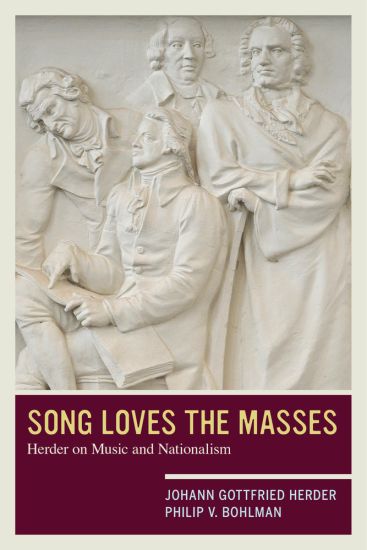
Distinguished ethnomusicologist Philip V. Bohlman compiles Johann Gottfried Herder's writings on music and nationalism, from his early volumes of Volkslieder through sacred song to the essays on aesthetics late in his life, shaping them as the book on music that Herder would have written had he gathered the many strands of his musical thought into a single publication. Framed by analytical chapters and extensive introductions to each translation, this book interprets Herder's musings on music to think through several major questions: What meaning did religion and religious thought have for Herder? Why do the nation and nationalism acquire musical dimensions at the confluence of aesthetics and religious thought? How did his aesthetic and musical thought come to transform the way Herder understood music and nationalism and their presence in global history? Bohlman uses the mode of translation to explore Herder's own interpretive practice as a translator of languages and cultures, providing today's readers with an elegantly narrated and exceptionally curated collection of essays on music by two major intellectuals.
Song Loves the Masses

Song Loves the Masses

Johann Gottfried Herder; Philip V. Bohlman

University of California Press
2017
pokkari
Distinguished ethnomusicologist Philip V. Bohlman compiles Johann Gottfried Herder's writings on music and nationalism, from his early volumes of Volkslieder through sacred song to the essays on aesthetics late in his life, shaping them as the book on music that Herder would have written had he gathered the many strands of his musical thought into a single publication. Framed by analytical chapters and extensive introductions to each translation, this book interprets Herder's musings on music to think through several major questions: What meaning did religion and religious thought have for Herder? Why do the nation and nationalism acquire musical dimensions at the confluence of aesthetics and religious thought? How did his aesthetic and musical thought come to transform the way Herder understood music and nationalism and their presence in global history? Bohlman uses the mode of translation to explore Herder's own interpretive practice as a translator of languages and cultures, providing today's readers with an elegantly narrated and exceptionally curated collection of essays on music by two major intellectuals.
Everyday Creativity

Everyday Creativity

Kirin Narayan; Philip V. Bohlman

University of Chicago Press
2016
sidottu
Kirin Narayan's imagination was captured the very first time, as a girl visiting the region, that she heard Kangra women join their voices together in song. Returning as an anthropologist, she became fascinated by how they spoke of singing as a form of enrichment, bringing feelings of accomplishment, companionship, happiness, and even good health all benefits of the "everyday creativity" she explores in this book. Part ethnography, part musical discovery, part poetry, part memoir, and part unforgettable portraits of creative individuals, this unique work draws on an association across forty years, and brings the Himalayan foothill region of Kangra in North India alive in sight and sound while celebrating the incredible powers of music in our lives. With rare and captivating eloquence, Narayan portrays Kangra songs about difficulties on the lives of goddesses and female saints as a path to well-being. Like the intricate geometries of mandalu patterns drawn in courtyards or the subtle balance of flavors in a meal, well-crafted songs offer a variety of deeply meaningful benefits: as a way of making something of value, as a means of establishing a community of shared pleasure and skill, as a path through hardships and limitations, and as an arena of renewed possibility. Everyday Creativity makes big the small world of Kangra song and opens up new ways of thinking about what creativity is to us and why we are so compelled to engage it.
Everyday Creativity

Everyday Creativity

Kirin Narayan; Philip V. Bohlman

University of Chicago Press
2016
nidottu
Kirin Narayan's imagination was captured the very first time, as a girl visiting the region, that she heard Kangra women join their voices together in song. Returning as an anthropologist, she became fascinated by how they spoke of singing as a form of enrichment, bringing feelings of accomplishment, companionship, happiness, and even good health all benefits of the "everyday creativity" she explores in this book. Part ethnography, part musical discovery, part poetry, part memoir, and part unforgettable portraits of creative individuals, this unique work draws on an association across forty years, and brings the Himalayan foothill region of Kangra in North India alive in sight and sound while celebrating the incredible powers of music in our lives. With rare and captivating eloquence, Narayan portrays Kangra songs about difficulties on the lives of goddesses and female saints as a path to well-being. Like the intricate geometries of mandalu patterns drawn in courtyards or the subtle balance of flavors in a meal, well-crafted songs offer a variety of deeply meaningful benefits: as a way of making something of value, as a means of establishing a community of shared pleasure and skill, as a path through hardships and limitations, and as an arena of renewed possibility. Everyday Creativity makes big the small world of Kangra song and opens up new ways of thinking about what creativity is to us and why we are so compelled to engage it.
Central European Folk Music

Central European Folk Music

Philip V. Bohlman

Routledge
2016
nidottu
This is the first annotated bibliography, in German or English, to gather the rich sources for German-language folk-music scholarship. It presents a comprehensive view of both historical and contemporary trends in a field embracing folkloristics and ethnomusicology, as well as philological and cultural studies. Beginning with early theories of folk song-formulated by Herder, Goethe, the Brothers Grimm, and others-the book examines the most important collections of the 19th-century folk-song movement, and surveys the 20th-century institutions and publications that have made folk-music scholarship essential to an understanding of German-speaking Europe. The book represents the enormous diversity of folk music. Ideas of genre and classification contrast with the ways in which minority and ethnic groups have contributed to the complex constructs of 19th- and 20th-century nationalism. The intellectual history in this book often takes the form of a clash between institutions and the forceful personalities of scholars who theorized that folk music was the product of individuals or the linguistic core of nations. Entries that illustrate the ways in which constructs of folk music have contributed to the politics of culture (e.g., in Nazi Germany or in the workers' culture of the former German Democratic Republic) also constitute the expansive musical landscape covered by this book The author includes diverse disciplinary perspectives, not just those of folklorists, but also concepts from ethnomusicology, historical musicology, and religious and cultural studies. In addition to traditional studies of the canons of German folk music (e.g., ballads and singing-society repertories), Bohlman includes studies of religious and ethnic minorities, and of German folk music in nations and regions outside Central Europe. The comprehensive nature of this book, not only makes available a rich history of scholarship, but also contextualizes Central European folk music as a vital and critical discipline for the interpretation of a changing Europe. Includes index.
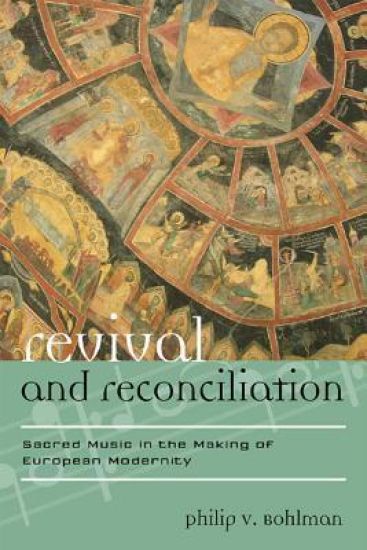
Revival and Reconciliation

Revival and Reconciliation

Philip V. Bohlman

Scarecrow Press
2013
sidottu
Sacred music has long contributed fundamentally to the making of Europe. The passage from origin myths to history, the sacred journeys that have mobilized pilgrims, crusaders, and colonizers, the politics and power sounded by the vox populi—all have joined in counterpoint to shape Europe’s historical longue durée. Drawing upon three decades of research in European sacred music, Philip V. Bohlman calls for a reexamination of European modernity in the twenty-first century, a modernity shaped no less by canonic religious and musical practices than by the proliferation of belief systems that today more than ever respond to the diverse belief systems that engender the New Europe. In contrast to most studies of sacred musical practice in European history, with their emphasis on the musical repertories and ecclesiastical practices at the center of society, Bohlman turns our attention to individual and marginalized communities and to the collectives of believers to whose lives meaning accrues upon sounding the sacred together. In the historical chapters that open Revival and Reconciliation, Bohlman examines the genesis of modern history in the convergence and conflict that lie at the heart of the Abrahamic faiths—Judaism, Christianity, and Islam. Critical to the meaning of these religions to Europe, Bohlman argues, has been their capacity to mobilize both sacred journey and social action, which enter the everyday lives of Europeans through folk religion, pilgrimage, and politics, the subjects of the second half of his study. The closing sections then cross the threshold from history into modernity, above all that of the New Europe, with its return to religion through revival and reconciliation. Based on an extensive ethnographic engagement with the sacred landscapes and sites of conflict in twenty-first-century Europe, Bohlman calls in his final chapters for new ways of hearing the silenced voices and the full chorus of sacred music in our contemporary world. Ethnomusicologists from different traditions as well as scholars of religious studies and the history of modern Europe will find Revival and Reconciliation a fascinating exploration of the connections between sacred music and the role it plays in the formations of the modern self.
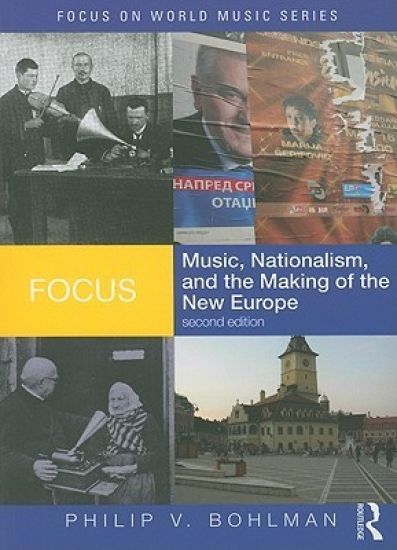
Focus: Music, Nationalism, and the Making of the New Europe
Two decades after the fall of communism in Eastern Europe and one decade into the twenty-first century, European music remains one of the most powerful forces for shaping nationalism. Using intensive fieldwork throughout Europe -- from participation in alpine foot pilgrimages to studies of the grandest music spectacle anywhere in the world, the Eurovision Song Contest -- Philip V. Bohlman reveals the ways in which music and nationalism intersect in the shaping of the New Europe. Focus: Music, Nationalism, and the Making of the New Europe begins with the emergence of the European nation-state in the Middle Ages and extends across long periods during which Europe’s nations used music to compete for land and language, and to expand the colonial reach of Europe to the entire world. Bohlman contrasts the "national" and the "nationalist" in music, examining the ways in which their impact on society can be positive and negative -- beneficial for European cultural policy and dangerous in times when many European borders are more fragile than ever. The New Europe of the twenty-first century is more varied, more complex, and more politically volatile than ever, and its music resonates fully with these transformations.
Focus: Music, Nationalism, and the Making of the New Europe
Two decades after the fall of communism in Eastern Europe and one decade into the twenty-first century, European music remains one of the most powerful forces for shaping nationalism. Using intensive fieldwork throughout Europe -- from participation in alpine foot pilgrimages to studies of the grandest music spectacle anywhere in the world, the Eurovision Song Contest -- Philip V. Bohlman reveals the ways in which music and nationalism intersect in the shaping of the New Europe. Focus: Music, Nationalism, and the Making of the New Europe begins with the emergence of the European nation-state in the Middle Ages and extends across long periods during which Europe’s nations used music to compete for land and language, and to expand the colonial reach of Europe to the entire world. Bohlman contrasts the "national" and the "nationalist" in music, examining the ways in which their impact on society can be positive and negative -- beneficial for European cultural policy and dangerous in times when many European borders are more fragile than ever. The New Europe of the twenty-first century is more varied, more complex, and more politically volatile than ever, and its music resonates fully with these transformations.
Central European Folk Music

Central European Folk Music

Philip V. Bohlman

CRC Press Inc
1996
sidottu
This is the first annotated bibliography, in German or English, to gather the rich sources for German-language folk-music scholarship. It presents a comprehensive view of both historical and contemporary trends in a field embracing folkloristics and ethnomusicology, as well as philological and cultural studies. Beginning with early theories of folk song-formulated by Herder, Goethe, the Brothers Grimm, and others-the book examines the most important collections of the 19th-century folk-song movement, and surveys the 20th-century institutions and publications that have made folk-music scholarship essential to an understanding of German-speaking Europe. The book represents the enormous diversity of folk music. Ideas of genre and classification contrast with the ways in which minority and ethnic groups have contributed to the complex constructs of 19th- and 20th-century nationalism. The intellectual history in this book often takes the form of a clash between institutions and the forceful personalities of scholars who theorized that folk music was the product of individuals or the linguistic core of nations. Entries that illustrate the ways in which constructs of folk music have contributed to the politics of culture (e.g., in Nazi Germany or in the workers' culture of the former German Democratic Republic) also constitute the expansive musical landscape covered by this book The author includes diverse disciplinary perspectives, not just those of folklorists, but also concepts from ethnomusicology, historical musicology, and religious and cultural studies. In addition to traditional studies of the canons of German folk music (e.g., ballads and singing-society repertories), Bohlman includes studies of religious and ethnic minorities, and of German folk music in nations and regions outside Central Europe. The comprehensive nature of this book, not only makes available a rich history of scholarship, but also contextualizes Central European folk music as a vital and critical discipline for the interpretation of a changing Europe. Includes index.
The Study of Folk Music in the Modern World

The Study of Folk Music in the Modern World

Philip V. Bohlman

Indiana University Press
1988
pokkari
"[This book] is a contribution of considerable substance because it takes a holistic view of the field of folk music and the scholarship that has dealt with it." —Bruno Nettl " . . . a praiseworthy combination of solid scholarship, penetrating discussion, and global relevance." —Asian Folklore Studies " . . . successfully ties the history and development of folk music scholarship with contemporary concepts, issues, and shifts, and which treats varied folk musics of the world cultures within the rubric of folklore and ethnomusicology with subtle generalizations making sense to serious minds . . . " —Folklore Forum " . . . [this book] challenges many carefully-nurtured sacred cows. Bohlman has executed an intellectual challenge of major significance by successfully organizing a welter of unruly data and ideas into a single, appropriately complex but coherent, system." —Folk Music Journal Bohlman examines folk music as a genre of folklore from a broadly cross-cultural perspective and espouses a more expansive view of folk music, stressing its vitality in non-Western cultures as well as Western, in the present as well as the past.