Kirjojen hintavertailu – 12 903 725 kirjaa ja 27 kauppaa

Kirjailija

Philip Whyman

Kirjat ja teokset yhdessä paikassa: 7 kirjaa, julkaisuja vuosilta 2003–2019, suosituimpiin kuuluu Sweden and the 'Third Way'. Vertaile teosten hintoja ja tarkista saatavuus suomalaisista kirjakaupoista.

7 kirjaa

Kirjojen julkaisuvuodet: 2003–2019.

Sweden and the 'Third Way'

Sweden and the 'Third Way'

Philip Whyman

Routledge
2019
nidottu
This title was first published in 2003. The creation of a 'Third Way' between unfettered capitalism and old-style Keynesian-corporatist forms of social democracy has become the driving force behind the policy programmes of many left-of-centre political parties in the industrialised nations of the world today. Sweden and the 'Third Way' critically evaluates this 'new' social democracy by examining the profound shift in Swedish political economy from being the prototype old-style social democracy towards the 'Third Way' synthesis of neo-liberalism and elements of traditional social democracy. Philip Whyman evaluates internal and external challenges to Swedish macroeconomic policy - including globalisation, European integration, post-Fordist technological change and the relative empowerment of capital - to discover the extent to which national economic autonomy is constrained. Furthermore, he considers the plausibility of revising the core elements of the traditional 'Swedish Model' as an alternative to the prevailing macroeconomic platform.
Sweden and the 'Third Way'

Sweden and the 'Third Way'

Philip Whyman

Routledge
2017
sidottu
This title was first published in 2003. The creation of a 'Third Way' between unfettered capitalism and old-style Keynesian-corporatist forms of social democracy has become the driving force behind the policy programmes of many left-of-centre political parties in the industrialised nations of the world today. Sweden and the 'Third Way' critically evaluates this 'new' social democracy by examining the profound shift in Swedish political economy from being the prototype old-style social democracy towards the 'Third Way' synthesis of neo-liberalism and elements of traditional social democracy. Philip Whyman evaluates internal and external challenges to Swedish macroeconomic policy - including globalisation, European integration, post-Fordist technological change and the relative empowerment of capital - to discover the extent to which national economic autonomy is constrained. Furthermore, he considers the plausibility of revising the core elements of the traditional 'Swedish Model' as an alternative to the prevailing macroeconomic platform.
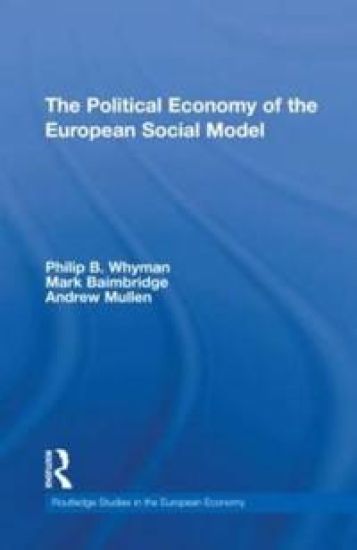
The Political Economy of the European Social Model

The Political Economy of the European Social Model

Philip Whyman; Mark Baimbridge; Andrew Mullen

Routledge
2014
nidottu
This book seeks to analyse the development of the European Union (EU), which was founded upon the principle of the free movement of capital, goods, services and people in 1957. Its central thesis is that, from a practical and theoretical point of view, such a basis is fundamentally at odds with the creation of an interventionist regime that the construction of a social Europe would require. The authors argue convincingly that - economically: the EU does not currently possess the budget or the economic tools to pursue such a strategy; politically: close to none of the institutions of the EU have backed such a policy; practically: conservative and neo-liberal forces (among member states and the institutions of the EU) have repeatedly thwarted any moves in this direction. In reality, the Single Internal Market, Economic and Monetary Union, enlargement, the Lisbon Agenda and European Constitution projects all prioritise supply-side measures and expanding the scope of the market rather than the boosting of demand and other economic intervention. Consequently, constructing a social Europe in the face of this would appear problematic. Hence, in both theory and practice, the idea that there can be a social Europe vis-à-vis neoliberalisation is a contradiction in terms. This controversial book will be an educating and refreshing read for advanced students and academics involved with European politics, the European Union, European Economics and Economic instititutions.
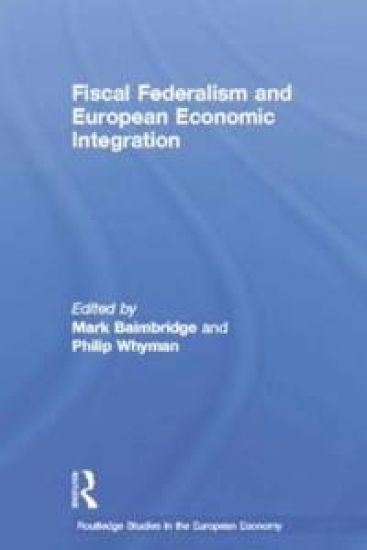
Fiscal Federalism and European Economic Integration

Fiscal Federalism and European Economic Integration

Mark Baimbridge; Philip Whyman

Routledge
2014
nidottu
The pace of economic integration amongst European Union (EU) member states has accelerated considerably during the past decade, highlighted by the process of Economic and Monetary Union (EMU). Many aspects of the EU's apparatus, however, have failed to evolve in order to meets these new challenges. This book explores the issue of fiscal federalism within the context of EU integration from theoretical, historical, policy and global perspectives. It contrasts the pace of integration amongst EU member states with the failure of financial and administrative apparatus to evolve to encompass fiscal federalism, i.e. the development of a centralised budgetary system. This impressive collection, with contributions from a range of internationally respected authors, shall interest students and researchers involved with European economics and economic integration. Its accessible style will also make it extremely useful to policy-makers and professionals for whom European economic integration is a daily topic of conversation.
The Political Economy of the European Social Model

The Political Economy of the European Social Model

Philip Whyman; Mark Baimbridge; Andrew Mullen

Routledge
2012
sidottu
This book seeks to analyse the development of the European Union (EU), which was founded upon the principle of the free movement of capital, goods, services and people in 1957. Its central thesis is that, from a practical and theoretical point of view, such a basis is fundamentally at odds with the creation of an interventionist regime that the construction of a social Europe would require. The authors argue convincingly that - economically: the EU does not currently possess the budget or the economic tools to pursue such a strategy; politically: close to none of the institutions of the EU have backed such a policy; practically: conservative and neo-liberal forces (among member states and the institutions of the EU) have repeatedly thwarted any moves in this direction. In reality, the Single Internal Market, Economic and Monetary Union, enlargement, the Lisbon Agenda and European Constitution projects all prioritise supply-side measures and expanding the scope of the market rather than the boosting of demand and other economic intervention. Consequently, constructing a social Europe in the face of this would appear problematic. Hence, in both theory and practice, the idea that there can be a social Europe vis-à-vis neoliberalisation is a contradiction in terms. This controversial book will be an educating and refreshing read for advanced students and academics involved with European politics, the European Union, European Economics and Economic instititutions.
Fiscal Federalism and European Economic Integration

Fiscal Federalism and European Economic Integration

Mark Baimbridge; Philip Whyman

Routledge
2003
sidottu
The pace of economic integration amongst European Union (EU) member states has accelerated considerably during the past decade, highlighted by the process of Economic and Monetary Union (EMU). Many aspects of the EU's apparatus, however, have failed to evolve in order to meets these new challenges. This book explores the issue of fiscal federalism within the context of EU integration from theoretical, historical, policy and global perspectives. It contrasts the pace of integration amongst EU member states with the failure of financial and administrative apparatus to evolve to encompass fiscal federalism, i.e. the development of a centralised budgetary system. This impressive collection, with contributions from a range of internationally respected authors, shall interest students and researchers involved with European economics and economic integration. Its accessible style will also make it extremely useful to policy-makers and professionals for whom European economic integration is a daily topic of conversation.