

Kirjailija
Philipp Richter
Kirjat ja teokset yhdessä paikassa: 8 kirjaa, julkaisuja vuosilta 2010–2021, suosituimpiin kuuluu Prognose Landtagswahlen Sachsen-Anhalt. Vertaile teosten hintoja ja tarkista saatavuus suomalaisista kirjakaupoista.
8 kirjaa
Kirjojen julkaisuvuodet: 2010–2021.

Relief for your patients with musculoskeletal pain... This unique guide takes an in-depth look at trigger point therapy. Divided into two sections – Functional Muscle Chains and Trigger Points and Their Treatment – this book combines detailed theory with tried and practical techniques. The text covers the basics of functional muscle chains and the origin of myofascial pain arising from the musculoskeletal system, for example, due to poor posture. The reader will learn how various stretching exercises augment the myofascial therapy methods. Anatomic drawings and liberal use of photographs in this book will help the reader to localize the trigger points and the associated pain areas. Praise for the first edition: "The information is brief but to the point; there is little wasted space so that the book is packed with information that can immediately be put into action." Doody's Review Key Features:Various models of muscle chains introduced and describedDetailed explanations of trigger points and their treatmentNew chapters about posture and influence of gravity, as well 46 new and redrawn illustrations, now totaling approximately 300, included in this new edition"Ticklish" and erogenous zones mapped out to help prevent unintended side effects of treatment Trigger Points and Muscle Chains, second edition, is an essential tool for osteopaths, physical therapists, and all practitioners involved in pain therapy. This book includes complimentary access to a digital copy on https://medone.thieme.com.

Philipp Richter untersucht Unterschiede in der Makroorganisation der Landesverwaltungen. In seiner verwaltungswissenschaftlich-empirischen Analyse zeigt er am Beispiel der Versorgungsverwaltung, wie sich der vormals einheitliche Verwaltungsaufbau durch Verwaltungsstruktur- und Funktionalreformen zwischen den Bundesländern ausdifferenziert hat und wie die dadurch entstandenen Unterschiede den Vollzug von Bundesgesetzen beeinflussen. Mit Blick auf die Implementation des Schwerbehinderten- und Sozialen Entschädigungsrechts identifiziert der Autor problemadäquate Lösungen und zieht praxisrelevante Schlussfolgerungen für eine Modernisierung des äußeren Verwaltungsaufbaus, die auch wichtige Erkenntnisse für die Ausgestaltung der Makroorganisation in anderen Verwaltungsbereichen bereithalten.

Ways Out of the Working Capital Trap
Erik Hofmann; Daniel Maucher; Sabrina Piesker; Philipp Richter
Springer-Verlag Berlin and Heidelberg GmbH Co. K
2013
nidottu
Especially in times of an economic boom following a crisis, companies have to deal with the phenomenon of the "working capital trap," which signifies a company's increasing need for financial liquidity in times of hindered access to debt capital, caused by the increasingly restrictive credit approval processes of financial institutions. As a consequence of cost savings, this situation is often reinforced by a low level of inventory. This book takes up the problem and shows ways of escaping the "trap" by identifying and strengthening in-house financing potential. First, different operating ratios will be introduced. These refer to the amount of capital committed to the flow of goods and to the amount of in-house financing possible. Subsequently, methods for consolidating in-house financing that are affected by procurement processes will be presented from the company's and the supply chain's perspective. From a company's perspective, the methods for consolidating the amount of in-house financing over the following topics: The Management of Payment Terms, Inventory Management and Product Group and Supplier Management From the supply chain's perspective, the following methods for extending the possible amount of in-house financing will be discussed: Finance-Oriented Supply Chain Sourcing, Supply Chain-Oriented Supplier Financing, Collaborative Cash-to-Cash Management, Collaborative Cash Pooling and Netting, Supply Chain Financing Platforms. The conceptual models will be clarified using a practical example from the automobile industry. Finally, the "Procurement Value Added" (PVA©) approach will be presented, a concept that measures the contribution of procurement to the company's success.


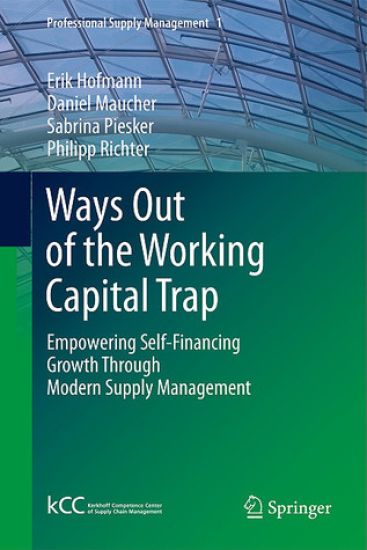
Ways Out of the Working Capital Trap
Erik Hofmann; Daniel Maucher; Sabrina Piesker; Philipp Richter
Springer-Verlag Berlin and Heidelberg GmbH Co. K
2011
sidottu
Especially in times of an economic boom following a crisis, companies have to deal with the phenomenon of the "working capital trap," which signifies a company's increasing need for financial liquidity in times of hindered access to debt capital, caused by the increasingly restrictive credit approval processes of financial institutions. As a consequence of cost savings, this situation is often reinforced by a low level of inventory. This book takes up the problem and shows ways of escaping the "trap" by identifying and strengthening in-house financing potential. First, different operating ratios will be introduced. These refer to the amount of capital committed to the flow of goods and to the amount of in-house financing possible. Subsequently, methods for consolidating in-house financing that are affected by procurement processes will be presented from the company's and the supply chain's perspective. From a company's perspective, the methods for consolidating the amount of in-house financing over the following topics: The Management of Payment Terms, Inventory Management and Product Group and Supplier Management From the supply chain's perspective, the following methods for extending the possible amount of in-house financing will be discussed: Finance-Oriented Supply Chain Sourcing, Supply Chain-Oriented Supplier Financing, Collaborative Cash-to-Cash Management, Collaborative Cash Pooling and Netting, Supply Chain Financing Platforms. The conceptual models will be clarified using a practical example from the automobile industry. Finally, the "Procurement Value Added" (PVA©) approach will be presented, a concept that measures the contribution of procurement to the company's success.

Wege aus der Working Capital-Falle
Erik Hofmann; Daniel Maucher; Sabrina Piesker; Philipp Richter
Springer-Verlag Berlin and Heidelberg GmbH Co. K
2010
sidottu
Gerade in Zeiten wirtschaftlichen Aufschwungs nach Durchschreiten einer Krise haben Unternehmen mit dem Phänomen einer „Working Capital-Falle" zu kämpfen. Die „Working Capital-Falle" bezeichnet die Kombination aus steigendem Liquiditätsbedarf eines Unternehmens, bei gleichzeitig erschwertem Zugang zu Fremdkapital aufgrund restriktiver Kreditvergabepraktiken der Finanzinstitute. Als Folge von Kosteneinsparungen wird diese Situation häufig noch durch ein geringes Bestandsniveau verstärkt. Das vorliegende Buch greift dieses Problem auf und zeigt Möglichkeiten, wie der Weg aus der „Working Capital-Falle" durch Ermittlung und Stärkung der Innenfinanzierung erfolgen kann. Dabei werden zunächst Kenngrößen zur Ermittlung der Kapitalbindung der Warenflüsse und zur Messung der Innenfinanzierungskraft beschrieben. Anschließend werden durch die Beschaffung beeinflussbare Maßnahmen zur Stärkung der Innenfinanzierungskraft aus Unternehmens- und aus Supply Chain-Sicht vorgestellt. Die Maßnahmen zur Stärkung der Innenfinanzierungskraft aus Unternehmenssicht umfassen folgende Themen: Management der ZahlungskonditionenBestandsmanagementWarengruppen- und LieferantenmanagementAus Supply Chain-Sicht werden folgende Konzepte zur Stärkung der Innenfinanzierungskraft diskutiert:Finanzierungsorientiertes Supply ChainSourcingSupply Chain-orientierte LieferantenfinanzierungCollaborative Cash-to-Cash ManagementCollaborative Cash Pooling und NettingSupply Chain-FinanzierungsplattformenDie konzeptionellen Ausführungen werden anhand eines Praxisbeispiels verdeutlicht. Mit dem "Procurement Value Added" (PVA©) wird schließlich ein Konzept präsentiert, durch den der Beitrag der Beschaffung auf den Unternehmenserfolg gemessen werden kann.