Kirjojen hintavertailu – 12 903 724 kirjaa ja 27 kauppaa

Kirjailija

Philippe C. Schmitter

Kirjat ja teokset yhdessä paikassa: 9 kirjaa, julkaisuja vuosilta 1986–2020, suosituimpiin kuuluu Politics as a Science. Vertaile teosten hintoja ja tarkista saatavuus suomalaisista kirjakaupoista.

Nimi esiintyy myös muodoissa: Philippe C Schmitter

9 kirjaa

Kirjojen julkaisuvuodet: 1986–2020.

Politics as a Science

Politics as a Science

Philippe C. Schmitter; Marc Blecher

Routledge
2020
sidottu
In Politics as a Science, two of the world's leading authorities on Comparative Politics, Philippe C. Schmitter and Marc Blecher, provide a lively introduction to the concepts and framework to study and analyze politics. Written with dexterity, concision and clarity, this short text makes no claim to being scientific. It contains no disprovable hypotheses, no original collection of evidence and no search for patterns of association. Instead, Schmitter and Blecher keep the text broadly conceptual and theoretical to convey their vision of the sprawling subject of politics. They map the process in which researchers try to specify the goal of the trip, some of the landmarks likely to be encountered en route and the boundaries that will circumscribe the effort. Examples, implications and elaborations are included in footnotes throughout the book. Politics as a Science is an ideal introduction for anyone interested in, or studying, comparative politics.“The Open Access version of this book, available at http://www.taylorfrancis.com/doi/view/10.4324/9781003032144, has been made available under a Creative Commons Attribution-Non Commercial-No Derivatives 4.0 license.”

Politics as a Science

Politics as a Science

Philippe C. Schmitter; Marc Blecher

Routledge
2020
nidottu
In Politics as a Science, two of the world's leading authorities on Comparative Politics, Philippe C. Schmitter and Marc Blecher, provide a lively introduction to the concepts and framework to study and analyze politics. Written with dexterity, concision and clarity, this short text makes no claim to being scientific. It contains no disprovable hypotheses, no original collection of evidence and no search for patterns of association. Instead, Schmitter and Blecher keep the text broadly conceptual and theoretical to convey their vision of the sprawling subject of politics. They map the process in which researchers try to specify the goal of the trip, some of the landmarks likely to be encountered en route and the boundaries that will circumscribe the effort. Examples, implications and elaborations are included in footnotes throughout the book. Politics as a Science is an ideal introduction for anyone interested in, or studying, comparative politics.“The Open Access version of this book, available at http://www.taylorfrancis.com/doi/view/10.4324/9781003032144, has been made available under a Creative Commons Attribution-Non Commercial-No Derivatives 4.0 license.”
Transitions from Authoritarian Rule

Transitions from Authoritarian Rule

Guillermo O’Donnell; Philippe C. Schmitter; Laurence Whitehead; Cynthia J. Arnson; Abraham F. Lowenthal

Johns Hopkins University Press
2013
pokkari
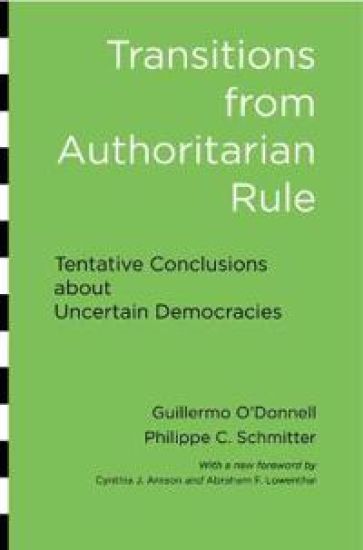
Political science scholars consider the four-volume work "Transitions from Authoritarian Rule" to be a foundational text for studying the process of democratization, specifically in those cases where an authoritarian regime is giving way to some form of democratic government. The most important of the four books is without a doubt the fourth volume, "Tentative Conclusions about Uncertain Democracies", also known as "the little green book." "Transitions from Authoritarian Rule" was the first book in any language to systematically compare the process of transition from authoritarianism across a broad range of countries. Political democracy is not the only possible outcome. Guillermo O'Donnell, Philippe C. Schmitter, and Laurence Whitehead emphasize that it's not the revolution but the transition that is critical to the growth of a democratic state. This ground-breaking insight remains highly relevant as the ramifications of the Arab Spring continue to play out. This reissue features a new foreword by Cynthia J. Arnson, director of the Latin American Program at the Woodow Wilson International Center for Scholars, and Abraham F. Lowenthal, founding director of the Latin American Program, who wrote the original volume's foreword.
How to Democratize the European Union...and Why Bother?

How to Democratize the European Union...and Why Bother?

Philippe C. Schmitter

Rowman Littlefield
2000
nidottu
A contradictory creation indeed, the European Union has most of the institutions of a modern democracy, yet it does not function as one. Moreover, its growing scope of activity and supranational decision making processes are undermining the legitimacy of democracy in its member states. Much has been written about this double "democratic deficit," but surprisingly little thought has been given to what to do about it—short of drafting and ratifying a new federal constitution. In this provocative book, Philippe C. Schmitter explores both the possibility and the desirability of democratizing the EU. He argues that as a "non-state" and a "non nation" it will have to invent new forms of citizenship, representation, and decisionmaking if it is ever to democratize itself. The author also contends that the timing and political context work against a full-scale constitutionalization of the process. He proposes a number of modest (and some less modest) reforms that could improve the situation in the near future and eventually lead to a genuine Euro-democracy.
Governance in the European Union

Governance in the European Union

Gary Marks; Fritz W Scharpf; Philippe C Schmitter; Wolfgang Streeck

SAGE Publications Inc
1996
sidottu
A fresh alternative to traditional state-centred analyses of the process of European integration is presented in this book. World-renowned scholars analyze the state in terms of its component parts and clearly show the interaction of subnational, national and supranational actors in the emerging European polity. This `multi-level politics' approach offers a powerful lens through which to view the future course of European integration. The contributors' empirical exploration of areas such as regional governance, social policy and social movements underpins their broad conceptual and theoretical framework providing significant new insight into European politics.
Governance in the European Union

Governance in the European Union

Gary Marks; Fritz W Scharpf; Philippe C Schmitter; Wolfgang Streeck

SAGE Publications Inc
1996
nidottu
A fresh alternative to traditional state-centred analyses of the process of European integration is presented in this book. World-renowned scholars analyze the state in terms of its component parts and clearly show the interaction of subnational, national and supranational actors in the emerging European polity. This `multi-level politics' approach offers a powerful lens through which to view the future course of European integration. The contributors' empirical exploration of areas such as regional governance, social policy and social movements underpins their broad conceptual and theoretical framework providing significant new insight into European politics.
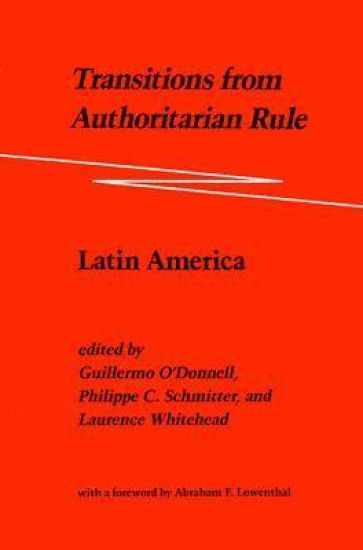
Transitions from Authoritarian Rule

Transitions from Authoritarian Rule

Guillermo O’Donnell; Philippe C. Schmitter; Laurence Whitehead

Johns Hopkins University Press
1986
pokkari
An array of internationally noted scholars examines the process of democratization in Southern Europe and Latin America. The authors provide new interpretations of both current and historical efforts of nations to end periods of authoritarian rule and to initiate transition to democracy, efforts that have met with widely varying degrees of success and failure. Extensive case studies of individual countries, a comparative overview, and a synthesis conclusions offer important insights for political scientists, students, and all concerned with the prospects for democracy. In Volume 3, despite the unique contexts of transitions in individual countries, significant points of comparison emerge — such as the influence of foreign nations and the role of agents outside the government. These analyses explore both intra- and interregional similarities and differences.
Transitions from Authoritarian Rule

Transitions from Authoritarian Rule

Guillermo O’Donnell; Philippe C. Schmitter; Laurence Whitehead

Johns Hopkins University Press
1986
pokkari
An array of internationally noted scholars examines the process of democratization in southern Europe and Latin America. They provide new interpretations of both current and historical efforts of nations to end periods of authoritarian rule and to initiate transition to democracy, efforts that have met with widely varying degrees of success and failure. Extensive case studies of individual countries, a comparative overview, and a synthesis conclusions offer important insights for political scientists, students, and all concerned with the prospects for democracy. The historical example of Italy after Mussolini as well as the more recent cases of Greece, Portugal, Spain, and Turkey suggest factors that may make a transition relatively secure.
Transitions from Authoritarian Rule

Transitions from Authoritarian Rule

Guillermo O’Donnell; Philippe C. Schmitter; Laurence Whitehead

Johns Hopkins University Press
1986
pokkari
An array of internationally noted scholars examines the process of democratization in southern Europe and Latin America. They provide new interpretations of both current and historical efforts of nations to end periods of authoritarian rule and to initiate transition to democracy, efforts that have met with widely varying degrees of success and failure. Extensive case studies of individual countries, a comparative overview, and a synthesis conclusions offer important insights for political scientists, students, and all concerned with the prospects for democracy. Southern Europe The historical example of Italy after Mussolini as well as the more recent cases of Greece, Portugal, Spain, and Turkey suggest factors that may make a transition relatively secure. Latin America Democratization is perhaps the central issue in Latin American politics today. Case studies focus on Argentina, Bolivia, Brazil, Chile, Mexico, Peru, Uruguay and Venezuela. Comparative Perspectives Despite the unique contexts of transitions in individual countries, significant points of comparison emerge -- such as the influence of foreign nations and the role of agents outside the government. These analyses explore both intra- and interregional similarities and differences. Tentative Conclusions about Uncertain Democracies Political democracy is not the only possible outcome of transitions from authoritarianism. Guillermo O'Donnell and Philippe C. Schmitter draw out the implications of democracy as a goal and of the uncertainty inherent in transitional situations.