Kirjojen hintavertailu – 12 903 725 kirjaa ja 27 kauppaa

Kirjailija

Philippe Huneman

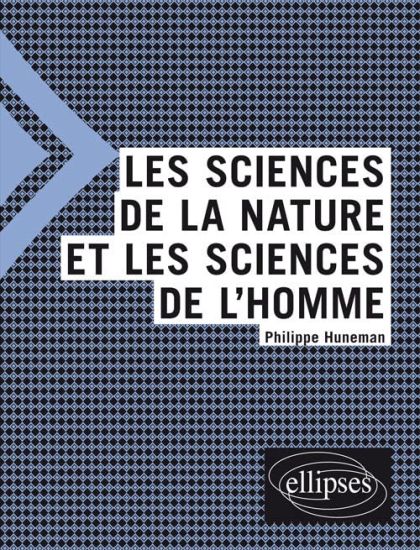
Kirjat ja teokset yhdessä paikassa: 8 kirjaa, julkaisuja vuosilta 2018–2026, suosituimpiin kuuluu Les sciences de la nature et les sciences de l'homme. Vertaile teosten hintoja ja tarkista saatavuus suomalaisista kirjakaupoista.

8 kirjaa

Kirjojen julkaisuvuodet: 2018–2026.

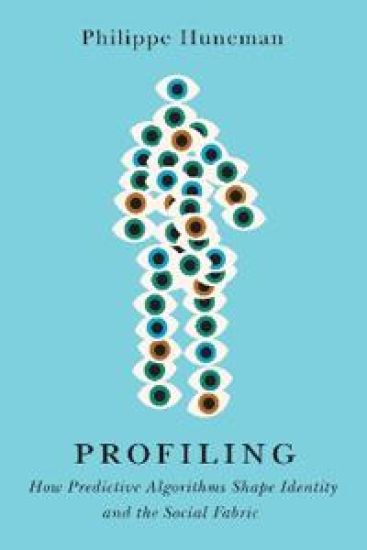
Profiling

Profiling

Philippe Huneman

STANFORD UNIVERSITY PRESS
2026
sidottu
In this book, philosopher Philippe Huneman aims to offer an unprecedented and systematic understanding of a simultaneously banal and singular phenomenon of modern life: the digital profile. Diving deeply into the algorithms that produce these profiles, Huneman examines the way in which an individual becomes a predictable subject, both as unwilling producer of their digital profile and unwitting subject of digital marketing's attempts to influence beliefs and behaviors. As the book demonstrates, today's society of profiling has profound implications for our understanding of self and politics. The book unfolds across three sections. In the first, Huneman explains profiles and profiling as they operate today and describes their contemporary pervasiveness, using examples from a variety of fields and considering the wide range of types of data that can be digitalized – be they traces, search histories, metadata or the like. In the second section, on profiles, Huneman reflects on who is the subject of profiling societies and what kind of consequences profiling has on individuals – from behavior to memory. And, finally, entering into metaphysical questioning, the book shines a spotlight on the feedback loop that develops between algorithmic profiling and reality.
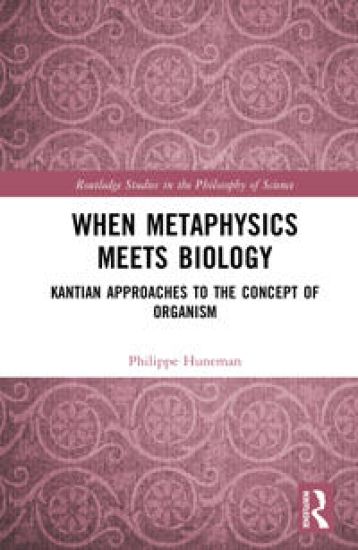
When Metaphysics Meets Biology

When Metaphysics Meets Biology

Philippe Huneman

TAYLOR FRANCIS LTD
2025
sidottu
This book explains the background and meaning of Kant’s account of the life sciences in the Critique of Judgment by reading the development of Kant’s ideas on the living since his 1763 precritical essays, in parallel with analyzing several milestones in the constitution of the concept of organism as a self-organized totality, studied by biology. This parallel reading frames Kant’s account of biology against influential theories developed by earlier scientists and naturalists, including Leibniz, Stahl, French vitalists, Albrecht von Haller, Caspar Wolff and Buffon, as well as his almost contemporaries such as Goethe and Cuvier. It reveals that Kant’s enquiry about teleological judgment ties in with important advances in his time about the organism as an integrated, functioning, and self-organizing entity. It explains how Kant’s idea of purposiveness, formulated in the context of a metaphysical inquiry about the order of the world and its knowledge, hence of contingency generaliter, became detached from the notion of intention, thus ascribing it a new meaning tied to autonomous biological practice. Then, considering 19th century biologists, it provides the genealogy of a post-Darwinian theoretical space in which biologists formulate complementary or competing accounts of organisms as developmental systems in evolution, and within which theoretical cleavages are generated. It thereby explains how the two theoretical trends known as form-centered and function-centered biology, now defined as “developmental“ and “adaptationist“ viewpoints, emerged as two distinct perspectives from a concept of “natural purposiveness“ unified by Kant’s transcendental perspective; then it unravels the way they currently articulate, on the background of their genesis. When Metaphysics Meets Biology offers a philosophical interpretation of the emergence of biology in Kant’s thinking, and sheds light on the philosophical issues currently embedded within the conceptual structure of biology. It is of interest to philosophers of biology as well as philosophers interested in metaphysics and its history.
Death

Death

Philippe Huneman

PALGRAVE MACMILLAN
2024
pokkari
This book addresses several key issues in the biological study of death with the intent of capturing their genealogy, the assumptions and presuppositions they make, and the way that they open specific new research avenues. The book is divided into two sections: the first considers physiology and the second evolutionary biology. In the first part, Huneman reconstructs a conceptual genealogy of experimental physiology based on an in-depth analysis of Bichat's investigations of death processes. In the second part he explains that biologists in the late 1950s put forth a research framework that evolutionarily accounts for death in terms of either an effect of the weakness of natural selection or a by-product of natural selection for early reproduction. He illustrates how the biology of death is a central field and that studying it provides insight into the way that the epistemic structure of this knowledge has been constituted, persists until now, and may conflict with some traditional philosophical ideas.
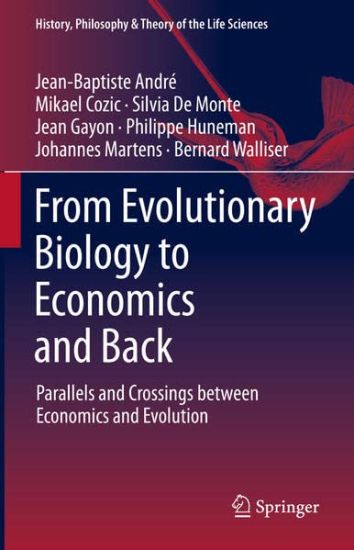
From Evolutionary Biology to Economics and Back

From Evolutionary Biology to Economics and Back

Jean-Baptiste André; Mikael Cozic; Silvia De Monte; Jean Gayon; Philippe Huneman; Johannes Martens; Bernard Walliser

Springer International Publishing AG
2024
nidottu
This book offers a comprehensive exploration of the major key concepts common to economics and evolutionary biology. Written by a group of philosophers of science, biologists and economists, it proposes analyses of the meaning of twenty-five concepts from the viewpoint respectively of economics and of evolutionary biology –each followed by a short synthesis emphasizing major discrepancies and commonalities. This analysis is surrounded by chapters exploring the nature of the analogy that connects evolution and economics, and chapters that summarize the major teachings of the analyses of the keywords. Most scholars in biology and in economics know that their science has something in common with the other one, for instance the notions of competition and resources. Textbooks regularly acknowledge that the two fields share some history – Darwin borrowing from Malthus the insistence on scarcity of resources, and then behavioral ecologists adapting and transforming game theory into evolutionary game theory in the 1980s, while Friedman famously alluded to a Darwinian process yielding the extant firms. However, the real extent of the similarities, the reasons why they are so close, and the limits and even the nature of the analogy connecting economics and biological evolution, remain inexplicit. This book proposes basis analyses that can sustain such explication. It is intended for researchers, grad students and master students in evolutionary and in economics, as well as in philosophy of science.
Why?

Why?

Philippe Huneman

STANFORD UNIVERSITY PRESS
2023
sidottu
A philosopher explores the many dimensions of a beguilingly simple question. Why did triceratops have horns? Why did World War I occur? Why does Romeo love Juliet? And, most importantly, why ask why? Through an analysis of these questions and others, philosopher Philippe Huneman describes the different meanings of "why," and how those meanings can, and should (or should not), be conflated. As Huneman outlines, there are three basic meanings of why: the cause of an event, the reason of a belief, and the reason why I do what I do (the purpose). Each of these meanings, in turn, impacts how we approach knowledge in a wide array of disciplines: science, history, psychology, and metaphysics. Exhibiting a rare combination of conversational ease and intellectual rigor, Huneman teases out the hidden dimensions of questions as seemingly simple as "Why did Mickey Mouse open the refrigerator?" or as seemingly unanswerable as "Why am I me?" In doing so, he provides an extraordinary tour of canonical and contemporary philosophical thought, from Plato and Aristotle, through Descartes and Spinoza, to Elizabeth Anscombe and Ruth Millikan, and beyond. Of course, no proper reckoning with the question "why?" can afford not to acknowledge its limits, which are the limits, and the ends, of reason itself. Huneman thus concludes with a provocative elaboration of what Kant called the "natural need for metaphysics," the unallayed instinct we have to ask the question even when we know there can be no unequivocal answer.
Death

Death

Philippe Huneman

Springer International Publishing AG
2023
sidottu
This book addresses several key issues in the biological study of death with the intent of capturing their genealogy, the assumptions and presuppositions they make, and the way that they open specific new research avenues. The book is divided into two sections: the first considers physiology and the second evolutionary biology. In the first part, Huneman reconstructs a conceptual genealogy of experimental physiology based on an in-depth analysis of Bichat's investigations of death processes. In the second part he explains that biologists in the late 1950s put forth a research framework that evolutionarily accounts for death in terms of either an effect of the weakness of natural selection or a by-product of natural selection for early reproduction. He illustrates how the biology of death is a central field and that studying it provides insight into the way that the epistemic structure of this knowledge has been constituted, persists until now, and may conflict with some traditional philosophical ideas.
From Evolutionary Biology to Economics and Back

From Evolutionary Biology to Economics and Back

Jean-Baptiste André; Mikael Cozic; Silvia De Monte; Jean Gayon; Philippe Huneman; Johannes Martens; Bernard Walliser

Springer International Publishing AG
2023
sidottu
This book offers a comprehensive exploration of the major key concepts common to economics and evolutionary biology. Written by a group of philosophers of science, biologists and economists, it proposes analyses of the meaning of twenty-five concepts from the viewpoint respectively of economics and of evolutionary biology –each followed by a short synthesis emphasizing major discrepancies and commonalities. This analysis is surrounded by chapters exploring the nature of the analogy that connects evolution and economics, and chapters that summarize the major teachings of the analyses of the keywords. Most scholars in biology and in economics know that their science has something in common with the other one, for instance the notions of competition and resources. Textbooks regularly acknowledge that the two fields share some history – Darwin borrowing from Malthus the insistence on scarcity of resources, and then behavioral ecologists adapting and transforming game theory into evolutionary game theory in the 1980s, while Friedman famously alluded to a Darwinian process yielding the extant firms. However, the real extent of the similarities, the reasons why they are so close, and the limits and even the nature of the analogy connecting economics and biological evolution, remain inexplicit. This book proposes basis analyses that can sustain such explication. It is intended for researchers, grad students and master students in evolutionary and in economics, as well as in philosophy of science.