Kirjojen hintavertailu – 12 903 725 kirjaa ja 27 kauppaa

Kirjailija

Philippe Van Parijs

Kirjat ja teokset yhdessä paikassa: 9 kirjaa, julkaisuja vuosilta 1993–2019, suosituimpiin kuuluu Just Democracy. Vertaile teosten hintoja ja tarkista saatavuus suomalaisista kirjakaupoista.

9 kirjaa

Kirjojen julkaisuvuodet: 1993–2019.

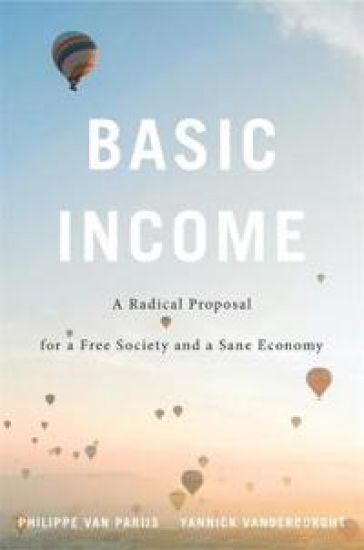
Basic Income

Basic Income

Philippe Van Parijs; Yannick Vanderborght

Harvard University Press
2019
nidottu
“Powerful as well as highly engaging—a brilliant book.”—Amartya SenA Times Higher Education Book of the WeekIt may sound crazy to pay people whether or not they’re working or even looking for work. But the idea of providing an unconditional basic income to everyone, rich or poor, active or inactive, has long been advocated by such major thinkers as Thomas Paine, John Stuart Mill, and John Kenneth Galbraith. Now, with the traditional welfare state creaking under pressure, it has become one of the most widely debated social policy proposals in the world. Basic Income presents the most acute and fullest defense of this radical idea, and makes the case that it is our most realistic hope for addressing economic insecurity and social exclusion.“They have set forth, clearly and comprehensively, what is probably the best case to be made today for this form of economic and social policy.”—Benjamin M. Friedman, New York Review of Books“A rigorous analysis of the many arguments for and against a universal basic income, offering a road map for future researchers.”—Wall Street Journal“What Van Parijs and Vanderborght bring to this topic is a deep understanding, an enduring passion and a disarming optimism.”—Steven Pearlstein, Washington Post

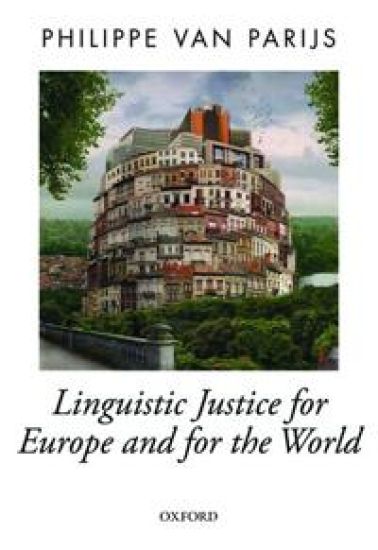
Linguistic Justice for Europe and for the World

Linguistic Justice for Europe and for the World

Philippe Van Parijs

Oxford University Press
2014
nidottu
In Europe and throughout the world, competence in English is spreading at a speed never achieved by any language in human history. This apparently irresistible growing dominance of English is frequently perceived and sometimes indignantly denounced as being grossly unjust. Linguistic Justice for Europe and for the World starts off arguing that the dissemination of competence in a common lingua franca is a process to be welcomed and accelerated, most fundamentally because it provides the the struggle for greater justice with an essential weapon: a cheap medium of cross-border communication and mobilization. However, the resulting linguistic situation is arguably unjust in three distinct senses. Firstly, the adoption of one natural language as the lingua franca implies that its native speakers are getting a free ride by benefiting costlessly from the learning effort of others. Secondly, Anglophones gain greater opportunities as a result of competence in their native language becoming a more valuable asset. Thirdly, the privilege given to one language failes to show equal respect for the various langauges with which different portions of the population concerned identify. The book spells out the corresponding interpretations of linguistic justice as cooperative justice, distributive justice, and parity of esteem. It discusses a wide range of policies that might help achieve linguistic justice in these three senses, from a linguistic tax on Anglophone countries to the banning of dubbing or the linguistic territoriality principle. It also argues that linguistic diversity, though not valuable in itself, will nonetheless need to be protected as a by-product of the pursuit of linguistic justice as parity of esteem.
Linguistic Justice for Europe and for the World

Linguistic Justice for Europe and for the World

Philippe Van Parijs

Oxford University Press
2011
sidottu
In Europe and throughout the world, competence in English is spreading at a speed never achieved by any language in human history. This apparently irresistible growing dominance of English is frequently perceived and sometimes indignantly denounced as being grossly unjust. Linguistic Justice for Europe and for the World starts off arguing that the dissemination of competence in a common lingua franca is a process to be welcomed and accelerated, most fundamentally because it provides the struggle for greater justice in Europe and in the world with an essential weapon: a cheap medium of communication and of mobilization. However, the resulting linguistic situation can plausibly be regarded as unjust in three distinct senses. Firstly, the adoption of one natural language as the lingua franca implies that its native speakers are getting a free ride by benefiting costlessly from the learning effort of others. Secondly, they gain greater opportunities as a result of competence in their native language becoming a more valuable asset. And thirdly the privilege systematically given to one language fails to show equal respect for the various languages with which different portions of the population concerned identify. The book spells out the corresponding interpretations of linguistic justice as cooperative justice, distributive justice and parity of esteem, respectively. And it discusses systematically a wide range of policies that might help achieve linguistic justice in these three senses, from a linguistic tax on Anglophone countries to the banning of dubbing or the linguistic territoriality principle. Against this background, the book argues that linguistic diversity is not valuable in itself but it will nonetheless need to be protected as a by-product of the pursuit of linguistic justice as parity of esteem.
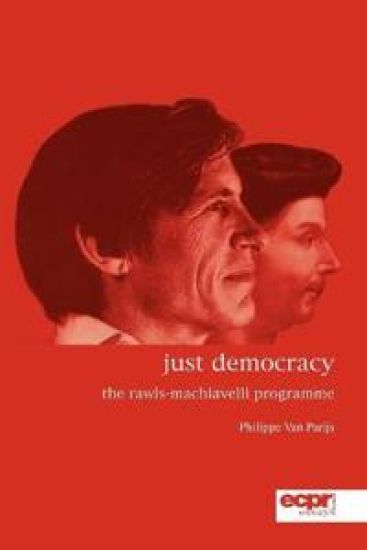
Just Democracy

Just Democracy

Philippe Van Parijs

ECPR Press
2011
nidottu
Philippe Van Parijs is one of the world's leading political philosophers. In this book, he argues that the purpose of democracy should be to promote justice - we need not just democracy (in the sense of unqualified democracy) but a just democracy. Machiavelli and Rawls must be brought together. In a series of provocative and timely essays, he explores what creating such a just democratic political system would involve in order to tackle such issues as intergenerational justice, multiculturalism and linguistic diversity. He illustrates his arguments with examples drawn from the European Union and his native Belgium.
Marxism Recycled

Marxism Recycled

Philippe van Parijs

Cambridge University Press
2009
pokkari
It was Philippe van Parijs' conviction that the Marxist tradition can be kept alive as an essential political component of the Left not through dutiful conservation, but through ruthless recycling: the discarding of encumbering elements, and the reshaping of the remainder using the latest intellectual 'technology'. The essays collected in this book examine the structure and potential of historical materialism as a general theory of social change. They draw on the lessons of the failure of Marxist crisis theory, and show how a rejuvenated notion of exploitation can illuminate the analysis of the class structure of welfare state capitalism or the assessment of international migration. They explore and advocate a 'capitalist road to communism' that expands the realm of freedom while bypassing socialism, and they develop those aspects of the Marxist project consistent with ecological concerns.
Redesigning Distribution

Redesigning Distribution

Anne Alstott; Bruce Ackerman; Philippe Van Parijs

Verso Books
2006
nidottu
Volume V in the acclaimed Real Utopias Project series, edited by Erik Olin Wright. Are there ways that contemporary capitalism can be rendered a dramatically more egalitarian economic system without destroying its productivity and capacity for growth? This book explores two proposals, unconditional basic income and stakeholder grants, that attempt just that. In a system of basic income, as elaborated by Philippe van Parijs, all citizens are given a monthly stipend sufficient to provide them with a no-frills but adequate standard of living. This monthly income is universal rather than means-tested, and it is unconditional - receiving the basic income does not depend upon performing any labor services or satisfying other conditions. It affirms the idea that as a matter of basic rights, no one should live in poverty in an affluent society. In a system of stakeholder grants, as discussed by Bruce Ackerman and Anne Alstott, all citizens upon reaching the age of early adulthood receive a substantial one-time lump-sum grant sufficiently large so that all young adults would be significant wealth holders. Ackerman and Alstott propose that this grant be in the vicinity of $80,000 and be financed by an annual wealth tax of roughly 2 percent. A system of stakeholder grants, they argue, "expresses a fundamental responsibility: every American has an obligation to contribute to a fair starting point for all."
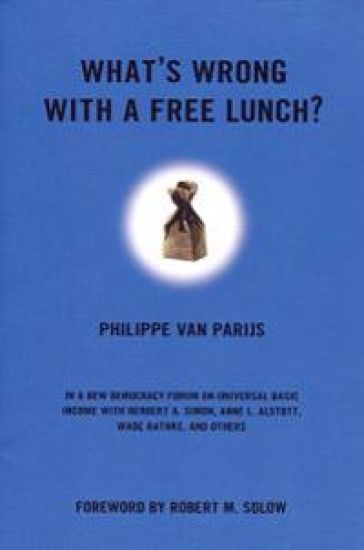
What's Wrong With a Free Lunch?

What's Wrong With a Free Lunch?

Philippe Van Parijs

BEACON PRESS
2001
pokkari
Our politicians insist that we live in a time of unprecedented prosperity, yet more and more Americans are pointing out that the richest 1% of our society holds more wealth than the bottom 90% put together. In this timely book, economist Philippe Van Parijs has a simple plan for addressing not only poverty but other social ills: everyone would be paid a universal basic income (UBI) at a level sufficient for subsistence. Everyone, including those who make no social contribution-who spend their mornings bickering with their partner, surf off Malibu in the afternoon, and smoke pot all night. Van Parijs argues that a UBI would reduce unemployment, improve women's lives, and prevent the environmental damage caused by overproduction and fast growth. At the heart of his proposal is the intention to secure real freedom for all, because it offers the greatest possible opportunity to those with the least opportunities. He acknowledges that an idle surfer might not deserve a UBI, but that the surfer's good luck would be no different than the good fortune enjoyed by those who benefit from the current distribution of resources. Responses to this controversial proposal vary: Some are in favor of a basic income, but only if it's tied to work. Others find the entire proposal unrealistic and unaffordable. Almost all agree, however, that it is time for us to talk about this issue. NEW DEMOCRACY FORUM: A series of short paperback originals exploring creative solutions to our most urgent national concerns. The series editors (for Boston Review), Joshua Cohen and Joel Rogers, aim to foster politically engaged, intellectually honest, and morally serious debate about fundamental issues-both on and off the agenda of conventional politics.
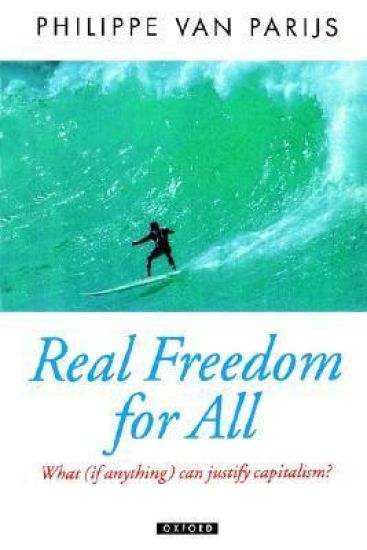
Real Freedom for All

Real Freedom for All

Philippe Van Parijs

Clarendon Press
1997
nidottu
Capitalist societies are full of unacceptable inequalities. Freedom is of paramount importance. These two convictions are widely shared across the world. Yet they often seem in complete contradiction with each other. Fighting inequality jeopardizes freedom; taking freedom seriously boosts inequality. What can be done? Can the circle be squared? Philippe Van Parijs offers a ground breaking solution to the dilemma. Assessing and rejecting the claims of both socialism and conventional capitalism, he presents a clear and compelling alternative vision of the just society: a capitalist society offering a substantial unconditional basic income to all its members. Moving beyond pure political theory, Van Parijs shows what his ideal of free society means in the real world by drawing out its controversial policy implications. Real Freedom for All will be essential reading for anyone concerned about the just society and the welfare state as we move into the twenty first century.
Marxism Recycled

Marxism Recycled

Philippe van Parijs

Cambridge University Press
1993
sidottu
It is Philippe van Parijs’ conviction that the Marxist tradition can be kept alive as an essential political component of the Left not through dutiful conservation, but through ruthless recycling: the discarding of encumbering elements, and the reshaping of the remainder using the latest intellectual ‘technology’. The essays collected in this book examine the structure and potential of historical materialism as a general theory of social change. They draw on the lessons of the failure of Marxist crisis theory, and show how a rejuvenated notion of exploitation can illuminate the analysis of the class structure of welfare state capitalism or the assessment of international migration. They explore and advocate a ‘capitalist road to communism’ that expands the realm of freedom while bypassing socialism, and they develop those aspects of the Marxist project consistent with ecological concerns.