Kirjojen hintavertailu – 12 859 828 kirjaa ja 27 kauppaa
Kirjailija
Phillip Brown
Kirjat ja teokset yhdessä paikassa: 38 kirjaa, julkaisuja vuosilta 1994–2024, suosituimpiin kuuluu Enjoyable Easy to Moderate Sudoku: Fun, Large Grid Sudoku Puzzles. Vertaile teosten hintoja ja tarkista saatavuus suomalaisista kirjakaupoista.
For decades, the idea that more education will lead to greater individual and national prosperity has been a cornerstone of developed economies. Indeed, it is almost universally believed that college diplomas give Americans and Europeans a competitive advantage in the global knowledge wars. Challenging this conventional wisdom, The Global Auction forces us to reconsider our deeply held and mistaken views about how the global economy really works and how to thrive in it. Drawing on cutting-edge research based on a major international study, the authors show that the competition for good, middle-class jobs is now a worldwide competition--an auction for cut-priced brainpower--fueled by an explosion of higher education across the world. They highlight a fundamental power shift in favor of corporate bosses and emerging economies such as China and India, a change that is driving the new global high-skill, low-wage workforce. Fighting for a dwindling supply of good jobs will compel the middle classes to devote more time, money, and effort to set themselves apart in a bare-knuckle competition that will leave many disappointed. The authors urge a new conversation about the kind of society we want to live in and about the kind of global economy that can benefit workers, but without condemning millions in emerging economies to a life of poverty. The Global Auction is a radical rethinking of the ideas that stand at the heart of the American Dream. It offers a timely exposé of the realities of the global struggle for middle class jobs, a competition that threatens the livelihoods of millions of American and European workers and their families. "A brilliant new book." - Andrew Reinbach, The Huffington Post "This is a very important book. Their critique of the present state of global capitalism is both timely and convincing." - Roger Brown, Times Higher Education "[A]truly outstanding volume."-Lois Weis, University of Buffalo, British Journal of Sociology of Education. "The Global Auction is a must-read for parents, college students, and policymakers. We press the message to our children: 'Study. Get degrees. Get a good job. And you will live the good life.' But such claims are strikingly at odds with the realities of income stagnation and poor job prospects. The authors explain how this dramatic breakdown between rhetoric and reality happened and how we might reconstruct an alternative future in which education becomes meaningful and fulfilling in its own right." -Henry M. Levin, Columbia University "This is a challenging and very timely book. The gauntlet is thrown down to economists wedded to human capital theory and to sociologists who see education as the great engine of social mobility." -John Goldthorpe, University of Oxford "The Global Auction deals with one of the most pressing issues of our times: how the significant expansion in the labor supply available to multinational corporations is leading to dramatic shifts in the location of employment around the world. It draws on years of in-depth research, offering valuable insights for both academics and business leaders."-David Finegold, Rutgers, The State University of New Jersey "Brown, Lauder, and Ashton's book is brilliantly argued and provides a wakeup call to global citizens everywhere. There is no substitute for the regulation of global capitalism in the interests of the many rather than the few, and this book slams the door on the last set of excuses for maintaining the current system-that somehow the educated will escape the race to the bottom."-Kevin Leicht, University of Iowa
For decades, the idea that more education will lead to greater individual and national prosperity has been a cornerstone of developed economies. Challenging this conventional wisdom, The Global Auction forces us to reconsider our deeply held and mistaken views about how the global economy really works and how to thrive in it. The authors show that the competition for good, middle class jobs is now a worldwide competition--an auction for cut-priced brainpower--fueled by an explosion of higher education across the world and a fundamental power shift in favor of corporate bosses and emerging economies such as China and India. These drivers of the new global high-skill, low-wage workforce threaten the livelihoods of millions of American workers and their families. Fighting for a dwindling supply of good jobs will compel Americans to devote more time, money and effort to set themselves apart in a bare-knuckle competition that will leave many disappointed. The Global Auction is a radical rethinking of the ideas that stand at the heart of the American Dream.
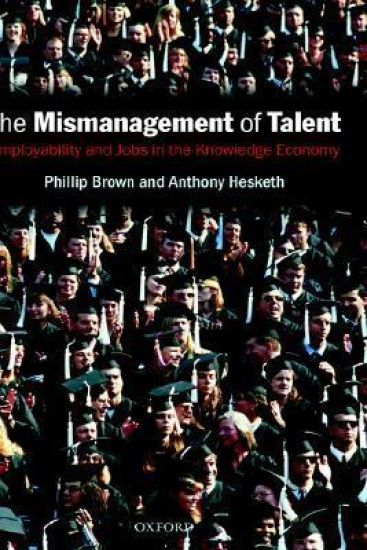
The knowledge economy conjures a world of smart people, in smart jobs, doing smart things, in smart ways, for smart money, a world increasingly open to all rather than a few. Glossy corporate brochures present a future in challenging, exciting and financially rewarding jobs for the winners in the competition for fast track management appointments. They also convey an image of enlightened employers actively seeking to diversify their talent pool, reflected in their approach to identifying, hiring and retaining outstanding talent. We are told that the challenge confronting governments around the world is to enhance the employability of the workforce. Every effort must be made to expand access to higher education, dismantle barriers to talent regardless of social circumstances, gender, or skin colour, and to harness human creativity and enterprise to meet the demands of the new economy. The Mismanagement of Talent comes to a different conclusion. Those leaving the world of mass higher education find themselves in a scramble for jobs with rising stakes for the winners and losers. The Mismanagement of Talent examines what determines the outcome of this race when a degree loses its badge of distinction. It shows how some graduates are playing 'the game' to win a competitive advantage and what really happens in the selection events of leading-edge employers. It also argues that talent is being mismanaged by employers that have yet to come to terms with the realities and possibilities of mass higher education. The Mismanagement of Talent will be thought-provoking and controversial reading for those involved in the recruitment of graduates, and those concerned with the way knowledge-based firms recruit and the impact of higher education policy: Professionals working in university careers services, HRM, training, or recruitment generally; Researchers, academics, or students of Business and Management, Human Resource Management, Public Policy, Education, or Sociology; and Job candidates themselves - the 'players' and 'purists' described in the book.
The knowledge economy conjures a world of smart people, in smart jobs, doing smart things, in smart ways, for smart money, a world increasingly open to all rather than a few. Glossy corporate brochures present a future in challenging, exciting and financially rewarding jobs for the winners in the competition for fast track management appointments. They also convey an image of enlightened employers actively seeking to diversify their talent pool, reflected in their approach to identifying, hiring and retaining outstanding talent. We are told that the challenge confronting governments around the world is to enhance the employability of the workforce. Every effort must be made to expand access to higher education, dismantle barriers to talent regardless of social circumstances, gender, or skin colour, and to harness human creativity and enterprise to meet the demands of the new economy. The Mismanagement of Talent comes to a different conclusion. Those leaving the world of mass higher education find themselves in a scramble for jobs with rising stakes for the winners and losers. The Mismanagement of Talent examines what determines the outcome of this race when a degree loses its badge of distinction. It shows how some graduates are playing 'the game' to win a competitive advantage and what really happens in the selection events of leading-edge employers. It also argues that talent is being mismanaged by employers that have yet to come to terms with the realities and possibilities of mass higher education. The Mismanagement of Talent will be thought-provoking and controversial reading for those involved in the recruitment of graduates, and those concerned with the way knowledge-based firms recruit and the impact of higher education policy: Professionals working in university careers services, HRM, training, or recruitment generally; Researchers, academics, or students of Business and Management, Human Resource Management, Public Policy, Education, or Sociology; and Job candidates themselves - the 'players' and 'purists' described in the book.
Economic globalization has led to intense debates about the competitiveness of nations. Prosperity, social justice, and welfare are now seen to depend on the creation of a 'high skilled' workforce. This international consensus around high skills has led recent American presidents to claim themselves 'education presidents' and in Britain, Tony Blair has announced that 'talent is 21st-century wealth'. This view of knowledge-driven capitalism has led all the developed economies to increase numbers of highly-trained people in preparation for technical, professional, and managerial employment. But it also harbours the view that what we regard as a 'skilled' worker is being transformed. The pace of technological innovation, corporate restructuring, and the changing nature of work require a new configuration of skills described in the language of creativity, teamwork, employability, self-management, and lifelong learning. But is this optimistic account of a future of high-skilled work for all justified? This book draws on the findings of a major international comparative study of national routes to a 'high skills' economy in Britain, Germany, Japan, Singapore, South Korea, and the United States, and includes data from interviews with over 250 key stakeholders. It is the first book to offer a comparative examination of 'high skill' policies -- a topic of major public debate that is destined to become of even greater importance in all the developed economies in the early decades of the twenty-first century.
A major contribution to current debates about the future of skill formation in a context of economic globalisation, rapid technological innovation, and change within education, training, and the labour market. It represents a major theoretical advance in its holistic approach to the political economy of high skills.
A new approach to the analysis of cultural reproduction focusing on the impact of economic change. The book demonstrates the reinforcement of cultural stereotypes in recruitment caused by interaction between corporate restructuring and the education system.; This book is intended for academics, postgraduates and advanced undergraduates in sociology with an interest in the sociology of work and the sociology of education as well as researchers and students within human resource management and cultural studies.
A new approach to the analysis of cultural reproduction focusing on the impact of economic change. The book demonstrates the reinforcement of cultural stereotypes in recruitment caused by interaction between corporate restructuring and the education system.; This book is intended for academics, postgraduates and advanced undergraduates in sociology with an interest in the sociology of work and the sociology of education as well as researchers and students within human resource management and cultural studies.