Kirjojen hintavertailu – 12 859 818 kirjaa ja 27 kauppaa
Kirjailija
Piero Formica
Kirjat ja teokset yhdessä paikassa: 8 kirjaa, julkaisuja vuosilta 2008–2023, suosituimpiin kuuluu Knowledge Matters. Vertaile teosten hintoja ja tarkista saatavuus suomalaisista kirjakaupoista.
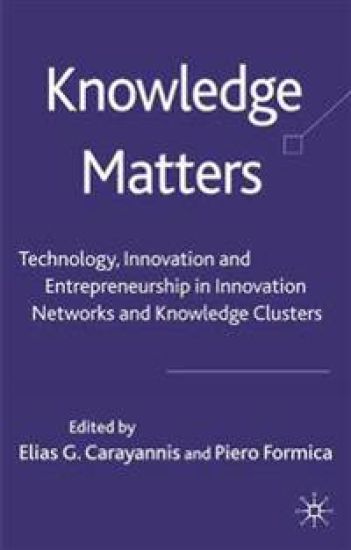
A profile in socio-technical terms of ways that innovation is manifested in American, European, and Asian knowledge-based innovation networks and knowledge clusters. Twelve conceptual and empirical studies are presented that contribute to a better understanding of the role of knowledge in technological entrepreneurship.
A profile in socio-technical terms of ways that innovation is manifested in American, European, and Asian knowledge-based innovation networks and knowledge clusters. Twelve conceptual and empirical studies are presented that contribute to a better understanding of the role of knowledge in technological entrepreneurship.
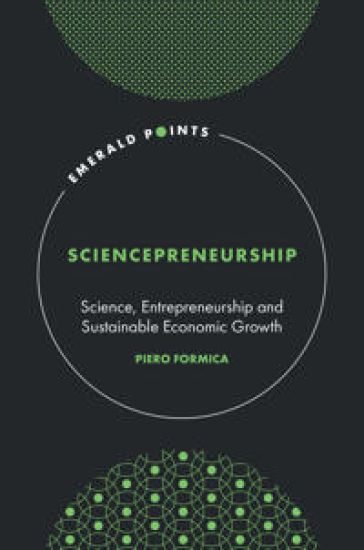
In Sciencepreneurship, author Piero Formica explores the symbiotic relationship between science, entrepreneurship, and sustainable economic growth. He argues that like artists, writers and educators, scientists and entrepreneurs foster social progress and provide opportunities to advance sustainable and environmentally friendly economic development. Innovative and future thinking entrepreneurs play a special role in the advancement of science and technology. They help guide scientific discoveries into our daily lives and reveal new opportunities for social innovation as they exploit the discoveries that scientists make of the natural world. Sciencepreneurship argues that forward-thinking scientific entrepreneurs are well placed to take advantage of recent breakthroughs ranging from genetic sequencing to smartphone applications—innovations that have entered our lives at breakneck speed. Taking a transdisciplinary approach, which is one that integrates the natural, social and health sciences in a humanities context, Formica teaches readers, from academic researchers to engaged entrepreneurs, how to valorise science and entrepreneurship by designing a context of close, long-term interaction between the two.
In an age where knowledge is so easily disseminated, the modern-day workplace, and roles as we know them, are beginning to transform. As ideation establishes itself as a concept, if put into action, it could help to create and form a more transformative entrepreneurial future generation. It will be the actions of many ideators that will motivate and contribute to the post-pandemic economy, and this becomes even more tangible as fewer people occupy predetermined and fixed positions in companies. By moving from the economy of mass production to knowledge-driven entrepreneurship, value creation is embedded in the lifeblood of ideas in action (the 'ideation'), combined, shared with investors, disseminated territorially, and adapted to the conditions of individual communities. Ideators: Their Words and Voices presents the concept of ideation and its applications in a thorough yet accessible format, focusing on the process of idea creation, and also presents a series of protagonists of creativity and innovation who will reflect on their own career changes.
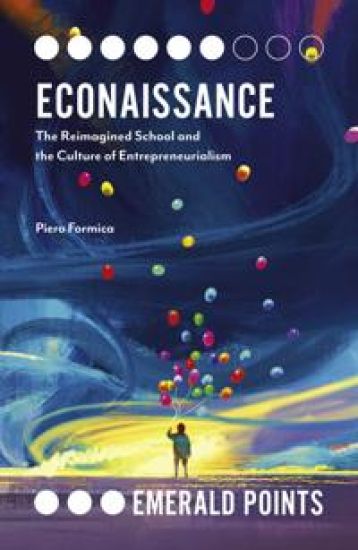
The intertwining of Economics, Knowledge and Renaissance, introduced by Piero Formica in this book as ‘Econaissance’, fosters the culture of entrepreneurialism, and imagines the reawakening of learning and culture. Acknowledging that schools of thought inherited from the past must be reimagined to give birth to this new age, this book maps out how stakeholders across society can become agents of this unique pathway to economic development. Formica offers readers an innovative perspective, asking not just how me might do better what we already do, but also how we can engage in activities beyond the economic sphere, and help to usher in the dawn of a new renaissance age that acts on the principles of human knowledge as well as the economy. In doing so, Econaissance highlights the figure of the ‘Ideator’, the polymath of the twenty-first century, set to become the ultimate athlete of social progress fuelled by sustainable and environmentally friendly economic development. This book will equip educators, scientists, innovators, entrepreneurs, and more to play a part in this imagined future.
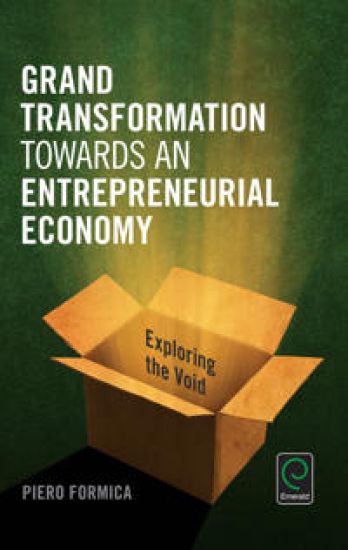
We are now entering a new entrepreneurial economy, as we have shifted away from an industrial economy. This sharing economy has created a new paradigm of aggregation of individuals. It is around these communities organized into categories (workers, employees, executives, entrepreneurs, professionals) that the legislation takes shape. If public policy intends to give voice to the sharing communities, then it needs to enact pro-entrepreneurship policies, and move away from policies that cater to the old industrial economy. This can be done by facilitating experiments and studies of entrepreneurial ventures and start-ups. There is no work at the crossroads of economics and entrepreneurship such as this. Formica explains why public policy now needs to shift towards the entrepreneurial economy, and how this can be done. Employing illustrative examples, this book focuses on the crucial role of policies to support entrepreneurs and establish the right environment for new business development and rapid conversion of ideas into enterprises that contribute to booming economic growth and prosperity.
The Springer book series Innovation, Technology, and Knowledge Management was launched in March 2008 as a forum and intellectual, scholarly “podium” for global/local, transdisciplinary, transsectoral, public–private, and leading/“bleeding” -edge ideas, theories, and perspectives on these topics. The book series is accompanied by the Springer Journal of the Knowledge Economy, which was launched in 2009 with the same editorial leadership. The series showcases provocative views that diverge from the current “conv- tional wisdom,” that are properly grounded in theory and practice, and that consider 1 2 the concepts of robust competitiveness, sustainable entrepreneurship, and demo- 3 cratic capitalism, central to its philosophy and objectives. More specifically, the aim of this series is to highlight emerging research and practice at the dynamic intersection of these fields, where individuals, organizations, industries, regions, and nations are harnessing creativity and invention to achieve and sustain growth. Books that are part of the series explore the impact of innovation at the “macro” (economies, markets), “meso” (industries, firms), and “micro” levels. (teams, indi viduals), drawing from such related disciplines as finance, organizational psychology, research and development, science policy, information systems, and 1 We define sustainable entrepreneurship as the creation of viable, profitable, and scalable firms. Such firms engender the formation of self-replicating and mutually enhancing innovation networks and knowledge clusters (innovation ecosystems), leading toward robust competitiveness (E. G. Carayannis, International Journal of Innovation and Regional Development, 1(3), 235–254, 2009).
The Springer book series Innovation, Technology, and Knowledge Management was launched in March 2008 as a forum and intellectual, scholarly “podium” for global/local, transdisciplinary, transsectoral, public–private, and leading/“bleeding” -edge ideas, theories, and perspectives on these topics. The book series is accompanied by the Springer Journal of the Knowledge Economy, which was launched in 2009 with the same editorial leadership. The series showcases provocative views that diverge from the current “conv- tional wisdom,” that are properly grounded in theory and practice, and that consider 1 2 the concepts of robust competitiveness, sustainable entrepreneurship, and demo- 3 cratic capitalism, central to its philosophy and objectives. More specifically, the aim of this series is to highlight emerging research and practice at the dynamic intersection of these fields, where individuals, organizations, industries, regions, and nations are harnessing creativity and invention to achieve and sustain growth. Books that are part of the series explore the impact of innovation at the “macro” (economies, markets), “meso” (industries, firms), and “micro” levels. (teams, indi viduals), drawing from such related disciplines as finance, organizational psychology, research and development, science policy, information systems, and 1 We define sustainable entrepreneurship as the creation of viable, profitable, and scalable firms. Such firms engender the formation of self-replicating and mutually enhancing innovation networks and knowledge clusters (innovation ecosystems), leading toward robust competitiveness (E. G. Carayannis, International Journal of Innovation and Regional Development, 1(3), 235–254, 2009).