Kirjojen hintavertailu – 12 903 724 kirjaa ja 27 kauppaa

Kirjailija

Pierre del Moral

Kirjat ja teokset yhdessä paikassa: 8 kirjaa, julkaisuja vuosilta 2004–2018, suosituimpiin kuuluu Modèles et méthodes stochastiques. Vertaile teosten hintoja ja tarkista saatavuus suomalaisista kirjakaupoista.

8 kirjaa

Kirjojen julkaisuvuodet: 2004–2018.

An Introduction to Wishart Matrix Moments

An Introduction to Wishart Matrix Moments

Adrian N. Bishop; Pierre Del Moral; Angèle Niclas

now publishers Inc
2018
nidottu
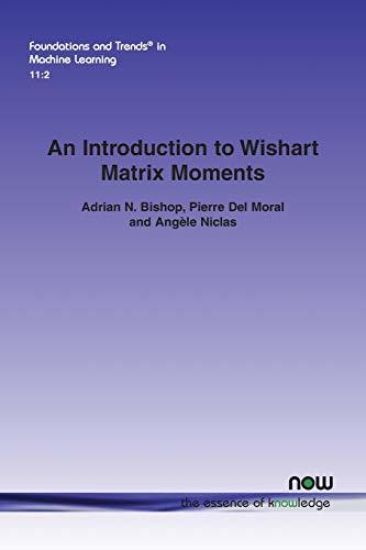
Random matrix theory plays a central role in statistical physics, computational mathematics and engineering sciences, including data assimilation, signal processing, combinatorial optimization, compressed sensing, econometrics and mathematical finance, among numerous others. The mathematical foundations of the theory of random matrices are technical, and mathematically difficult to penetrate for non-experts, regular users and practitioners. This book reviews and extends some important results in random matrix theory in the specific context of real random Wishart matrices. To overcome the complexity of the subject matter, the authors use a lecture note style to make the material accessible to a wide audience. This results in a comprehensive and self-contained introduction to the analysis of Wishart matrix moments. This study may act as an introduction to some particular aspects of random matrix theory, or as a self-contained exposition of Wishart matrix moments. All researchers and students requiring an accessible introduction to the topic will find this book essential reading.
Stochastic Processes

Stochastic Processes

Pierre Del Moral; Spiridon Penev

Productivity Press
2016
sidottu
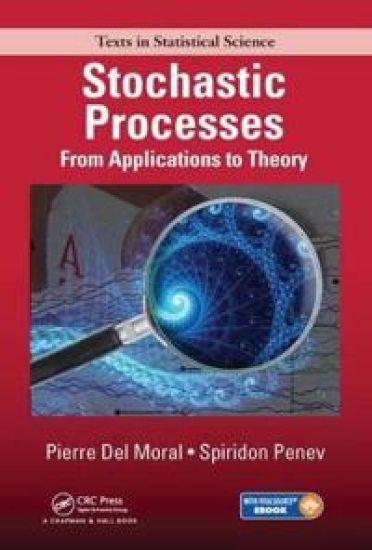
Unlike traditional books presenting stochastic processes in an academic way, this book includes concrete applications that students will find interesting such as gambling, finance, physics, signal processing, statistics, fractals, and biology. Written with an important illustrated guide in the beginning, it contains many illustrations, photos and pictures, along with several website links. Computational tools such as simulation and Monte Carlo methods are included as well as complete toolboxes for both traditional and new computational techniques.
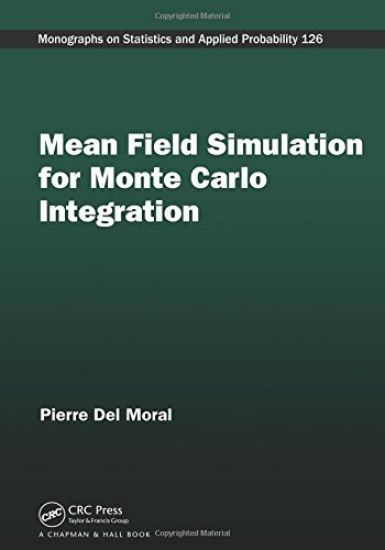
Mean Field Simulation for Monte Carlo Integration
In the last three decades, there has been a dramatic increase in the use of interacting particle methods as a powerful tool in real-world applications of Monte Carlo simulation in computational physics, population biology, computer sciences, and statistical machine learning. Ideally suited to parallel and distributed computation, these advanced particle algorithms include nonlinear interacting jump diffusions; quantum, diffusion, and resampled Monte Carlo methods; Feynman-Kac particle models; genetic and evolutionary algorithms; sequential Monte Carlo methods; adaptive and interacting Markov chain Monte Carlo models; bootstrapping methods; ensemble Kalman filters; and interacting particle filters. Mean Field Simulation for Monte Carlo Integration presents the first comprehensive and modern mathematical treatment of mean field particle simulation models and interdisciplinary research topics, including interacting jumps and McKean-Vlasov processes, sequential Monte Carlo methodologies, genetic particle algorithms, genealogical tree-based algorithms, and quantum and diffusion Monte Carlo methods. Along with covering refined convergence analysis on nonlinear Markov chain models, the author discusses applications related to parameter estimation in hidden Markov chain models, stochastic optimization, nonlinear filtering and multiple target tracking, stochastic optimization, calibration and uncertainty propagations in numerical codes, rare event simulation, financial mathematics, and free energy and quasi-invariant measures arising in computational physics and population biology. This book shows how mean field particle simulation has revolutionized the field of Monte Carlo integration and stochastic algorithms. It will help theoretical probability researchers, applied statisticians, biologists, statistical physicists, and computer scientists work better across their own disciplinary boundaries.
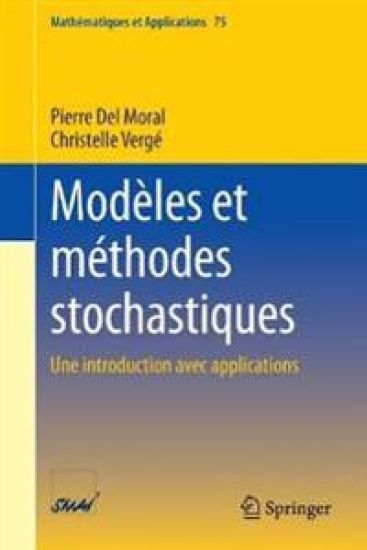
Modèles et méthodes stochastiques

Modèles et méthodes stochastiques

Pierre del Moral; Christelle Vergé

Springer-Verlag Berlin and Heidelberg GmbH Co. K
2014
nidottu
La théorie des probabilités et des processus stochastiques est sans aucun doute l'un des plus importants outils mathématiques des sciences modernes. Le théorie des probabilité s'illustre dans de nombreux domaines issus de la biologie, de la physique, et des sciences de l'ingénieur : dynamique des populations, traitement du signal et de l'image, chimie moléculaire, économétrie, sciences actuarielles, mathématiques financières, ainsi qu'en analyse de risque. Le but de cet ouvrage est de parcourir les principaux modèles et méthodes stochastiques de cette théorie en pleine expansion. Ce voyage ne nécessite aucun bagage spécifique sur la théorie des processus stochastiques. Les outils d'analyses nécessaires à une bonne compréhension sont donnés au fur et à mesure de leur construction, révélant ainsi leur nécessité. La théorie des processus stochastiques est une extension naturelle de la théorie de systèmes dynamiques à des phénomènes aléatoires. Elle contient des formalisation d'évolutions de phénomènes aléatoires rencontrés en physique, en biologique, en économie, ou en sciences de l'ingénieur, mais aussi des algorithmes d'exploration stochastique d'espaces de solutions complexes pour résoudre des problèmes d'estimation, d'optimisation et d'apprentissage statistique. Des techniques de résolution avancées en statistique bayésienne, en traitement du signal, en analyse d’événements rares, en combinatoire énumérative, en optimisation combinatoire, ainsi qu'en physique et chimie quantique sont exposées dans cet ouvrage. Probability theory and stochastic process theory are undoubtedly among the most important mathematic tools for the modern sciences. Probability theory has applications in several fields, such as biology, physics and the engineering sciences: population dynamics, signal and image processing, molecular chemistry,econometrics, actuarial science, financial mathematics, and risk analysis. This book provides an overview of stochastic models and methods for this very active field. Stochastic process theory is a natural extension of dynamic systems to random events. The book covers the modeling of random events in physics, biology, economics and the engineering sciences, while also introducing advanced problem-solving techniques in Bayesian statistics, signal processing and rare event analysis. No scientific background in stochastic process theory is needed.
Mean Field Simulation for Monte Carlo Integration
In the last three decades, there has been a dramatic increase in the use of interacting particle methods as a powerful tool in real-world applications of Monte Carlo simulation in computational physics, population biology, computer sciences, and statistical machine learning. Ideally suited to parallel and distributed computation, these advanced particle algorithms include nonlinear interacting jump diffusions; quantum, diffusion, and resampled Monte Carlo methods; Feynman-Kac particle models; genetic and evolutionary algorithms; sequential Monte Carlo methods; adaptive and interacting Markov chain Monte Carlo models; bootstrapping methods; ensemble Kalman filters; and interacting particle filters. Mean Field Simulation for Monte Carlo Integration presents the first comprehensive and modern mathematical treatment of mean field particle simulation models and interdisciplinary research topics, including interacting jumps and McKean-Vlasov processes, sequential Monte Carlo methodologies, genetic particle algorithms, genealogical tree-based algorithms, and quantum and diffusion Monte Carlo methods. Along with covering refined convergence analysis on nonlinear Markov chain models, the author discusses applications related to parameter estimation in hidden Markov chain models, stochastic optimization, nonlinear filtering and multiple target tracking, stochastic optimization, calibration and uncertainty propagations in numerical codes, rare event simulation, financial mathematics, and free energy and quasi-invariant measures arising in computational physics and population biology. This book shows how mean field particle simulation has revolutionized the field of Monte Carlo integration and stochastic algorithms. It will help theoretical probability researchers, applied statisticians, biologists, statistical physicists, and computer scientists work better across their own disciplinary boundaries.
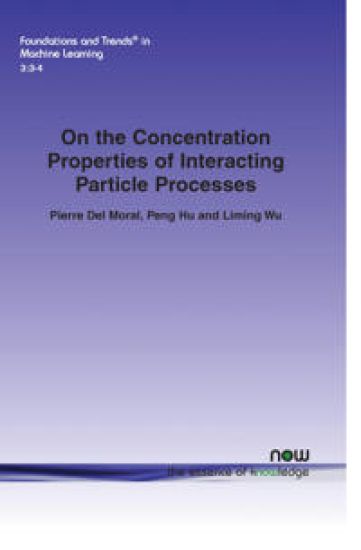
On the Concentration Properties of Interacting Particle Processes

On the Concentration Properties of Interacting Particle Processes

Pierre Del Moral; Peng Hu; Liming Wu

now publishers Inc
2012
nidottu
This book presents some new concentration inequalities for Feynman-Kac particle processes. It analyzes different types of stochastic particle models, including particle profile occupation measures, genealogical tree based evolution models, particle free energies, as well as backward Markov chain particle models. It illustrates these results with a series of topics related to computational physics and biology, stochastic optimization, signal processing and Bayesian statistics, and many other probabilistic machine learning algorithms. Special emphasis is given to the stochastic modeling, and to the quantitative performance analysis of a series of advanced Monte Carlo methods; including particle filters, genetic type island models, Markov bridge models, and interacting particle Markov chain Monte Carlo methodologies.
Feynman-Kac Formulae

Feynman-Kac Formulae

Pierre Del Moral

Springer-Verlag New York Inc.
2011
nidottu
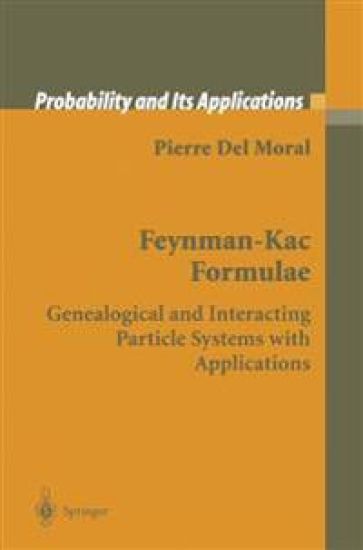
The central theme of this book concerns Feynman-Kac path distributions, interacting particle systems, and genealogical tree based models. This re­ cent theory has been stimulated from different directions including biology, physics, probability, and statistics, as well as from many branches in engi­ neering science, such as signal processing, telecommunications, and network analysis. Over the last decade, this subject has matured in ways that make it more complete and beautiful to learn and to use. The objective of this book is to provide a detailed and self-contained discussion on these connec­ tions and the different aspects of this subject. Although particle methods and Feynman-Kac models owe their origins to physics and statistical me­ chanics, particularly to the kinetic theory of fluid and gases, this book can be read without any specific knowledge in these fields. I have tried to make this book accessible for senior undergraduate students having some familiarity with the theory of stochastic processes to advanced postgradu­ ate students as well as researchers and engineers in mathematics, statistics, physics, biology and engineering. I have also tried to give an "expose" of the modem mathematical theory that is useful for the analysis of the asymptotic behavior of Feynman-Kac and particle models.
Feynman-Kac Formulae

Feynman-Kac Formulae

Pierre Del Moral

Springer-Verlag New York Inc.
2004
sidottu
The central theme of this book concerns Feynman-Kac path distributions, interacting particle systems, and genealogical tree based models. This re­ cent theory has been stimulated from different directions including biology, physics, probability, and statistics, as well as from many branches in engi­ neering science, such as signal processing, telecommunications, and network analysis. Over the last decade, this subject has matured in ways that make it more complete and beautiful to learn and to use. The objective of this book is to provide a detailed and self-contained discussion on these connec­ tions and the different aspects of this subject. Although particle methods and Feynman-Kac models owe their origins to physics and statistical me­ chanics, particularly to the kinetic theory of fluid and gases, this book can be read without any specific knowledge in these fields. I have tried to make this book accessible for senior undergraduate students having some familiarity with the theory of stochastic processes to advanced postgradu­ ate students as well as researchers and engineers in mathematics, statistics, physics, biology and engineering. I have also tried to give an "expose" of the modem mathematical theory that is useful for the analysis of the asymptotic behavior of Feynman-Kac and particle models.