
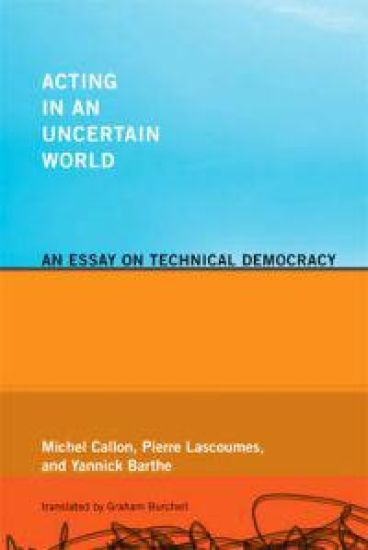
Acting in an Uncertain World
Michel Callon; Pierre Lascoumes; Yannick Barthe
MIT Press
2011
pokkari
Halvin toimitettuna 53,60 €
A call for a new form of democracy in which "hybrid forums" composed of experts and laypeople address such sociotechnical controversies as hazardous waste, genetically modified organisms, and nanotechnology. Controversies over such issues as nuclear waste, genetically modified organisms, asbestos, tobacco, gene therapy, avian flu, and cell phone towers arise almost daily as rapid scientific and technological advances create uncertainty and bring about unforeseen concerns. The authors of Acting in an Uncertain World argue that political institutions must be expanded and improved to manage these controversies, to transform them into productive conversations, and to bring about "technical democracy." They show how "hybrid forums"-in which experts, non-experts, ordinary citizens, and politicians come together-reveal the limits of traditional delegative democracies, in which decisions are made by quasi-professional politicians and techno-scientific information is the domain of specialists in laboratories. The division between professionals and laypeople, the authors claim, is simply outmoded. The authors argue that laboratory research should be complemented by everyday experimentation pursued in the real world, and they describe various modes of cooperation between the two. They explore a range of concrete examples of hybrid forums that have dealt with sociotechnical controversies including nuclear waste disposal in France, industrial waste and birth defects in Japan, a childhood leukemia cluster in Woburn, Massachusetts, and mad cow disease in the United Kingdom. The authors discuss the implications for political decision making in general and describe a "dialogic" democracy that enriches traditional representative democracy. To invent new procedures for consultation and representation, they suggest, is to contribute to an endless process that is necessary for the ongoing democratization of democracy.