Kirjojen hintavertailu – 12 903 725 kirjaa ja 27 kauppaa

Kirjailija

Pietro Terna

Kirjat ja teokset yhdessä paikassa: 4 kirjaa, julkaisuja vuosilta 2019–2025, suosituimpiin kuuluu Rethinking Macroeconomics with Endogenous Market Structure. Vertaile teosten hintoja ja tarkista saatavuus suomalaisista kirjakaupoista.

4 kirjaa

Kirjojen julkaisuvuodet: 2019–2025.

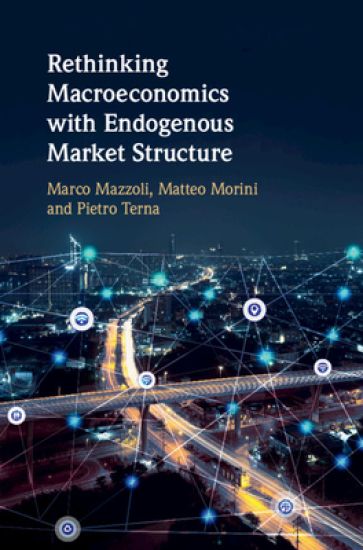
Rethinking Macroeconomics with Endogenous Market Structure

Rethinking Macroeconomics with Endogenous Market Structure

Marco Mazzoli; Matteo Morini; Pietro Terna

Cambridge University Press
2025
pokkari
The birth and death of firms is one of the main features of the business cycle. Yet mainstream DGSE macroeconomic models mostly ignore this phenomenon, thereby excluding any potential impact of economic policy on the probability of the birth and death of firms. Those DGSE models that do allow for this phenomenon do so at the cost of drastic simplifications, which effectively rule out causal links between the strategic interaction of industrial firms and the macroeconomy. This innovative new book develops a bottom-up, agent-based framework that shows how strategic interactions at the level of oligopolistic firms, and even at the level of individuals, affect entire industrial sectors and the equilibrium of the macroeconomy. It will appeal to academic researchers and graduate students working in computational economics, agent-based modelling and econophysics, as well as mainstream economists interested in learning more about alternatives to DGSE models in macroeconomics.

Active Particles Methods in Economics

Active Particles Methods in Economics

Nicola Bellomo; Diletta Burini; Valeria Secchini; Pietro Terna

Cambridge University Press
2025
pokkari
The aim of this Element is to understand how far mathematical theories based on active particle methods have been applied to describe the dynamics of complex systems in economics, and to look forward to further research perspectives in the interaction between mathematics and economics. The mathematical theory of active particles and the theory of behavioural swarms are selected for the above interaction. The mathematical approach considered in this work takes into account the complexity of living systems, which is a key feature of behavioural economics. The modelling and simulation of the dynamics of prices within a heterogeneous population is reviewed to show how mathematical tools can be used in real applications.
Active Particles Methods in Economics

Active Particles Methods in Economics

Nicola Bellomo; Diletta Burini; Valeria Secchini; Pietro Terna

Cambridge University Press
2025
sidottu
The aim of this Element is to understand how far mathematical theories based on active particle methods have been applied to describe the dynamics of complex systems in economics, and to look forward to further research perspectives in the interaction between mathematics and economics. The mathematical theory of active particles and the theory of behavioural swarms are selected for the above interaction. The mathematical approach considered in this work takes into account the complexity of living systems, which is a key feature of behavioural economics. The modelling and simulation of the dynamics of prices within a heterogeneous population is reviewed to show how mathematical tools can be used in real applications.
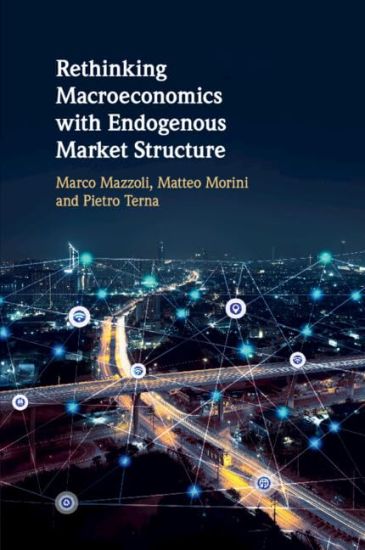
Rethinking Macroeconomics with Endogenous Market Structure

Rethinking Macroeconomics with Endogenous Market Structure

Marco Mazzoli; Matteo Morini; Pietro Terna

Cambridge University Press
2019
sidottu
The birth and death of firms is one of the main features of the business cycle. Yet mainstream DGSE macroeconomic models mostly ignore this phenomenon, thereby excluding any potential impact of economic policy on the probability of the birth and death of firms. Those DGSE models that do allow for this phenomenon do so at the cost of drastic simplifications, which effectively rule out causal links between the strategic interaction of industrial firms and the macroeconomy. This innovative new book develops a bottom-up, agent-based framework that shows how strategic interactions at the level of oligopolistic firms, and even at the level of individuals, affect entire industrial sectors and the equilibrium of the macroeconomy. It will appeal to academic researchers and graduate students working in computational economics, agent-based modelling and econophysics, as well as mainstream economists interested in learning more about alternatives to DGSE models in macroeconomics.