
Kirjailija
Plato Plato
Kirjat ja teokset yhdessä paikassa: 11 kirjaa, julkaisuja vuosilta 2000–2025, suosituimpiin kuuluu Timaeus and Critias. Vertaile teosten hintoja ja tarkista saatavuus suomalaisista kirjakaupoista.
11 kirjaa
Kirjojen julkaisuvuodet: 2000–2025.

In Plato's "Parmenides," the dialogue explores profound philosophical questions, primarily focusing on the nature of being and non-being. The character Parmenides presents a series of challenging arguments to Socrates, questioning the feasibility and coherence of the "Theory of Forms". Parmenides argues that if something exists, it must be completely unified and unchanging. He suggests that a true being is a singular, undivided entity that cannot be differentiated, or subdivided. The dialogue contrasts the ideas of the Sophists, who often questioned the nature of truth and knowledge, with the more rigorous philosophical inquiry presented by Parmenides. Parmenides demonstrates the complexities and potential inconsistencies within the "Theory of Forms" prompting deeper reflection on the nature of reality and knowledge. The poem addresses human beliefs and perceptions, which Parmenides sees as unreliable. These perceptions suggest a reality of change and diversity, which he believes are illusions and do not reflect the true nature of Being. Sensory experiences are seen as deceptive, as they suggest a world of change and plurality, which contradicts the true nature of Being., Parmenides argues that reality is a single, unchanging entity, and any perception of change or diversity is illusory.
What is virtue? Can it be learned or is it innate? Is it possible to know things a priori (before experience)? In this important and influential Socratic dialogue, Plato addresses a wealth of philosophy's fundamental questions, including the difference between actually knowing something and merely maintaining a correct belief about it. The dialogue begins when Meno, a young aristocrat from Thessaly, confidently declares that he can define virtue—only to be reduced in short order to utter confusion, a fate common to those engaging in debate with Socrates. Meno's contention that a concept cannot be defined without knowledge of its nature leads to one of the most celebrated passages in the history of philosophy: Socrates asserts the doctrine of reincarnation, and by posing a mathematical puzzle to Meno's slave, demonstrates the existence of innate knowledge. This brief but profound dialogue, which forms the basis for subsequent examinations of a priori knowledge, appears here in the translation by the distinguished scholar Benjamin Jowett.
What is knowledge? A systematic treatment of this question takes the form of a dialogue between the great philosopher Socrates and his student, Theaetetus. They explore a variety of answers, including knowledge as perception; knowledge as true belief; knowledge as true belief plus an account (i.e., a justified true belief); as well as variations on each of these possibilities. Like most Socratic dialogues, it ends without a definitive answer, leaving the subject open for the reader's further consideration. One of Plato's later masterpieces, the Theaetetus poses eternal questions that keep the dialogue relevant not only for students of philosophy but also for every serious reader and thinker. This edition, translated by the noted classical scholar Francis M. Cornford, features extensive commentaries by the interpreter that provide helpful background information and valuable insights.
These two dialogues by the greatest of the ancient Greek philosophers explore a vital concern of a democratic society: how to define the special abilities and qualities that make a genuine statesman. They further examine the distinction between an authentic statesman and the sophist, an individual who pretends to be a statesman but lacks the essential knowledge, personal qualities, and philosophical outlook. Written after Parmenides -- in which the philosopher condemned his own theory of separate, immaterial forms -- Sophist and Statesman are of special interest in terms of their reflection of Plato's conceptions of method and metaphysics. In addition, Statesman provides a transitional view of the author's political philosophy in the period between the Republic and the Laws. Together, the dialogues illuminate Plato's growing preoccupation with practical knowledge, offering a more informal and pragmatic approach than his earlier works. This edition features the acclaimed translations by Benjamin Jowett.
Plato's brilliant dialogues, written in the fourth century B. C., rank among Western civilization's most important philosophical works. Presented as a series of probing conversations between Socrates and his students and fellow citizens, they form a magnificent dialectical quest that examines enduring political, ethical, metaphysical, and epistemological issues. Here, in one inexpensive edition, are six of Plato's remarkable and revelatory dialogues, each translated by distinguished classical scholar Benjamin Jowett. Apology defends the integrity of Socrates' teachings. Crito discusses respect for the law. Phaedo considers death and the immortality of the soul. Phaedrus explores the psychology of love. Symposium reflects on the ultimate manifestation of the love that controls the world, and The Republic ponders society and the philosopher's role within it. Stimulating, dramatic, and always relevant, these dialogues have profoundly influenced the history of intellectual thought, and offer crucial insight into mystical, aesthetic, and other aspects of Platonic doctrine.
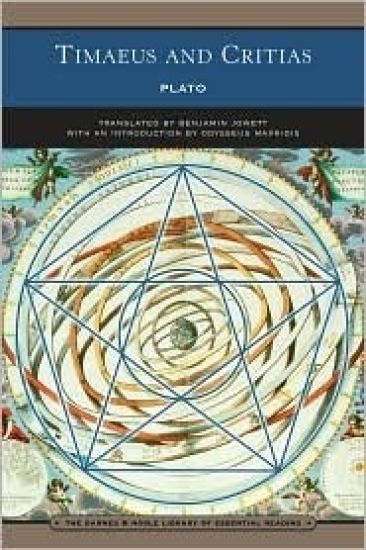
Plato’sambitious dialogue Timaeus and the unfinished Critias were meant to be part of a trilogy that would outline a proper and sufficiently detailed natural philosophy and cosmology. The Timaeus is Plato’s spirited response to the cosmogony and physics of the “atheist” Atomist philosophers Leucippus and Democritus. The Critias presents what might be a famous Platonic fiction: the story of Atlantis, recounted as a moral metaphor for the cycles of human history. In Plato’s philosophy, history and nature are both governed by the order that Reason imposes on an initially chaotic and recalcitrant material universe. Both natural philosophy and philosophic history are, in this view, imbued with rational meaning; the serious reader is expected to gain a proper understanding of moral values in addition to grasping the mechanisms of the material universe and human history. Conversely, according to Plato, the failure to study philosophy properly is dangerous for morality and would allow the ordered to return to chaos.
Plato`s Symposium – A Translation by Seth Benardete with Commentaries by Allan Bloom and Seth Benardete
Plato Plato; Seth Benardete
University of Chicago Press
2001
nidottu
Halvin toimitettuna 26,50 €
Plato, Allan Bloom wrote, is "the most erotic of philosophers," and his Symposium is one of the greatest works on the nature of love ever written. This new edition brings together the English translation of the renowned Plato scholar and translator, Seth Benardete, with two illuminating commentaries on it: Benardete's "On Plato's Symposium" and Allan Bloom's provocative essay, "The Ladder of Love." In the Symposium, Plato recounts a drinking party following an evening meal, where the guests include the poet Aristophanes, the drunken Alcibiades, and, of course, the wise Socrates. The revelers give their views on the timeless topics of love and desire, all the while addressing many of the major themes of Platonic philosophy: the relationship of philosophy and poetry, the good, and the beautiful.
Famous philosophical treatise of the 4th century BC concerns itself chiefly with the idea of justice, as well as such Platonic theories as that of ideas, the criticism of poetry, and the philosopher's role. Source of the famous cave myth and prototype for other imaginary commonwealths, including those of Cicero, St. Augustine, and More. Benjamin Jowett translation.
The Trial and Death of Socrates: Four Dialogues
David Wyllie; Plato Plato
Dover Publications Inc.
2000
nidottu
Among the most important and influential philosophical works in Western thought: Euthyphro, exploring the concepts and aims of piety and religion; Apology, a defense of the integrity of Socrates' teachings; Crito, exploring Socrates' refusal to flee his death sentence; and Phaedo, in which Socrates embraces death and discusses the immortality of the soul.