Kirjojen hintavertailu – 12 859 818 kirjaa ja 27 kauppaa

Kirjailija

Plutarch

Kirjat ja teokset yhdessä paikassa: 262 kirjaa, julkaisuja vuosilta 1914–2026, suosituimpiin kuuluu Alexander. Vertaile teosten hintoja ja tarkista saatavuus suomalaisista kirjakaupoista.

Nimi esiintyy myös muodoissa: Plutarch.

262 kirjaa

Kirjojen julkaisuvuodet: 1914–2026.

Plutarque, Oeuvres Morales: Tome XV, 1ere Partie: Traite 70-71: Sur Les Contradictions Stoiciennes - Synopsis Du Traite 'Que Les Stoiciens Tiennent De
La reflexion sur le stoicisme, occupe, chez Plutarque, une place beaucoup plus importante que ne le laissent supposer les ecrits d'orientation aristotelicienne que nous avons conserves: des huit ecrits expressement diriges contre les Stoiciens, seuls trois nous sont parvenus. A ceux-ci s'ajoutent les opuscules consacres, en tout ou en partie, a une refutation des doctrines stoiciennes, sans que leur titre l'indique explicitement, comme c'est le cas, par exemple, pour le traite Sur la vertu ethique. Dans les deux traites, Sur les contradictions stoiciennes et Synopsis du traite Que les stoiciens tiennent des propos plus paradoxaux que les poetes, Plutarque se prend au jeu de la critique litteraire et philosophique, en citant et en refutant point par point les theories du Portique. Le Sur les contradictions stoiciennes se propose de chercher, dans le texte de Chrysippe, les propositions contradictoires en les citant, et, par consequent, constitue pour nous une source majeure pour la connaissance des textes, aujourd'hui perdus, du philosophe. Le Synopsis du traite Que les stoiciens tiennent des propos plus paradoxaux que les poetes compare la figue du sage stoicien a celle des heros de la poesie, tel qu'Ulysse ou Heracles, en montrant que ce sage ideal n'a pas meme cette coherence dans l'invraisemblable que l'on peut trouver dans les fictions des poetes. Notre edition regroupe en un volume ces deux traites et fournit, dans une notice eclairante, tous les elements necessaires a la comprehension des dogmes auxquels Plutarque se refere. La question des sources est abordee, de meme que le probleme relatif a la place, dans l'oeuvre de Plutarque, de ces deux traites. L'histoire de la tradition manuscrite est relatee de maniere synthetique. Des notes accompagnent la lecture et sont assorties, en fin d'ouvrage, d'un abondant commentaire.
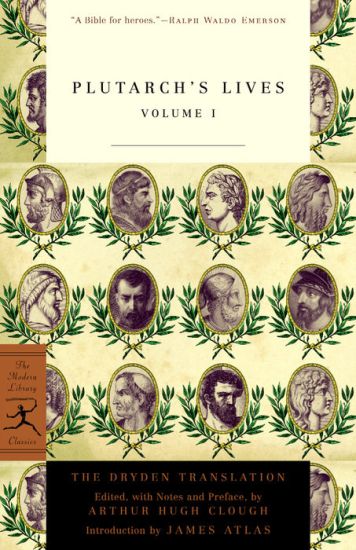
Plutarch's Lives, Volume 1

Plutarch's Lives, Volume 1

Plutarch

Modern Library Inc
2001
pokkari

Halvin toimitettuna 18,80 €

Plutarch's Lives, written at the beginning of the second century A. D., is a brilliant social history of the ancient world by one of the greatest biographers and moralists of all time. In what is by far his most famous and influential work, Plutarch reveals the character and personality of his subjects and how they led ultimately to tragedy or victory. Richly anecdotal and full of detail, Volume I contains profiles and comparisons of Romulus and Theseus, Numa and Lycurgus, Fabius and Pericles, and many more powerful figures of ancient Greece and Rome. The present translation, originally published in 1683 in conjunction with a life of Plutarch by John Dryden, was revised in 1864 by the poet and scholar Arthur Hugh Clough, whose notes and preface are also included in this edition.
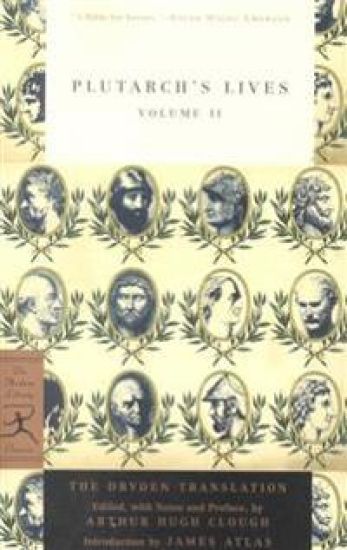
Plutarch's Lives, Volume 2

Plutarch's Lives, Volume 2

Plutarch

Modern Library Inc
2001
pokkari

Halvin toimitettuna 22,40 €

Plutarch's Lives, written at the beginning of the second century A. D., is a brilliant social history of the ancient world by one of the greatest biographers and moralists of all time. In what is by far his most famous and influential work, Plutarch reveals the character and personality of his subjects and how they led ultimately to tragedy or victory. Richly anecdotal and full of detail, Volume I contains profiles and comparisons of Romulus and Theseus, Numa and Lycurgus, Fabius and Pericles, and many more powerful figures of ancient Greece and Rome. The present translation, originally published in 1683 in conjunction with a life of Plutarch by John Dryden, was revised in 1864 by the poet and scholar Arthur Hugh Clough, whose notes and preface are also included in this edition.
Vitae Parallelae, Vol. I, Fas CB

Vitae Parallelae, Vol. I, Fas CB

Plutarch

The University of Michigan Press
2000
nidottu
The Bibliotheca Teubneriana, established in 1849, has evolved into the world's most venerable and extensive series of editions of Greek and Latin literature, ranging from classical to Neo-Latin texts. Some 4-5 new editions are published every year. A team of renowned scholars in the field of Classical Philology acts as advisory board: Gian Biagio Conte (Scuola Normale Superiore di Pisa)Marcus Deufert (Universitat Leipzig)James Diggle (University of Cambridge)Donald J. Mastronarde (University of California, Berkeley)Franco Montanari (Universita di Genova)Heinz-Gunther Nesselrath (Georg-August-Universitat Goettingen)Dirk Obbink (University of Oxford)Oliver Primavesi (Ludwig-Maximilians Universitat Munchen)Michael D. Reeve (University of Cambridge)Richard J. Tarrant (Harvard University) Formerly out-of-print editions are offered as print-on-demand reprints. Furthermore, all new books in the Bibliotheca Teubneriana series are published as eBooks. The older volumes of the series are being successively digitized and made available as eBooks. If you are interested in ordering an out-of-print edition, which hasn't been yet made available as print-on-demand reprint, please contact us: Tessa. [email protected] editions of Latin texts published in the Bibliotheca Teubneriana are collected in the online database BTL Online.
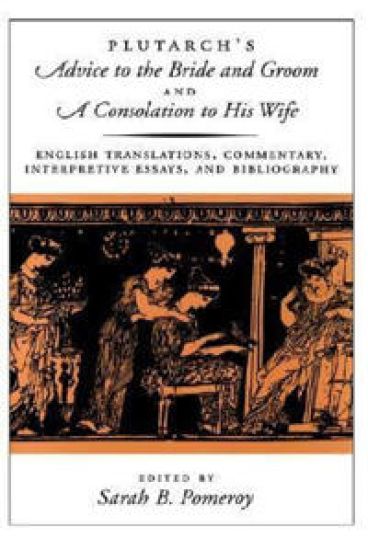
Plutarch's Advice to the Bride and Groom and A Consolation to His Wife
This book is a collection of essays with commentary and evaluative bibliography on Plutarch. Advice to the Bride and Groom and Consolation to His Wife along with the Greek texts and English translations. It is designed to help readers understand and appreciate two important documents for the study of gender and the family in the Graeco-Roman world and in later Western history. To populate the dearth of prior scholarly discussion of Plutarch's works on the family, Pomeroy has assembled a team of experts in Plutarch, the Hellenistic World, religion, cultural studies, and the family and gender, who use various historical and theoretical approaches in discussing the wide range of issues and questions raised by these texts. For example, what does one mean by "Roman" or "Greek" marriage in a Hellenistic context when Greeks and Romans were mutually influential? To begin to answer this question, it is imperative to take notice of Greek traditions, the Roman Imperial context, and the changing views of the family in Greek philosophy and early Christianity. Furthermore, for an understanding of the Consolation to His Wife it is necessary to understand Roman demography and to examine contemporary Latin consolatory literature. Though Plutarch addressed both these essays to individual Greeks whom he knew personally, he had a much wider audience in mind. The commentary, essays, and bibliography are written so as to be accessible to those who are reading the English translation.
A Commentary on Plutarch's Life of Agesilaos
Shipley presents the first modern commentary on Plutarch's Life of Agesilaos (c.444-360 BC) together with the full Greek text and a bibliography. Plutarch's biographies have long been valued for their literary, philosophic, and historiographic content, and the Life of Agesilaos, king of Sparta for forty years after the Peloponnesian war, has special interest as an introduction to Greek history, society, and culture in the fourth century, a critical period that has received little attention in comparison with the fifth century in Athens. Internal problems in Sparta followed the accession of Agesilaos: failures of hierarchical cohesion, unrest among social and subject groups, and division between aggressive and moderate foreign policies. Plato and Aristotle, Ephoros, Xenophon, Diodoros, and Nepos contributed variously to the knowledge and understanding of the period, and Plutarch created from their evidence -- and other sources -- an independent, penetrating, and balanced account of the character of those in power, and of Sparta, at their best and in decline.
Essay On the Life and Poetry Of Homer

Essay On the Life and Poetry Of Homer

Plutarch

Oxford University Press Inc
1996
nidottu
This bilingual edition, with introduction and brief commentary, makes accessible for the first time in English a text of great importance for the history and interpretation of Homer. Although attributed to Plutarch, the Essay is probably the work of a grammaticus of the second and third century and is the single most valuable source of evidence for the nature of the teaching of Homer in the schools of the Roman Empire. Well represented in the manuscript tradition, the Essay was used as prefatory material by Renaissance editors of Homer, beginning with the editio princeps (1488), and so exercised a powerful influence on Renaissance and early-modern readers, who often refer to "Plutarch" as an authority on Homer. The newly edited Greek text is presented with facing translation.
Lives of Galba and Otho

Lives of Galba and Otho

Plutarch

Bristol Classical Press
1994
pokkari
Plutarch's "Lives of Galba and Otho" constitute the earliest surviving history of the shocking events that shook the Roman Empire in AD 68 and 69 - the rebellions against Nero, his betrayal and suicide, and Galba's disastrous reign, which ended in his murder. No other source preserves such a coherent account of the extraordinary events of 68, and for 69 Plutarch's "Lives" are comparable with Tacitus' "Histories". As well as including a translation, this useful companion explains the background, and provides a commentary that makes serious use of the numismatic evidence.
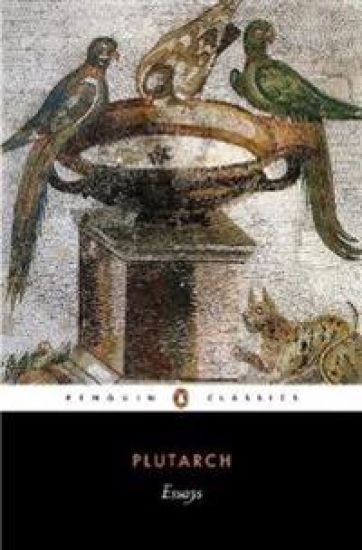
Essays

Essays

Plutarch

Penguin Classics
1992
pokkari

Halvin toimitettuna 23,70 €

One of the greatest essayists of the Graeco-Roman world, Plutarch (c. AD 46 -120) used an encyclopedic knowledge of the Roman Empire to produce a compelling and individual voice. In this superb selection from his writings, he offers personal insights into moral subjects that include the virtue of listening, the danger of flattery and the avoidance of anger, alongside more speculative essays on themes as diverse as God's slowness to punish man, the use of reason by supposedly 'irrational' animals and the death of his own daughter. Brilliantly informed, these essays offer a treasure-trove of ancient wisdom, myth and philosophy, and a powerful insight into a deeply intelligent man.
Plutarch: Life of Antony

Plutarch: Life of Antony

Plutarch

Cambridge University Press
1988
pokkari
Plutarch's Life of Antony is a work remarkable for its colourful narrative and vivid characterisation of Antony and Cleopatra. This book presents the Greek text of the Life, accompanied by an extensive introduction and a detailed commentary. Dr Pelling is concerned throughout to discuss the work as literature. The introduction sets the life in its historical and literary context and the commentary pays particular attention to discussing the value of Plutarch's narrative as a historical source for the period and to explaining points of linguistic difficulty. An especially interesting and friutful approach used by Dr Pelling is to compare the work with Shakespeare's Antony and Cleopatra (which was almost wholly based to Plutarch's Life), bringing out how much Shakespeare's conception of the character and destiny of his protagonists owes to Plutarch, and tracing its transposition into dramatic form. Intended primarily as a textbook for undergraduate students, this edition will nevertheless be of interest to all Greek scholars, to ancient historians, and also the students of English literature since the relevant discussions require no knowledge of Greek.
Plutarque, Oeuvres Morales: Tome III: Traites 15 Et 16: Apophtegmes de Rois Et de Generaux - Apophtegmes Laconiens
Le premier de ces ecrits se presente comme une suite de tres courts textes - quelques lignes en moyenne -, consacres a des heros regroupes par nations, en majorite grecs et romains, selon l'ordre chronologique. Introduit par une lettre dedicatoire adressee a Trajan, il veut etre une sorte le document psychologique et moral, un condense utilitaire offert a un empereur trop occupe pour pouvoir se livrer a d'amples lectures Le second, semblable a premiere vue, constitue en fait une compilation fort heteroclite. Il s'agit de notes brutes, prises par Plutarque en vue, notamment, de la composition des Vies, mais restees telles quelles dans sa bibliotheque, et qui ont probablement ete publiees apres sa mort avec l'ensemble du corpus.
Moralia, Volume XIII

Moralia, Volume XIII

Plutarch

Harvard University Press
1976
sidottu
Eclectic essays on ethics, education, and much else besides. Plutarch (Plutarchus), ca. AD 45–120, was born at Chaeronea in Boeotia in central Greece, studied philosophy at Athens, and, after coming to Rome as a teacher in philosophy, was given consular rank by the emperor Trajan and a procuratorship in Greece by Hadrian. He was married and the father of one daughter and four sons. He appears as a man of kindly character and independent thought, studious and learned. Plutarch wrote on many subjects. Most popular have always been the forty-six Parallel Lives, biographies planned to be ethical examples in pairs (in each pair, one Greek figure and one similar Roman), though the last four lives are single. All are invaluable sources of our knowledge of the lives and characters of Greek and Roman statesmen, soldiers and orators. Plutarch’s many other varied extant works, about sixty in number, are known as Moralia or Moral Essays. They are of high literary value, besides being of great use to people interested in philosophy, ethics, and religion. The Loeb Classical Library edition of the Moralia is in fifteen volumes, volume XIII having two parts. Volume XVI is a comprehensive Index.
Moralia, Volume XIII

Moralia, Volume XIII

Plutarch

Harvard University Press
1976
sidottu
Eclectic essays on ethics, education, and much else besides. Plutarch (Plutarchus), ca. AD 45–120, was born at Chaeronea in Boeotia in central Greece, studied philosophy at Athens, and, after coming to Rome as a teacher in philosophy, was given consular rank by the emperor Trajan and a procuratorship in Greece by Hadrian. He was married and the father of one daughter and four sons. He appears as a man of kindly character and independent thought, studious and learned. Plutarch wrote on many subjects. Most popular have always been the forty-six Parallel Lives, biographies planned to be ethical examples in pairs (in each pair, one Greek figure and one similar Roman), though the last four lives are single. All are invaluable sources of our knowledge of the lives and characters of Greek and Roman statesmen, soldiers and orators. Plutarch’s many other varied extant works, about sixty in number, are known as Moralia or Moral Essays. They are of high literary value, besides being of great use to people interested in philosophy, ethics, and religion. The Loeb Classical Library edition of the Moralia is in fifteen volumes, volume XIII having two parts. Volume XVI is a comprehensive Index.
Moralia, Volume XV

Moralia, Volume XV

Plutarch

Harvard University Press
1969
sidottu
Eclectic essays on ethics, education, and much else besides. Plutarch (Plutarchus), ca. AD 45–120, was born at Chaeronea in Boeotia in central Greece, studied philosophy at Athens, and, after coming to Rome as a teacher in philosophy, was given consular rank by the emperor Trajan and a procuratorship in Greece by Hadrian. He was married and the father of one daughter and four sons. He appears as a man of kindly character and independent thought, studious and learned. Plutarch wrote on many subjects. Most popular have always been the forty-six Parallel Lives, biographies planned to be ethical examples in pairs (in each pair, one Greek figure and one similar Roman), though the last four lives are single. All are invaluable sources of our knowledge of the lives and characters of Greek and Roman statesmen, soldiers and orators. Plutarch’s many other varied extant works, about sixty in number, are known as Moralia or Moral Essays. They are of high literary value, besides being of great use to people interested in philosophy, ethics, and religion. The Loeb Classical Library edition of the Moralia is in fifteen volumes, volume XIII having two parts. Volume XVI is a comprehensive Index.
Moralia, VIII

Moralia, VIII

Plutarch

Harvard University Press
1969
sidottu
Eclectic essays on ethics, education, and much else besides. Plutarch (Plutarchus), ca. AD 45–120, was born at Chaeronea in Boeotia in central Greece, studied philosophy at Athens, and, after coming to Rome as a teacher in philosophy, was given consular rank by the emperor Trajan and a procuratorship in Greece by Hadrian. He was married and the father of one daughter and four sons. He appears as a man of kindly character and independent thought, studious and learned. Plutarch wrote on many subjects. Most popular have always been the forty-six Parallel Lives, biographies planned to be ethical examples in pairs (in each pair, one Greek figure and one similar Roman), though the last four lives are single. All are invaluable sources of our knowledge of the lives and characters of Greek and Roman statesmen, soldiers and orators. Plutarch’s many other varied extant works, about sixty in number, are known as Moralia or Moral Essays. They are of high literary value, besides being of great use to people interested in philosophy, ethics, and religion. The Loeb Classical Library edition of the Moralia is in fifteen volumes, volume XIII having two parts. Volume XVI is a comprehensive Index.
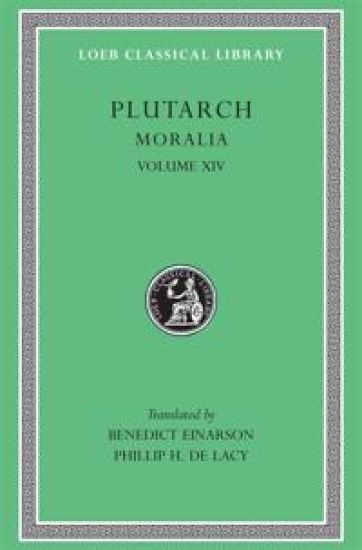
Moralia, XIV

Moralia, XIV

Plutarch

Harvard University Press
1967
sidottu
Eclectic essays on ethics, education, and much else besides. Plutarch (Plutarchus), ca. AD 45–120, was born at Chaeronea in Boeotia in central Greece, studied philosophy at Athens, and, after coming to Rome as a teacher in philosophy, was given consular rank by the emperor Trajan and a procuratorship in Greece by Hadrian. He was married and the father of one daughter and four sons. He appears as a man of kindly character and independent thought, studious and learned. Plutarch wrote on many subjects. Most popular have always been the forty-six Parallel Lives, biographies planned to be ethical examples in pairs (in each pair, one Greek figure and one similar Roman), though the last four lives are single. All are invaluable sources of our knowledge of the lives and characters of Greek and Roman statesmen, soldiers and orators. Plutarch’s many other varied extant works, about sixty in number, are known as Moralia or Moral Essays. They are of high literary value, besides being of great use to people interested in philosophy, ethics, and religion. The Loeb Classical Library edition of the Moralia is in fifteen volumes, volume XIII having two parts. Volume XVI is a comprehensive Index.