Kirjojen hintavertailu – 12 903 725 kirjaa ja 27 kauppaa

Kirjailija

Polybius

Kirjat ja teokset yhdessä paikassa: 32 kirjaa, julkaisuja vuosilta 1979–2026, suosituimpiin kuuluu The Histories of Polybius. Vertaile teosten hintoja ja tarkista saatavuus suomalaisista kirjakaupoista.

32 kirjaa

Kirjojen julkaisuvuodet: 1979–2026.

The Histories

The Histories

Polybius

Digireads.com
2019
pokkari
Written in the 2nd century by the Greek historian Polybius, "The Histories" is a multi-volume work detailing many of the events, people, and ideas of the Hellenistic Period. While his focus is the space of time in which ancient Rome became a world power from 220 to 167 BC, Polybius also discusses his role as a 'pragmatic historian', a discourse on fate (called tyche), and the superiority of the mixed constitution. Though all forty volumes have not survived to the present day, the complete books extant today cover the affairs of all the important nations of the time, including Egypt, Greece, and Spain, as well as the first and second Punic Wars. Polybius speaks at length on the government of the Romans, citing it as the reason for Rome's success as a force of the world. Though it includes a couple of digressions concerning lesser issues of the time, "The Histories" has proven and continues to be a valuable text when studying the Hellenistic time period and manner of writing. Presented here in this volume are the complete extant histories of Polybius in a translation by W. R. Paton printed on premium acid-free paper.
The General History of Polybius. In Five Books. Translated From the Greek. By Mr. Hampton. The Third Edition. In two Volumes. ... of 2; Volume 1
The 18th century was a wealth of knowledge, exploration and rapidly growing technology and expanding record-keeping made possible by advances in the printing press. In its determination to preserve the century of revolution, Gale initiated a revolution of its own: digitization of epic proportions to preserve these invaluable works in the largest archive of its kind. Now for the first time these high-quality digital copies of original 18th century manuscripts are available in print, making them highly accessible to libraries, undergraduate students, and independent scholars. Rich in titles on English life and social history, this collection spans the world as it was known to eighteenth-century historians and explorers. Titles include a wealth of travel accounts and diaries, histories of nations from throughout the world, and maps and charts of a world that was still being discovered. Students of the War of American Independence will find fascinating accounts from the British side of conflict. ++++The below data was compiled from various identification fields in the bibliographic record of this title. This data is provided as an additional tool in helping to insure edition identification: ++++British LibraryN018347Often found with octavo issue of vol.3-4, 1773. London: printed by H. S. Woodfall, for J. Dodsley, 1772. 2v., plates: maps; 8
The General History of Polybius. In Five Books. Translated From the Greek. By Mr. Hampton. The Third Edition. In two Volumes. ... of 2; Volume 2
The 18th century was a wealth of knowledge, exploration and rapidly growing technology and expanding record-keeping made possible by advances in the printing press. In its determination to preserve the century of revolution, Gale initiated a revolution of its own: digitization of epic proportions to preserve these invaluable works in the largest archive of its kind. Now for the first time these high-quality digital copies of original 18th century manuscripts are available in print, making them highly accessible to libraries, undergraduate students, and independent scholars. Rich in titles on English life and social history, this collection spans the world as it was known to eighteenth-century historians and explorers. Titles include a wealth of travel accounts and diaries, histories of nations from throughout the world, and maps and charts of a world that was still being discovered. Students of the War of American Independence will find fascinating accounts from the British side of conflict. ++++The below data was compiled from various identification fields in the bibliographic record of this title. This data is provided as an additional tool in helping to insure edition identification: ++++British LibraryN018347Often found with octavo issue of vol.3-4, 1773. London: printed by H. S. Woodfall, for J. Dodsley, 1772. 2v., plates: maps; 8
The General History of Polybius. In Five Books. Translated From the Greek by Mr. Hampton. The Third Edition.; Volume I
The 18th century was a wealth of knowledge, exploration and rapidly growing technology and expanding record-keeping made possible by advances in the printing press. In its determination to preserve the century of revolution, Gale initiated a revolution of its own: digitization of epic proportions to preserve these invaluable works in the largest archive of its kind. Now for the first time these high-quality digital copies of original 18th century manuscripts are available in print, making them highly accessible to libraries, undergraduate students, and independent scholars. Rich in titles on English life and social history, this collection spans the world as it was known to eighteenth-century historians and explorers. Titles include a wealth of travel accounts and diaries, histories of nations from throughout the world, and maps and charts of a world that was still being discovered. Students of the War of American Independence will find fascinating accounts from the British side of conflict. ++++The below data was compiled from various identification fields in the bibliographic record of this title. This data is provided as an additional tool in helping to insure edition identification: ++++British LibraryT117894With an index. London: printed for J. Dodsley, 1772. xxiv, 8],559, 1]p., plates: maps; 4
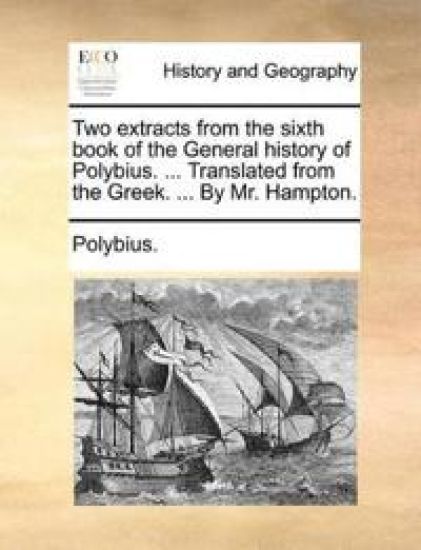
Two Extracts From the Sixth Book of the General History of Polybius. ... Translated From the Greek. ... By Mr. Hampton
The 18th century was a wealth of knowledge, exploration and rapidly growing technology and expanding record-keeping made possible by advances in the printing press. In its determination to preserve the century of revolution, Gale initiated a revolution of its own: digitization of epic proportions to preserve these invaluable works in the largest archive of its kind. Now for the first time these high-quality digital copies of original 18th century manuscripts are available in print, making them highly accessible to libraries, undergraduate students, and independent scholars. Rich in titles on English life and social history, this collection spans the world as it was known to eighteenth-century historians and explorers. Titles include a wealth of travel accounts and diaries, histories of nations from throughout the world, and maps and charts of a world that was still being discovered. Students of the War of American Independence will find fascinating accounts from the British side of conflict. ++++The below data was compiled from various identification fields in the bibliographic record of this title. This data is provided as an additional tool in helping to insure edition identification: ++++British LibraryT110707London: printed by J. Hughs, for R. and J. Dodsley, 1764. 8],39, 1]p.; 4
The Histories, Volume VI

The Histories, Volume VI

Polybius

Loeb Classical Library
2012
sidottu
Hellenistic history. The historian Polybius (ca. 200–118 BC) was born into a leading family of Megalopolis in the Peloponnese (Morea) and served the Achaean League in arms and diplomacy for many years, favoring alliance with Rome. From 168 to 151 he was held hostage in Rome, where he became a friend of Lucius Aemilius Paulus and his two sons, especially Scipio Aemilianus, whose campaigns, including the destruction of Carthage, he later attended. Late in his life he became a trusted mediator between Greece and the Romans; helped in the discussions that preceded the final war with Carthage; and after 146 was entrusted by the Romans with the details of administration in Greece. Polybius’ overall theme is how and why the Romans spread their power as they did. The main part of his history covers the years 264–146 BC, describing the rise of Rome, her destruction of Carthage, and her eventual domination of the Greek world. It is a great work: accurate, thoughtful, largely impartial, based on research, and full of insight into customs, institutions, geography, the causes of events, and the character of peoples. It is a vital achievement of the first importance despite the incomplete state in which all but the first five of its original forty books have reached us. For this edition, W. R. Paton’s excellent translation, first published in 1922, has been thoroughly revised, the Büttner-Wobst Greek text corrected, and explanatory notes and a new introduction added, all reflecting the latest scholarship. The Loeb Classical Library edition of Polybius is in six volumes.

The Histories, Volume V

The Histories, Volume V

Polybius

Loeb Classical Library
2012
sidottu
Hellenistic history. The historian Polybius (ca. 200–118 BC) was born into a leading family of Megalopolis in the Peloponnese (Morea) and served the Achaean League in arms and diplomacy for many years, favoring alliance with Rome. From 168 to 151 he was held hostage in Rome, where he became a friend of Lucius Aemilius Paulus and his two sons, especially Scipio Aemilianus, whose campaigns, including the destruction of Carthage, he later attended. Late in his life he became a trusted mediator between Greece and the Romans; helped in the discussions that preceded the final war with Carthage; and after 146 was entrusted by the Romans with the details of administration in Greece. Polybius’ overall theme is how and why the Romans spread their power as they did. The main part of his history covers the years 264–146 BC, describing the rise of Rome, her destruction of Carthage, and her eventual domination of the Greek world. It is a great work: accurate, thoughtful, largely impartial, based on research, and full of insight into customs, institutions, geography, the causes of events, and the character of peoples. It is a vital achievement of the first importance despite the incomplete state in which all but the first five of its original forty books have reached us. For this edition, W. R. Paton’s excellent translation, first published in 1922, has been thoroughly revised, the Büttner-Wobst Greek text corrected, and explanatory notes and a new introduction added, all reflecting the latest scholarship. The Loeb Classical Library edition of Polybius is in six volumes.

The Histories, Volume IV

The Histories, Volume IV

Polybius

Loeb Classical Library
2011
sidottu
Hellenistic history. The historian Polybius (ca. 200–118 BC) was born into a leading family of Megalopolis in the Peloponnese (Morea) and served the Achaean League in arms and diplomacy for many years, favoring alliance with Rome. From 168 to 151 he was held hostage in Rome, where he became a friend of Lucius Aemilius Paulus and his two sons, especially Scipio Aemilianus, whose campaigns, including the destruction of Carthage, he later attended. Late in his life he became a trusted mediator between Greece and the Romans; helped in the discussions that preceded the final war with Carthage; and after 146 was entrusted by the Romans with the details of administration in Greece. Polybius’ overall theme is how and why the Romans spread their power as they did. The main part of his history covers the years 264–146 BC, describing the rise of Rome, her destruction of Carthage, and her eventual domination of the Greek world. It is a great work: accurate, thoughtful, largely impartial, based on research, and full of insight into customs, institutions, geography, the causes of events, and the character of peoples. It is a vital achievement of the first importance despite the incomplete state in which all but the first five of its original forty books have reached us. For this edition, W. R. Paton’s excellent translation, first published in 1922, has been thoroughly revised, the Büttner-Wobst Greek text corrected, and explanatory notes and a new introduction added, all reflecting the latest scholarship. The Loeb Classical Library edition of Polybius is in six volumes.

The Histories, Volume III

The Histories, Volume III

Polybius

Loeb Classical Library
2011
sidottu
Hellenistic history. The historian Polybius (ca. 200–118 BC) was born into a leading family of Megalopolis in the Peloponnese (Morea) and served the Achaean League in arms and diplomacy for many years, favoring alliance with Rome. From 168 to 151 he was held hostage in Rome, where he became a friend of Lucius Aemilius Paulus and his two sons, especially Scipio Aemilianus, whose campaigns, including the destruction of Carthage, he later attended. Late in his life he became a trusted mediator between Greece and the Romans; helped in the discussions that preceded the final war with Carthage; and after 146 was entrusted by the Romans with the details of administration in Greece. Polybius’ overall theme is how and why the Romans spread their power as they did. The main part of his history covers the years 264–146 BC, describing the rise of Rome, her destruction of Carthage, and her eventual domination of the Greek world. It is a great work: accurate, thoughtful, largely impartial, based on research, and full of insight into customs, institutions, geography, the causes of events, and the character of peoples. It is a vital achievement of the first importance despite the incomplete state in which all but the first five of its original forty books have reached us. For this edition, W. R. Paton’s excellent translation, first published in 1922, has been thoroughly revised, the Büttner-Wobst Greek text corrected, and explanatory notes and a new introduction added, all reflecting the latest scholarship. The Loeb Classical Library edition of Polybius is in six volumes.

The Histories

The Histories

Polybius

Oxford University Press
2010
nidottu

Halvin toimitettuna 20,90 €

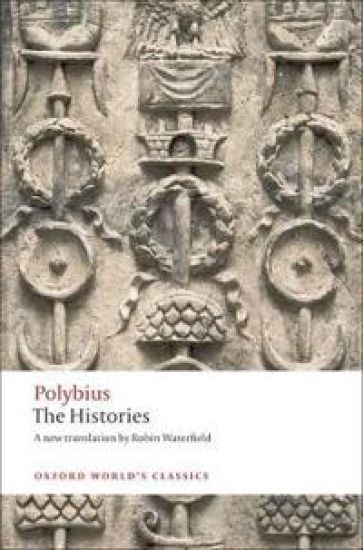
'no one else in our times has attempted to write a universal history' Polybius' ambitious goal was to describe how Rome conquered the Mediterranean world in less than fifty-three years. This great study of imperialism takes the reader back to Rome's first encounter with Carthage in 264 and forward to her destruction of that renowned city in 146. Polybius, himself a leading Greek politician of the time, emphasizes the importance of practical experience for the writing of political history as well as the critical assessment of all the evidence. He attributes Rome's success to the greatness of its constitution and the character of its people, but also allows Fortune a role in designing the shape of world events. This new translation by Robin Waterfield, the first for over thirty years, includes the first five books in their entirety, and all of the fragmentary Books 6 and 12, containing Polybius' account of the Roman constitution and his outspoken views on how (and how not) to write history. Brian McGing's accompanying introduction and notes illuminate this remarkable political history. ABOUT THE SERIES: For over 100 years Oxford World's Classics has made available the widest range of literature from around the globe. Each affordable volume reflects Oxford's commitment to scholarship, providing the most accurate text plus a wealth of other valuable features, including expert introductions by leading authorities, helpful notes to clarify the text, up-to-date bibliographies for further study, and much more.
The Histories, Volume II

The Histories, Volume II

Polybius

Loeb Classical Library
2010
sidottu
Hellenistic history. The historian Polybius (ca. 200–118 BC) was born into a leading family of Megalopolis in the Peloponnese (Morea) and served the Achaean League in arms and diplomacy for many years, favoring alliance with Rome. From 168 to 151 he was held hostage in Rome, where he became a friend of Lucius Aemilius Paulus and his two sons, especially Scipio Aemilianus, whose campaigns, including the destruction of Carthage, he later attended. Late in his life he became a trusted mediator between Greece and the Romans; helped in the discussions that preceded the final war with Carthage; and after 146 was entrusted by the Romans with the details of administration in Greece. Polybius’ overall theme is how and why the Romans spread their power as they did. The main part of his history covers the years 264–146 BC, describing the rise of Rome, her destruction of Carthage, and her eventual domination of the Greek world. It is a great work: accurate, thoughtful, largely impartial, based on research, and full of insight into customs, institutions, geography, the causes of events, and the character of peoples. It is a vital achievement of the first importance despite the incomplete state in which all but the first five of its original forty books have reached us. For this edition, W. R. Paton’s excellent translation, first published in 1922, has been thoroughly revised, the Büttner-Wobst Greek text corrected, and explanatory notes and a new introduction added, all reflecting the latest scholarship. The Loeb Classical Library edition of Polybius is in six volumes.
The Histories, Volume I

The Histories, Volume I

Polybius

Loeb Classical Library
2010
sidottu
Hellenistic history. The historian Polybius (ca. 200–118 BC) was born into a leading family of Megalopolis in the Peloponnese (Morea) and served the Achaean League in arms and diplomacy for many years, favoring alliance with Rome. From 168 to 151 he was held hostage in Rome, where he became a friend of Lucius Aemilius Paulus and his two sons, especially Scipio Aemilianus, whose campaigns, including the destruction of Carthage, he later attended. Late in his life he became a trusted mediator between Greece and the Romans; helped in the discussions that preceded the final war with Carthage; and after 146 was entrusted by the Romans with the details of administration in Greece. Polybius’ overall theme is how and why the Romans spread their power as they did. The main part of his history covers the years 264–146 BC, describing the rise of Rome, her destruction of Carthage, and her eventual domination of the Greek world. It is a great work: accurate, thoughtful, largely impartial, based on research, and full of insight into customs, institutions, geography, the causes of events, and the character of peoples. It is a vital achievement of the first importance despite the incomplete state in which all but the first five of its original forty books have reached us. For this edition, W. R. Paton’s excellent translation, first published in 1922, has been thoroughly revised, the Büttner-Wobst Greek text corrected, and explanatory notes and a new introduction added, all reflecting the latest scholarship. The Loeb Classical Library edition of Polybius is in six volumes.