Kirjailija
Pope Benedict XVI
Kirjat ja teokset yhdessä paikassa: 30 kirjaa, julkaisuja vuosilta 1995–2025, suosituimpiin kuuluu Sacramentum Caritatis. Vertaile teosten hintoja ja tarkista saatavuus suomalaisista kirjakaupoista.
30 kirjaa
Kirjojen julkaisuvuodet: 1995–2025.
During the special Pauline Jubilee Year, Pope Benedict XVI used his Wednesday audiences as an opportunity to meet one of the most influential persons in the history of Christianity, Saint Paul. Meeting Saint Paul is the complete collection of these twenty-one papal reflections.
Benedict XVI has something for everyone in Charity in Truth--from praising profit to defending the environment, from calling for a role for government in the economy to insisting on the necessity of moral transformation and "gratuitousness" in economic life, from the issue of immigration to the importance of technology. However, he also insists on discernment and the purification of our ideas by faith and reason, in order to temper any immoderate and one-sided enthusiasms. Charity and Truth was expected to be--and is--the Pope's encyclical on "social justice." And indeed "justice" and "rights" find their proper place. But "charity" and truth are shown to be the fundamental principles. Charity is at the heart of the Church's social doctrine, he writes. "Without truth, without trust and love for what is true, there is no social conscience and responsibility, and social action ends up serving private interests and the logic of power". Benedict calls for "integral human development," which promotes "the good of every man and of the whole man", including the spiritual dimension, "the perspective of eternal life". Without this, "human progress in this world is denied breathing-space." What's more, true development requires "openness to life". ""If there is lack of respect for the right to life and a natural death," he writes, "if human conception, gestation and birth are made artificial, if human embryos are sacrificed to research, the conscience of society ends up losing the concept of human ecology and, along with it, that of environmental ecology. It is contradictory to insist that future generations respect the natural environment when our educational system and laws do not help them to respect themselves." With respect to economics, the Pope insists every economic decision has a moral consequence. He avoids the extremes of an unbridled capitalism and socialism. Instead, he holds that "the logic of the market and the logic of the State"--free economic exchange with political oversight and restraint--are not enough to secure human flourishing. There must be a generosity and gratuitousness among citizens and nations that goes beyond economic and political systems. "Charity" is necessary for "justice" to be "justice". Benedict also argues that technology must not be seen as automatically providing solutions to problems, without the need for morality. Nor must man seek to avoid responsibility for overcoming social problems by rejecting technological development as inevitably evil. Benedict insists that man must be humble yet confident that he can, through faith and reason, make true progress in human development.

Jesus of Nazareth: From the Baptism in the Jordan to the Transfiguration Volume 1
Pope Benedict XVI
IGNATIUS PRESS
2008
nidottu
Halvin toimitettuna 22,20 €
In this bold, momentous work, Joseph Ratzinger--in his first book written since he became Pope--seeks to salvage the person of Jesus from recent "popular" depictions and to restore Jesus' true identity as discovered in the Gospels. Through his brilliance as a theologian and his personal conviction as a believer, the Pope shares a rich, compelling, flesh-and-blood portrait of Jesus and invites us to encounter, face-to-face, the central figure of the Christian faith. From Jesus of Nazareth: "the great question that will be with us throughout this entire book: What did Jesus actually bring, if not world peace, universal prosperity, and a better world? What has he brought? The answer is very simple: God. He has brought God He has brought the God who formerly unveiled his countenance gradually first to Abraham, then to Moses and the Prophets, and then in the Wisdom Literature--the God who revealed his face only in Israel, even though he was also honored among the pagans in various shadowy guises. It is this God, the God of Abraham, Isaac, and Jacob, the true God, whom he has brought to the peoples of the earth. He has brought God, and now we know his face, now we can call upon him. Now we know the path that we human beings have to take in this world. Jesus has brought God and with God the truth about where we are going and where we come from: faith, hope, and love." The Study Guide is also available
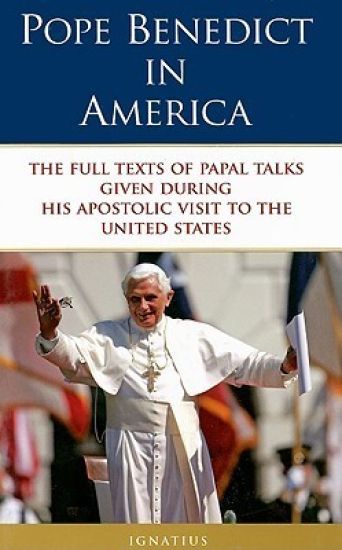
Pope Benedict in America: The Full Texts of Papal Talks
Pope Benedict XVI
IGNATIUS PRESS
2008
sidottu
During his six-day apostolic visit to Washington and New York, Pope Benedict addressed millions of people�in person or via the media. He gave some fifteen major addresses, ranging from his remarks to the President of the United States to his address to ecumenical leaders at St. Joseph Parish in New York, from his speech to the General Assembly of the United Nations to his message to the Jewish community celebrating the feast of Passover. In all of his addresses, Benedict spoke as the Vicar of Christ with the message of divine truth and love, of genuine faith and a well-founded, Christ-centered hope. This book contains all of Benedict's major addresses in a handy slim deluxe hardcover edition perfect for studying and reflecting on the Pope's profound and insightful words on a variety of important spiritual, moral, and social issues. Readers will readily see the truth of Jesuit Father James Schall's statement from his introduction to this volume: "Benedict XVI is an amazingly learned man . . . There is no one else in any public office in the world that has � his breadth of knowledge and scholarship. Though he speaks the learned German academic tongue with the best of them, his writings are strikingly straightforward and clear . . . One sensed that the media understood this somehow, that this man was on top of every subject and operated at a depth few could match. The papacy does have the duty of teaching, and Benedict does teach. He also thinks and ponders. What is characteristic of him is that he not only speaks authoritatively when he must, but that he mostly offers what he says on the grounds of common sense and reason. He goes directly to the minds and hearts of his readers or listeners."
En este original y oportuno libro --el primero que escribe desde su elecci n como papa--, Benedicto XVI rescata la figura de Jes s de recientes descripciones populares y restaura la verdadera identidad de Jes s que nos presentan los Evangelios. El papa, con su excepcional lucidez como te logo y su convicci n personal como creyente, nos presenta un retrato de Jes s impactante y veraz, y nos invita a encontrarnos cara a cara con la figura principal de la fe cristiana. De Jes s de Nazaret: La gran pregunta que nos acompa ar a lo largo de todo este libro: qu ha tra do Jes s realmente, si no ha tra do la paz al mundo, el bienestar para todos, un mundo mejor? Qu ha tra do? La respuesta es muy sencilla: a Dios. Ha tra do a Dios. Aquel Dios cuyo rostro se hab a ido revelando primero poco a poco, desde Abraham hasta la literatura sapiencial, pasando por Mois s y los Profetas; el Dios que s lo hab a mostrado su rostro en Israel y que, si bien entre muchas sombras, hab a sido honrado en el mundo de los pueblos; ese Dios, el Dios de Abraham, Isaac y Jacob, el Dios verdadero, l lo ha tra do a los pueblos de la tierra. Ha tra do a Dios: ahora conocemos su rostro, ahora podemos invocarlo. Ahora conocemos el camino que debemos seguir como hombres en este mundo. Jes s ha tra do a Dios y, con l, la verdad sobre nuestro origen y nuestro destino; la fe, la esperanza y el amor .
Jesus of Nazareth: From the Baptism in the Jordan to the Transfiguration
Pope Benedict XVI; Joseph Ratzinger
Image
2007
sidottu
Halvin toimitettuna 27,80 €
Pope Benedict XVI's iconic life of Jesus, a rich, compelling, flesh-and-blood portrait of the central figure of the Christian faith. "This book is . . . my personal search 'for the face of the Lord.'"--Benedict XVI In this bold, momentous work, the Pope seeks to salvage the person of Jesus from today's "popular" depictions and to restore his true identity as discovered in the Gospels. Through his brilliance as a theologian and his personal conviction as a believer, the Pope incites us to encounter Jesus face to face. From Jesus of Nazareth ". . . the great question that will be with us throughout this entire book: But what has Jesus really brought, then, if he has not brought world peace, universal prosperity, and a better world? What has he brought? The answer is very simple: God. He has brought God He has brought the God who once gradually unveiled his countenance first to Abraham, then to Moses and the prophets, and then in the wisdom literature--the God who showed his face only in Israel, even though he was also honored among the pagans in various shadowy guises. It is this God, the God of Abraham, of Isaac, and of Jacob, the true God, whom he has brought to the peoples of the earth. He has brought God, and now we know his face, now we can call upon him. Now we know the path that we human beings have to take in this world. Jesus has brought God and with God the truth about where we are going and where we come from: faith, hope, and love."
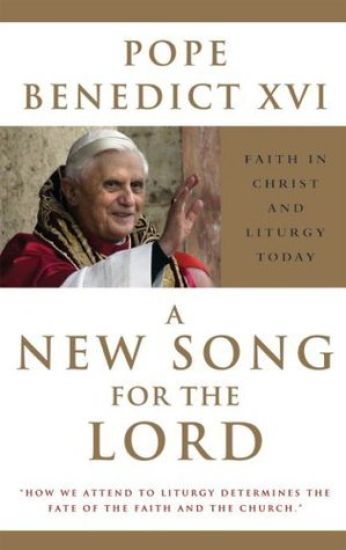
The pope’s definitive statement on liturgical reform. Pope Benedict XVI shows that in the controversies over liturgical reform and the Latin mass, liturgy is not just a pragmatic matter but a central feature in our relationship to Christ, the Church, and ourselves.
In the Beginning...
Joseph Cardinal Ratzinger; Boniface (TRN) Ramsey; Pope Benedict XVI
William B Eerdmans Publishing Co
1995
pokkari
Halvin toimitettuna 19,10 €
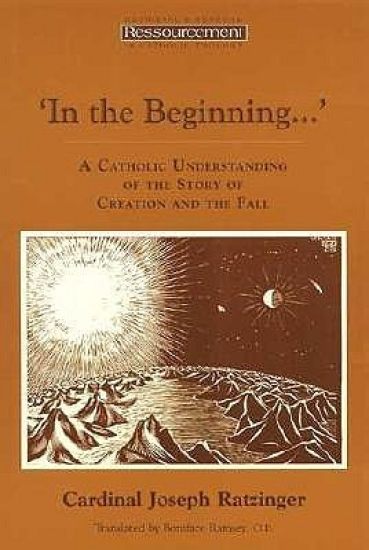
In four superb homilies and a concluding essay, Joseph Ratzinger, now Pope Benedict XVI, provides a clear and inspiring exploration of the Genesis creation narratives. While the stories of the world's creation and the fall of humankind have often been subjected to reductionism of one sort or another literalists treat the Bible as a science textbook whereas rationalists divorce God from creation Ratzinger presents a rich, balanced Catholic understanding of these early biblical writings and attests to their enduring vitality. Beginning each homily with a text selected from the first three chapters of Genesis, Ratzinger discusses, in turn, God the creator, the meaning of the biblical creation accounts, the creation of human beings, and sin and salvation; in the appendix he unpacks the beneficial consequences of faith in creation. Expertly translated from German, these reflections set out a reasonable and biblical approach to creation. In the Beginning . . .' also serves as an excellent homiletic resource for priests and pastors."