Kirjojen hintavertailu – 12 903 725 kirjaa ja 27 kauppaa

Kirjailija

Prakash Mahadeo Dixit

Kirjat ja teokset yhdessä paikassa: 3 kirjaa, julkaisuja vuosilta 2008–2025, suosituimpiin kuuluu Modeling of Metal Forming and Machining Processes. Vertaile teosten hintoja ja tarkista saatavuus suomalaisista kirjakaupoista.

3 kirjaa

Kirjojen julkaisuvuodet: 2008–2025.

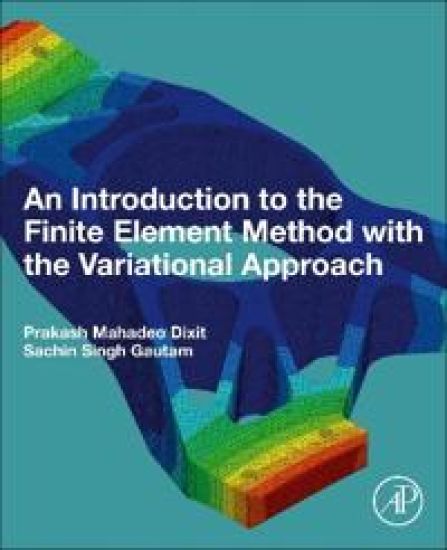
An Introduction to the Finite Element Method with the Variational Approach

An Introduction to the Finite Element Method with the Variational Approach

Prakash Mahadeo Dixit; Sachin Singh Gautam

ELSEVIER SCIENCE PUBLISHING CO INC
2025
nidottu
An Introduction to the Finite Element Method with the Variational Approach offers a comprehensive solution to the gaps often found in introductory texts on the Finite Element Method (FEM). The book provides a thorough introduction to the fundamental principles of linear and time-independent FEM within the variational framework. It meticulously covers the derivation of 1-D FEM equations based on variational functionals, encompassing both linear and higher-order elements, and shape functions driven by convergence criteria. Furthermore, it explores 1-D numerical integration, outlines coding procedures, and provides insights into handling material nonlinearity and time-dependent scenarios. Expanding into 2-D problems, the book offers derivations of 2-D FEM equations tailored to diverse engineering disciplines, including Steady-State Heat Conduction, Solid Mechanics (covering torsion, plane strain/axisymmetric cases, and the bending, stability, and vibrations of thin plates), as well as Fluid Mechanics (addressing incompressible inviscid and viscous fluids). It includes detailed discussions on element continuity, numerical integration techniques, and even includes 2-D codes for selected problems. The book concludes by delving into recent advancements in FEM, with a specific focus on applications in machine learning and isogeometric analysis.
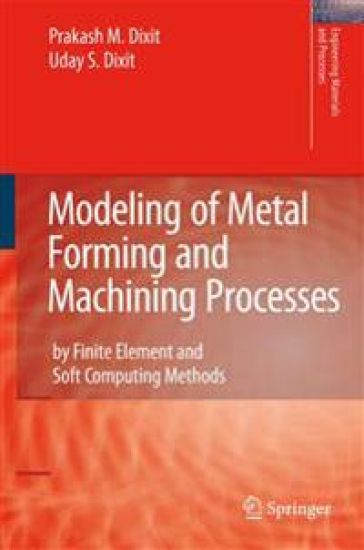
Modeling of Metal Forming and Machining Processes

Modeling of Metal Forming and Machining Processes

Prakash Mahadeo Dixit; U.S. Dixit

Springer London Ltd
2010
nidottu
The use of computational techniques is increasing day by day in the manufacturing sector. Process modeling and optimization with the help of computers can reduce expensive and time consuming experiments for manufacturing good quality products. Metal forming and machining are two prominent manufacturing processes. Both of these processes involve large deformation of elasto-plastic materials due to applied loads. In metal forming, the material is plastically deformed without causing fracture. On the other hand, in machining, the material is deformed till fracture, in order to remove material in the form of chips. To understand the physics of metal forming and machining processes, one needs to understand the kinematics of large deformation (dependence of deformation and its rate on displacement) as well as the constitutive behavior of elasto-plastic materials (dependence of internal forces on deformation and its rate). Once the physics is understood, these phenomena have to be converted to mathematical relations in the form of differential equations. The interaction of the work-piece with the tools/dies and other surroundings also needs to be expressed in a mathematical form (known as the boundary and initial conditions). In this book, the first four chapters essentially discuss the physics of metal forming and machining processes. The physical behavior of the work-piece during the processes is modeled in the form of differential equations and boundary and initial conditions.
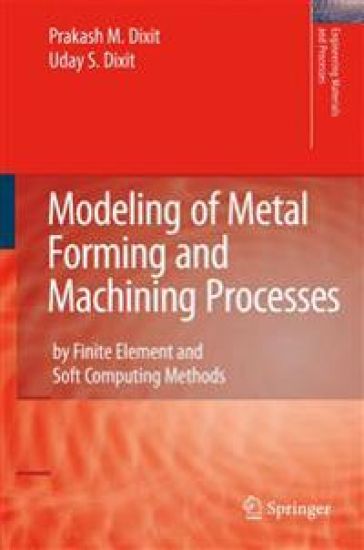
Modeling of Metal Forming and Machining Processes

Modeling of Metal Forming and Machining Processes

Prakash Mahadeo Dixit; U.S. Dixit

Springer London Ltd
2008
sidottu
The use of computational techniques is increasing day by day in the manufacturing sector. Process modeling and optimization with the help of computers can reduce expensive and time consuming experiments for manufacturing good quality products. Metal forming and machining are two prominent manufacturing processes. Both of these processes involve large deformation of elasto-plastic materials due to applied loads. In metal forming, the material is plastically deformed without causing fracture. On the other hand, in machining, the material is deformed till fracture, in order to remove material in the form of chips. To understand the physics of metal forming and machining processes, one needs to understand the kinematics of large deformation (dependence of deformation and its rate on displacement) as well as the constitutive behavior of elasto-plastic materials (dependence of internal forces on deformation and its rate). Once the physics is understood, these phenomena have to be converted to mathematical relations in the form of differential equations. The interaction of the work-piece with the tools/dies and other surroundings also needs to be expressed in a mathematical form (known as the boundary and initial conditions). In this book, the first four chapters essentially discuss the physics of metal forming and machining processes. The physical behavior of the work-piece during the processes is modeled in the form of differential equations and boundary and initial conditions.