Kirjojen hintavertailu – 12 903 727 kirjaa ja 27 kauppaa

Kirjailija

Prema-chandra Athukorala

Kirjat ja teokset yhdessä paikassa: 10 kirjaa, julkaisuja vuosilta 1998–2026, suosituimpiin kuuluu Global Production Sharing, Industrialisation And Trade Patterns: Lessons And Insights From Asia. Vertaile teosten hintoja ja tarkista saatavuus suomalaisista kirjakaupoista.

Nimi esiintyy myös muodoissa: Prema–Chandra Athukorala

10 kirjaa

Kirjojen julkaisuvuodet: 1998–2026.

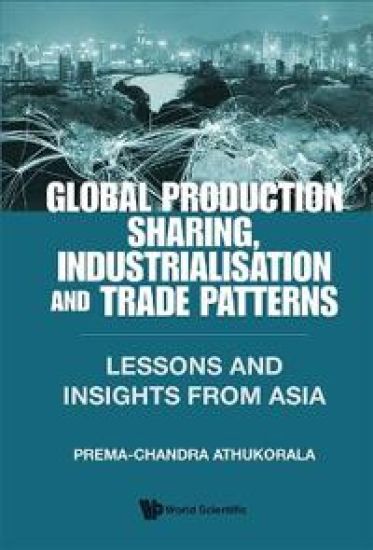
Global Production Sharing, Industrialisation And Trade Patterns: Lessons And Insights From Asia
This book examines how developing economies integrate into global manufacturing value chains and the policy challenges associated with export-oriented industrialisation, drawing on the experiences of nine major Asian countries: China, India, Indonesia, Singapore, Malaysia, Thailand, Philippines, Vietnam and Sri Lanka. Together, these countries provide a rich analytical setting, reflecting wide diversity in development trajectories, policy regimes, and stages of integration into global production networks. The analysis of country experiences is framed within a clear and accessible overview of the concepts and processes of global production sharing and the key policy issues it raises. Although global value chains are widely acknowledged as a central feature of contemporary globalisation, their role in fostering sustained industrialisation and technological upgrading in developing countries remains imperfectly understood. This book addresses that gap through systematic empirical analysis, drawing on previously unexplored or underutilised data sources. The findings offer practical insights for policymakers seeking to leverage global manufacturing networks to support export diversification, industrial deepening, and long-term development.
Revisiting Globalization

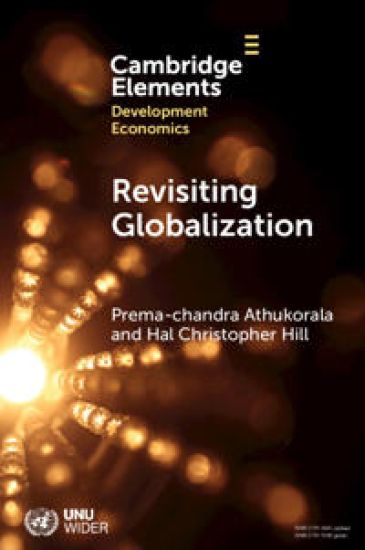
Revisiting Globalization

Prema-chandra Athukorala; Hal Christopher Hill

Cambridge University Press
2026
pokkari
One of the most significant innovations in international industrial organization over the past half-century has been the vertical disintegration of production, with different stages carried out in different countries-a process widely known as the Global Manufacturing Value Chain (GMVC). Trade based on global production sharing within GMVC has been the primary driver behind the dramatic shift in world manufacturing exports from developed to developing countries. However, there are growing concerns in policy circles about whether the GMVC is beginning to lose momentum. This study examines this issue with reference to Southeast Asian countries, which serve as an ideal laboratory for such an analysis. Engagement in GMVC has played a major role in the economic dynamism of these countries, although their levels of participation vary significantly. This title is also available as open access on Cambridge Core.
Revisiting Globalization

Revisiting Globalization

Prema-chandra Athukorala; Hal Christopher Hill

Cambridge University Press
2026
sidottu
One of the most significant innovations in international industrial organization over the past half-century has been the vertical disintegration of production, with different stages carried out in different countries-a process widely known as the Global Manufacturing Value Chain (GMVC). Trade based on global production sharing within GMVC has been the primary driver behind the dramatic shift in world manufacturing exports from developed to developing countries. However, there are growing concerns in policy circles about whether the GMVC is beginning to lose momentum. This study examines this issue with reference to Southeast Asian countries, which serve as an ideal laboratory for such an analysis. Engagement in GMVC has played a major role in the economic dynamism of these countries, although their levels of participation vary significantly. This title is also available as open access on Cambridge Core.
The 1918–20 Influenza Pandemic

The 1918–20 Influenza Pandemic

Prema-chandra Athukorala; Chaturica Athukorala

Cambridge University Press
2022
pokkari
The pandemic of 1918–20-commonly known as the Spanish flu-infected over a quarter of the world's population and killed over fifty million people. It is by far the greatest humanitarian disaster caused by an infectious disease in modern history. Epidemiologists and health scientists often draw on this experience to set the plausible upper bound (the 'worst case scenario') on future pandemic mortality. The purpose of this study is to piece together and analyse the scattered multi-disciplinary literature on the pandemic in order to place debates on the evolving course of the current COVID-19 crisis in historical perspective. The analysis focuses on the changing characteristics of pathogens and disease over time, the institutional factors that shaped the global spread, the demographic and socio-economic consequences, and pharmaceutical and non-pharmaceutical responses to the pandemic. This title is also available as Open Access on Cambridge Core.
The Sri Lankan Economy

The Sri Lankan Economy

Prema–Chandra Athukorala; Edimon Ginting; Hal Hill; Utsav Kumar

Asian Development Bank
2017
nidottu
This is a pivotal period in Sri Lanka’s economic development. The end of conflict opens a door for accelerated economic growth and poverty reduction. Reform is needed to regain momentum because fiscal imbalances and rising public debt could jeopardize macroeconomic stability. The economy would benefit from significant trade and commercial policy reform. The labor market suffers from sluggish growth of formal sector employment and from skills mismatches, which can be addressed by changes in education policy and systems.
Multinational Enterprises in Asian Development

Multinational Enterprises in Asian Development

Prema-Chandra Athukorala

Edward Elgar Publishing Ltd
2007
sidottu
This book takes a fresh look at unresolved issues associated with the role of multinational enterprises and foreign direct investment in economic development in light of the experiences of developing countries in Asia. Each chapter presents a self-contained treatment of a specific theme relating to the developmental implications of MNEs, encompassing the current state of the debate, and relevant theory and policy implications. The key aspects of MNE-development interface covered in the book include expansion of manufacturing exports, global integration through international fragmentation of production, research and development, productivity growth, susceptibility to and recovery from financial crises, macroeconomic adjustment and international competitiveness, and economic transition from plan to market. Multinational Enterprises in Asian Development will prove a valuable reference tool for academics, researchers and students focusing on trade, development and international business. Professional economists and policy makers wishing to broaden their understanding of the role of MNEs as an integral part of the international development policy will also find much to interest them in this book.
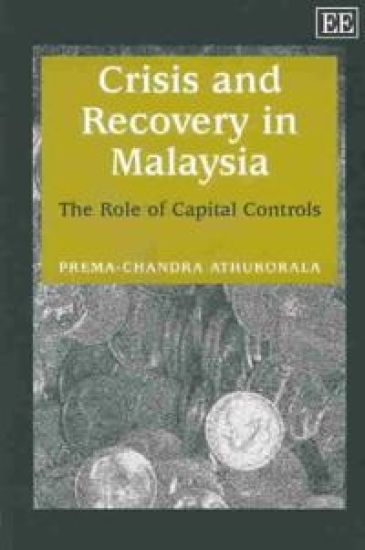
Crisis and Recovery in Malaysia

Crisis and Recovery in Malaysia

Prema-chandra Athukorala

Edward Elgar Publishing Ltd
2003
nidottu
In the light of the Malaysian experience during the Asian financial crisis, this book examines the role of international capital mobility in making countries susceptible to financial crises and the use of capital controls as a crisis management tool. Malaysia provides an interesting case study of this subject given its significant capital market liberalisation prior to the onset of the crisis, and its fundamental shift in crisis management policy in September 1998. The prime focus of the book is on Malaysia's radical policy decision to pursue an independent recovery path, cut off from world markets by a system of capital control, as a viable alternative to the conventional market centred approach. The analysis suggests that, against the initial dire predictions of many economists, the capital controls have actually played a crucial supportive role in crisis management. Whether the controls have played a special role in delivering a superior recovery outcome in Malaysia compared to IMF-program countries remains a point of contention. However, there is strong evidence to suggest that this pragmatic policy choice was instrumental in achieving recovery, while minimising potential economic disruption and related social costs. The book provides an integrated view of the modalities and working of the capital-control based recovery package in the context of a comprehensive survey of macroeconomic management in Malaysia and from a comparative East Asian perspective. It will prove to be of great value to development macroeconomists, monetary and financial economists and students of Malaysian and East Asian development.
Crisis and Recovery in Malaysia

Crisis and Recovery in Malaysia

Prema-Chandra Athukorala

Edward Elgar Publishing Ltd
2001
sidottu
In the light of the Malaysian experience during the Asian financial crisis, this book examines the role of international capital mobility in making countries susceptible to financial crises and the use of capital controls as a crisis management tool. Malaysia provides an interesting case study of this subject given its significant capital market liberalisation prior to the onset of the crisis, and its fundamental shift in crisis management policy in September 1998. The prime focus of the book is on Malaysia's radical policy decision to pursue an independent recovery path, cut off from world markets by a system of capital control, as a viable alternative to the conventional market centred approach. The analysis suggests that, against the initial dire predictions of many economists, the capital controls have actually played a crucial supportive role in crisis management. Whether the controls have played a special role in delivering a superior recovery outcome in Malaysia compared to IMF-program countries remains a point of contention. However, there is strong evidence to suggest that this pragmatic policy choice was instrumental in achieving recovery, while minimising potential economic disruption and related social costs. The book provides an integrated view of the modalities and working of the capital-control based recovery package in the context of a comprehensive survey of macroeconomic management in Malaysia and from a comparative East Asian perspective. It will prove to be of great value to development macroeconomists, monetary and financial economists and students of Malaysian and East Asian development.
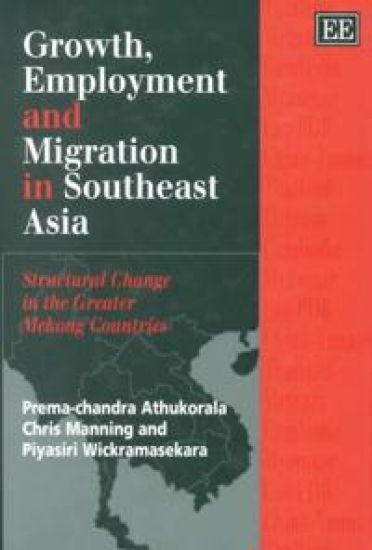
Growth, Employment and Migration in Southeast Asia

Growth, Employment and Migration in Southeast Asia

Prema-Chandra Athukorala; Chris Manning; Piyasiri Wickramasekara

Edward Elgar Publishing Ltd
2000
sidottu
This comparative analysis of growth, structural change and labour market dynamics in the Greater Mekong countries (Yunnan Province in China, Thailand, Vietnam, Cambodia, Lao PDR and Myanmar) of Southeast Asia is the first of its kind. It explores economic integration and cooperation, the possibilities for improving the functioning of labour markets and facilitating mutually beneficial labour flows in the region. The book begins with a comparative overview of policy reforms, economic performance and structural changes, focusing on economic relations in the Greater Mekong countries. It then examines the salient features of labour market structures and policies, patterns of cross-border migration, and information systems, paying attention to the similarities and differences between countries. It is especially timely in the context of economic transition from socialist systems in the three Indochina countries, the ongoing policy reforms in Yunnan Province and Myanmar, and in light of the Asian financial crisis in shaping growth trends. The analysis yields policy recommendations for improvement in labour market performance. The book will be of great interest to development and labour economists and those working in the field of Asian studies, as well as to policymakers.
Trade Policy Issues in Asian Development

Trade Policy Issues in Asian Development

Prema-chandra Athukorala

Routledge
1998
sidottu
This study examines issues of trade policy in the light of the experience of developing Asian economies. Case studies highlight rapidly unfolding issues in trade and development with reference to Sri Lanka, Malaysia, India, Indonesia, Pakistan, South Korea, Taiwan and Thailand. The issues explored include trade liberalization and industrial adjustment, employment and equity outcomes of export-oriented industrialization, the impact of structural adjustment reforms on savings and investment and the role of foreign direct investment in export expansion.