Kirjojen hintavertailu – 12 903 725 kirjaa ja 27 kauppaa

Kirjailija

Priyam Verma

Kirjat ja teokset yhdessä paikassa: 4 kirjaa, julkaisuja vuosilta 2020–2024, suosituimpiin kuuluu Determining Sample Size and Power in Research Studies. Vertaile teosten hintoja ja tarkista saatavuus suomalaisista kirjakaupoista.

4 kirjaa

Kirjojen julkaisuvuodet: 2020–2024.

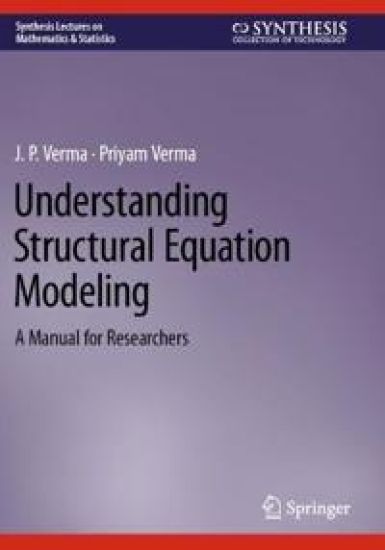
Understanding Structural Equation Modeling

Understanding Structural Equation Modeling

J.P. Verma; Priyam Verma

Springer International Publishing AG
2024
nidottu
This book presents a comprehensive overview of Structural Equation Modeling and how it can be applied to address research issues in different disciplines. The authors employ a ‘simple to complex’ approach. The book reviews topics such as variance, covariance, correlation, multiple regression, mediation, moderation, path analysis, and confirmatory factor analysis. The authors then discuss the initial steps for performing structural equation modeling, including model specification, model identification, model estimation, model testing, and model modification. The book includes an introduction to the IBM SPSS and IBM SPSS Amos software. The authors the explain how this software can be utilized for developing measurement, structural models, and SEM models. The book provides conceptual clarity in understanding the models and discusses practical approaches to solving them. The authors also highlight how these techniques can be applied to various disciplines, including psychology, education,sociology, business, medicine, political science, and biological sciences.
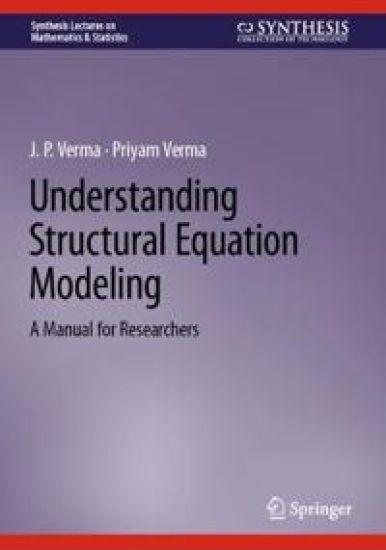
Understanding Structural Equation Modeling

Understanding Structural Equation Modeling

J.P. Verma; Priyam Verma

Springer International Publishing AG
2023
sidottu
This book presents a comprehensive overview of Structural Equation Modeling and how it can be applied to address research issues in different disciplines. The authors employ a ‘simple to complex’ approach. The book reviews topics such as variance, covariance, correlation, multiple regression, mediation, moderation, path analysis, and confirmatory factor analysis. The authors then discuss the initial steps for performing structural equation modeling, including model specification, model identification, model estimation, model testing, and model modification. The book includes an introduction to the IBM SPSS and IBM SPSS Amos software. The authors the explain how this software can be utilized for developing measurement, structural models, and SEM models. The book provides conceptual clarity in understanding the models and discusses practical approaches to solving them. The authors also highlight how these techniques can be applied to various disciplines, including psychology, education,sociology, business, medicine, political science, and biological sciences.
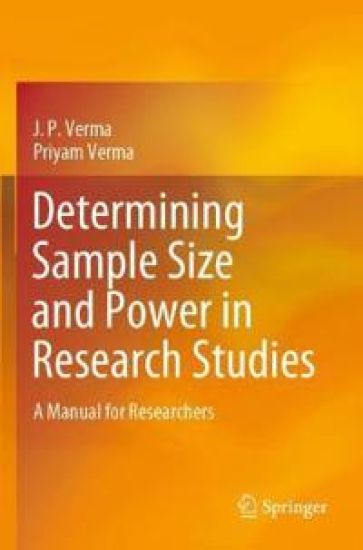
Determining Sample Size and Power in Research Studies

Determining Sample Size and Power in Research Studies

J. P. Verma; Priyam Verma

SPRINGER VERLAG, SINGAPORE
2021
nidottu
This book addresses sample size and power in the context of research, offering valuable insights for graduate and doctoral students as well as researchers in any discipline where data is generated to investigate research questions. It explains how to enhance the authenticity of research by estimating the sample size and reporting the power of the tests used. Further, it discusses the issue of sample size determination in survey studies as well as in hypothesis testing experiments so that readers can grasp the concept of statistical errors, minimum detectable difference, effect size, one-tail and two-tail tests and the power of the test. The book also highlights the importance of fixing these boundary conditions in enhancing the authenticity of research findings and improving the chances of research papers being accepted by respected journals. Further, it explores the significance of sample size by showing the power achieved in selected doctoral studies. Procedure has been discussed to fix power in the hypothesis testing experiment. One should usually have power at least 0.8 in the study because having power less than this will have the issue of practical significance of findings. If the power in any study is less than 0.5 then it would be better to test the hypothesis by tossing a coin instead of organizing the experiment. It also discusses determining sample size and power using the freeware G*Power software, based on twenty-one examples using different analyses, like t-test, parametric and non-parametric correlations, multivariate regression, logistic regression, independent and repeated measures ANOVA, mixed design, MANOVA and chi-square.
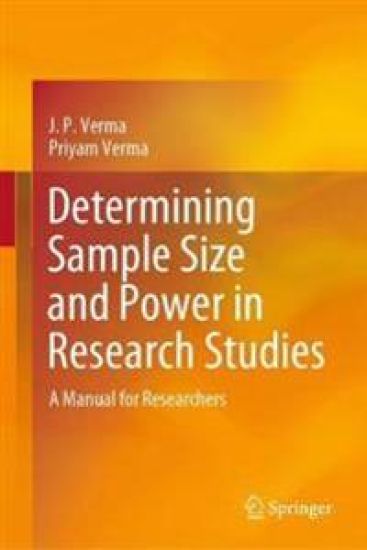
Determining Sample Size and Power in Research Studies

Determining Sample Size and Power in Research Studies

J. P. Verma; Priyam Verma

Springer Verlag, Singapore
2020
sidottu
This book addresses sample size and power in the context of research, offering valuable insights for graduate and doctoral students as well as researchers in any discipline where data is generated to investigate research questions. It explains how to enhance the authenticity of research by estimating the sample size and reporting the power of the tests used. Further, it discusses the issue of sample size determination in survey studies as well as in hypothesis testing experiments so that readers can grasp the concept of statistical errors, minimum detectable difference, effect size, one-tail and two-tail tests and the power of the test. The book also highlights the importance of fixing these boundary conditions in enhancing the authenticity of research findings and improving the chances of research papers being accepted by respected journals. Further, it explores the significance of sample size by showing the power achieved in selected doctoral studies. Procedure has been discussed to fix power in the hypothesis testing experiment. One should usually have power at least 0.8 in the study because having power less than this will have the issue of practical significance of findings. If the power in any study is less than 0.5 then it would be better to test the hypothesis by tossing a coin instead of organizing the experiment. It also discusses determining sample size and power using the freeware G*Power software, based on twenty-one examples using different analyses, like t-test, parametric and non-parametric correlations, multivariate regression, logistic regression, independent and repeated measures ANOVA, mixed design, MANOVA and chi-square.