Kirjojen hintavertailu – 12 859 819 kirjaa ja 27 kauppaa

Kirjailija

Prof. Dr. Hans-Bernd Schäfer

Kirjat ja teokset yhdessä paikassa: 6 kirjaa, julkaisuja vuosilta 2005–2009, suosituimpiin kuuluu State Liability for Breaches of European Law. Vertaile teosten hintoja ja tarkista saatavuus suomalaisista kirjakaupoista.

Nimi esiintyy myös muodoissa: Prof. Dr. Hans Bernd Schäfer

6 kirjaa

Kirjojen julkaisuvuodet: 2005–2009.

Professional Testimonial Privileges

Professional Testimonial Privileges

Lev Eppelbaum; Prof. Dr. Hans-Bernd Schäfer

GWV Fachverlage GmbH
2009
nidottu
This work contributes to a field in the literature of law & economics in which little research has been done thus far namely the relationship between corporate law and procedural law such as the rules of evidence and of civil procedure. As the reader will discover in the following pages, attorneys, accountants, and journalists, each play an important role in promoting corporate compliance with the law as gatekeepers and monitors against wrongdoing. Ido Baum evaluates the importance of the professional testimonial privilege - a rule that allows the professional to refrain from testifying with regard to information received from his client - in promoting this objective. He does so by looking at the efficient performance of the professional privilege in the United States, England, and Germany while taking into account systemic differences such as the starkly different civil procedure regimes and the structural differences in corporate ownership and control in the capital markets of the compared jurisdictions. Focusing on the relationship between the corporate counsel and the corporation, this book provides new insights into the internal effects of the corporate lawyer-client privilege on corporate decision-making. For example, it is shown that the narrow application of the privilege in some US states creates an inefficient incentive to inflate corporate boards in order to reduce the exposure to sanctions for corporate malfeasance. As accounting standards are converging around the world, the author provides some warnings with respect to situations in which accountants and lawyers choose to work together.
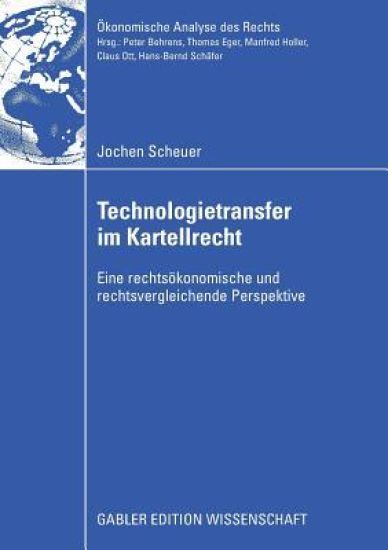
Technologietransfer im Kartellrecht

Technologietransfer im Kartellrecht

Jochen Scheuer; Prof. Dr. Hans-Bernd Schäfer

Gabler Verlag
2008
nidottu
Jochen Scheuer analysiert die Verordnung des Lizenzkartellrechts aus ökonomischer Sicht und vergleicht sie mit den US-amerikanischen „Guidelines for the Licensing of Intellectual Property“. Er kommt zu dem Ergebnis, dass die Chance verspielt wurde, das Lizenzkartellrecht in Europa so zu justieren, dass eine Verwässerung der Innovationsanreize verhindert wird.
State Liability for Breaches of European Law

State Liability for Breaches of European Law

Bert Van Roosebeke; Prof. Dr. Hans Bernd Schäfer

Deutscher Universitats-Verlag
2007
nidottu
With this work, which was written under my academic supervision at the Graduate College for Law and Economics, Bert Van Roosebeke has covered a topic which is rather unusual to the literature of law and economics in a number of ways. This work does not – as does the huge majority of law and economics scholarship – deal with individual behaviour, as addressed by private law. Rather does the author analyse state behaviour as governed by European made state liability jurisdiction and law. He does so with the law and economics instruments traditionally used in the analysis of contract law, tort law and criminal law. The methods of analysis are truly interdisciplinary as well: legal, empirical as well as model-theoretical methods are applied to the questions under discussion. The starting point for the academic discussion on state liability was the European Court of Justice’s landmark Francovich judgement in 1991. In that judgement, the ECJ – against the declared political opinion of EU member states – controversially paved the way for a liability of EU member states for damages caused by the n- transposition of European directives into national law. The judgement was followed by a rich and lengthy discussion among legal scholars, in which the competency of the ECJ to introduce such non-contractual state liability was controversially debated.
Ökonomische Analyse der EU-Emissionshandelsrichtlinie

Ökonomische Analyse der EU-Emissionshandelsrichtlinie

Katja Zwingmann; Prof. Dr. Hans-Bernd Schäfer

Deutscher Universitatsverlag
2007
nidottu
Geleitwort Um ihren Treibhausgasemissionsreduktionsverpflichtungen aus dem Kyoto Protokoll nachzukommen, erliess die Europaische Union im Oktober 2003 die europaische Emis- onshandelsrichtlinie. Sie ist Gegenstand der vorliegenden Arbeit von Katja Zwingmann. Die Richtlinie implementiert einen Emissionshandel auf Unternehmensebene fur CO - 2 Emissionen durch energieintensive Industrien in der EU 25. Damit sollen die Treibha- gasemissionen kosteneffizient vermindert werden. Die Primarallokation der Zertifikate ist eines der wichtigsten Elemente des Emissio- handels. Denn die gewahlte Allokationsform legt fest, ob das System spater funktions- hig und effizient ist, ob ausreichend Nachfrage generiert wird und wie hoch die Gesa- kosten der Zielerreichung sein werden. Frau Zwingmann weist nach, dass durch die A- gestaltung der Primarallokation der Zertifikate nicht nur verteilungspolitische Aspekte, sondern auch Effizienzfragen aufgeworfen werden. Eine effiziente Anfangsverteilung tragt dazu bei, die Transaktionskosten des spateren Handels niedrig zu halten und hat - dem Auswirkungen auf das Investitionsverhalten in Vermeidungstechnologien sowie auf strategisches Verhalten der beteiligten Handelsakteure. Nur eine effiziente Primarallo- tion kann einen funktionierenden Handel generieren. Fur eine effiziente Allokation ist somit auch die Wahl des Allokationsverfahrens e- scheidend. Frau Zwingmann hat im Rahmen ihrer Dissertation bei den unentgeltlichen Vergabeformen das Grandfathering, das Benchmarking und das Updating, bei den Auk- onsformen, die Hollandische, die Englische, die Vickrey und die Hochstpreisauktion sowie verschiedene Mischformen dahin gehend untersucht, ob sie ein effizientes Allo- tionsergebnis generieren."
Court Delay and Law Enforcement in China

Court Delay and Law Enforcement in China

Qing-Yun Jiang; Prof. Dr. Hans-Bernd Schäfer

Deutscher Universitats-Verlag
2006
nidottu
Foreword Qing-Yun Jiang was born in Fujian, China. He studied International Business Administration at the Shanghai Institute of Foreign Trade in Shanghai, where he graduated with a Bachelor of Economics. In 1997, he started studying at the University of Hamburg. After his Master study and his successful completion of the necessary law examinations, he was admitted as a doctoral student in the law faculty in 2001. In addition to his study of German civil, criminal and administrative laws, Jiang demonstrated an increasing interest in law and economics, especially in the relationship between law and economic development. It is now a well-established fact that the rule of law, the protection of property rights and a swift and timely resolution to conflicts are corner stones of economic development and long-term economic growth. In many developing countries court delays are a major shortcoming of the legal system. This is true for countries in Latin America and in many Asian countries. Empirical findings show a 15 year length of civil procedure from the first filing of the case to the Supreme Court decision. This leads to court crises in the sense that private disputes are not brought to the court. Private parties attempt to circumvent the official legal system all together. When making contracts they resort to self enforcing contracts, to self help and, if available, to private alternative dispute settlement. In his thesis, Jiang presents an empirical study of court delays in China.
Regulierung von Analysten

Regulierung von Analysten

Christina Müller; Prof. Dr. Hans-Bernd Schäfer

Deutscher Universitats-Verlag
2005
nidottu
Christina Muller untersucht, wie die Gesetzesinitiativen der letzten beiden Jahre hinsichtlich der Regulierung von Analysten in den USA und in Deutschland unter okonomischen Aspekten zu beurteilen sind. Besonderen Wert legt sie auf die Frage, in wie weit Analysten fur fehlerhafte Aktienempfehlungen in den Medien haftbar gemacht werden sollten. Sie kommt zu dem Ergebnis, dass die Regulierung der Analysten in beiden Rechtssystemen gelungen ist, aber weiterhin Verbesserungen erforderlich sind.