
Kirjailija
Ptolemy
Kirjat ja teokset yhdessä paikassa: 16 kirjaa, julkaisuja vuosilta 1940–2026, suosituimpiin kuuluu Ptolemy's Letter to Flora. Vertaile teosten hintoja ja tarkista saatavuus suomalaisista kirjakaupoista.
16 kirjaa
Kirjojen julkaisuvuodet: 1940–2026.



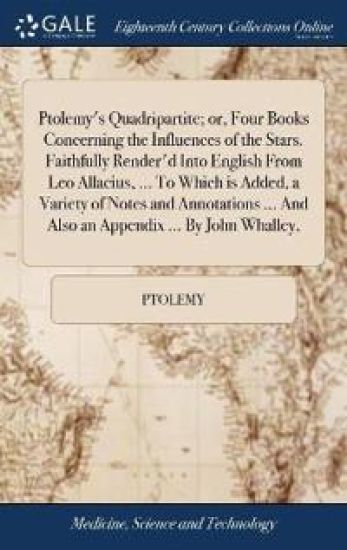
Ptolemy's Quadripartite; or, Four Books Concerning the Influences of the Stars. Faithfully Render'd Into English From Leo Allacius, ... To Which is Added, a Variety of Notes and Annotations ... And Also an Appendix ... By John Whalley,
Ptolemy
Gale Ecco, Print Editions
2018
sidottu
The 18th century was a wealth of knowledge, exploration and rapidly growing technology and expanding record-keeping made possible by advances in the printing press. In its determination to preserve the century of revolution, Gale initiated a revolution of its own: digitization of epic proportions to preserve these invaluable works in the largest archive of its kind. Now for the first time these high-quality digital copies of original 18th century manuscripts are available in print, making them highly accessible to libraries, undergraduate students, and independent scholars. Medical theory and practice of the 1700s developed rapidly, as is evidenced by the extensive collection, which includes descriptions of diseases, their conditions, and treatments. Books on science and technology, agriculture, military technology, natural philosophy, even cookbooks, are all contained here.++++The below data was compiled from various identification fields in the bibliographic record of this title. This data is provided as an additional tool in helping to insure edition identification: ++++British LibraryT143305A translation by John Whalley of Allacius' Latin version of Proclus's 'Institutio theologica', a paraphrase of Ptolemy's 'Tetrabiblos'. The appendix has separate pagination and a titlepage reading: 'An appendix concerning part of fortune, taken from the London: printed for John Sprint, 1701]. 16],168,4, 4]p.; 8

Pi: Calculated to 1,000,001 Digits After the Decimal Point
Archimedes; Ptolemy; Leonardo Fibonacci
Obvious Press
2015
nidottu

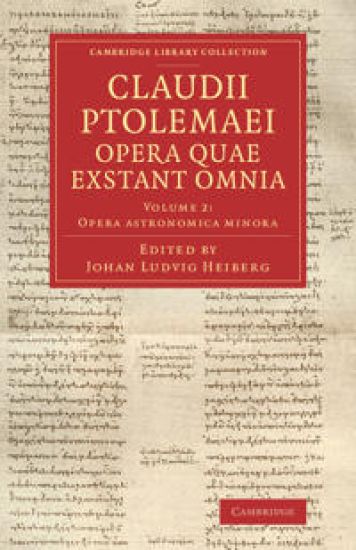
Best known for his 1906 discovery of lost texts in the Archimedes Palimpsest, Danish scholar Johan Ludvig Heiberg (1854–1928), professor of classical philology at Copenhagen, published numerous editions of ancient mathematicians, including Archimedes and Apollonius of Perga (also reissued in this series). Between 1898 and 1907, he published in three parts the extant astronomical works of Ptolemy, active in second-century Alexandria. The Ptolemaic system, his geocentric model of the universe, prevailed in the Islamic world and in medieval Europe until the time of Copernicus. Volume 2, published in 1907, contains a brief preface and a substantial prolegomena in Latin, followed by the Greek text of Ptolemy's shorter astronomical works, including Phaeis aplanon asteron, a treatise on the phenomena of the fixed stars, and Hypotheseis ton planomenon, his planetary hypotheses representing the most influential statement of his geocentric model, provided here with a facing-page translation into German.
Best known for his 1906 discovery of lost texts in the Archimedes Palimpsest, Danish scholar Johan Ludvig Heiberg (1854–1928), professor of classical philology at Copenhagen, published numerous editions of ancient mathematicians, including Archimedes and Apollonius of Perga (also reissued in this series). Between 1898 and 1907, he published in three parts the extant astronomical works of Ptolemy, active in second-century Alexandria. The Ptolemaic system, his geocentric model of the universe, prevailed in the Islamic world and in medieval Europe until the time of Copernicus. This second part of Volume 1, published in 1903, contains a brief Latin preface and the Greek text of Books 7-13 of Ptolemy's major astronomical treatise, known as the Almagest. It demonstrates how to use astronomical observations to construct cosmological models and includes tables that make it possible for celestial phenomena to be calculated for arbitrary dates.
Best known for his 1906 discovery of lost texts in the Archimedes Palimpsest, Danish scholar Johan Ludvig Heiberg (1854–1928), professor of classical philology at Copenhagen, published numerous editions of ancient mathematicians, including Archimedes and Apollonius of Perga (also reissued in this series). Between 1898 and 1907, he published in three parts the extant astronomical works of Ptolemy, active in second-century Alexandria. The Ptolemaic system, his geocentric model of the universe, prevailed in the Islamic world and in medieval Europe until the time of Copernicus. Volume 1 appeared in two parts. Part 1 (1898) contains Books 1-6 of Ptolemy's major astronomical treatise, the Almagest. Part 2 (1903) contains Books 7-13. Volume 2 (1907) contains a substantial prolegomena in Latin, followed by the Greek text of Ptolemy's shorter astronomical works, notably Hypotheseis ton planomenon, his planetary hypotheses, provided here with a facing-page translation into German.
Best known for his 1906 discovery of lost texts in the Archimedes Palimpsest, Danish scholar Johan Ludvig Heiberg (1854–1928), professor of classical philology at Copenhagen, published numerous editions of ancient mathematicians, including Archimedes and Apollonius of Perga (also reissued in this series). Between 1898 and 1907, he published in three parts the extant astronomical works of Ptolemy, active in second-century Alexandria. The Ptolemaic system, his geocentric model of the universe, prevailed in the Islamic world and in medieval Europe until the time of Copernicus. This first part of Volume 1, published in 1898, contains a brief Latin preface and the Greek text of Books 1-6 of Ptolemy's major astronomical treatise, known as the Almagest. It demonstrates how to use astronomical observations to construct cosmological models and includes tables that make it possible for celestial phenomena to be calculated for arbitrary dates.
Ptolemy's Quadripartite; Or, Four Books Concerning the Influences of the Stars. Faithfully Render'd Into English from Leo Allacius, ... to Which Is Added, a Variety of Notes and Annotations ... and Also an Appendix ... by John Whalley, ...
Ptolemy
Gale Ecco, Print Editions
2010
pokkari
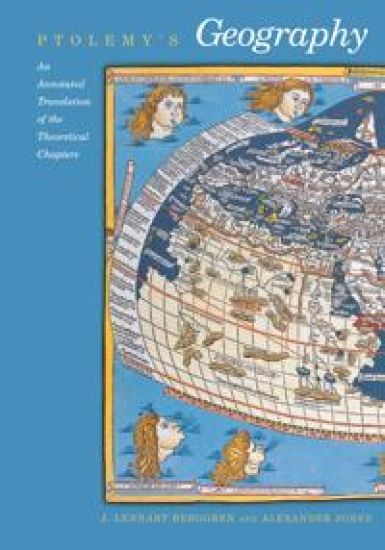
Ptolemy's Geography is the only book on cartography to have survived from the classical period and one of the most influential scientific works of all time. Written in the second century AD, for more than fifteen centuries it was the most detailed topography of Europe and Asia available and the best reference on how to gather data and draw maps. Ptolemy championed the use of astronomical observation and applied mathematics in determining geographical locations. But more importantly, he introduced the practice of writing down coordinates of latitude and longitude for every feature drawn on a world map, so that someone else possessing only the text of the Geography could reproduce Ptolemy's map at any time, in whole or in part, at any scale. Here Berggren and Jones render an exemplary translation of the Geography and provide a thorough introduction, which treats the historical and technical background of Ptolemy's work, the contents of the Geography, and the later history of the work.
Classic astrology. The Tetrabiblos of the famous astronomer and geographer Claudius Ptolemaeus (ca. AD 100–178) of Egypt consists of four books, the title given in some manuscripts meaning “Mathematical Treatise in Four Books,” in others “The Prognostics addressed to Syrus.” The subject is astrology, which in Ptolemy’s time as down to the Renaissance was fused as a respectable science with astronomy. Translations and commentaries are few, and only three Greek texts had been printed (all in the 16th century) before the present one and the one begun by F. Boll and finished by Emilie Boer in 1940.