

Kirjailija
Purnima Mankekar
Kirjat ja teokset yhdessä paikassa: 6 kirjaa, julkaisuja vuosilta 1999–2025, suosituimpiin kuuluu Unsettling India. Vertaile teosten hintoja ja tarkista saatavuus suomalaisista kirjakaupoista.
6 kirjaa
Kirjojen julkaisuvuodet: 1999–2025.

In The Future of Futurity, Purnima Mankekar and Akhil Gupta examine the lives and experiences of call center agents in India’s business process outsourcing (BPO) industry, who live in Bengaluru and work for customers in the Global North. Mankekar and Gupta show how futurity—an affective-temporal potentiality and mode of being that emphasizes the unfolding of time—enables BPO workers to strive for hopeful futures despite their experiences of growing inequality, volatility, and violence. Drawing on long-term fieldwork with managers, owners, and workers of BPO companies, the authors explore how workers find pathways for navigating a globalized world and for imagining their futures in it. They point to the heterogeneous lives, yearnings, and anxieties of BPO workers, foregrounding the disjunctions and conjunctions between labor, corporeality, intimacy, family life, and mobility. Mankekar and Gupta show how workers’ daily lives and imaginings of the future point to the relationships between futurity, capital, and technology as well as futurity’s imbrications with contemporary racial capitalism. In so doing, the authors insist on the transformative potential of futurity even in conditions of extreme precarity.

In Unsettling India, Purnima Mankekar offers a new understanding of the affective and temporal dimensions of how India and “Indianness,” as objects of knowledge production and mediation, circulate through transnational public cultures. Based on over a decade of ethnographic fieldwork in New Delhi and the San Francisco Bay Area, Mankekar tracks the sense of unsettlement experienced by her informants in both places, disrupting binary conceptions of homeland and diaspora, and the national and transnational. She examines Bollywood films, Hindi TV shows, advertisements, and such commodities as Indian groceries as interconnected nodes in the circulation of transnational public cultures that continually reconfigure affective connections to India and what it means to be Indian, both within the country and outside. Drawing on media and cultural studies, feminist anthropology, and Asian/Asian American studies, this book deploys unsettlement as an analytic to trace modes of belonging and not-belonging.

In Unsettling India, Purnima Mankekar offers a new understanding of the affective and temporal dimensions of how India and “Indianness,” as objects of knowledge production and mediation, circulate through transnational public cultures. Based on over a decade of ethnographic fieldwork in New Delhi and the San Francisco Bay Area, Mankekar tracks the sense of unsettlement experienced by her informants in both places, disrupting binary conceptions of homeland and diaspora, and the national and transnational. She examines Bollywood films, Hindi TV shows, advertisements, and such commodities as Indian groceries as interconnected nodes in the circulation of transnational public cultures that continually reconfigure affective connections to India and what it means to be Indian, both within the country and outside. Drawing on media and cultural studies, feminist anthropology, and Asian/Asian American studies, this book deploys unsettlement as an analytic to trace modes of belonging and not-belonging.
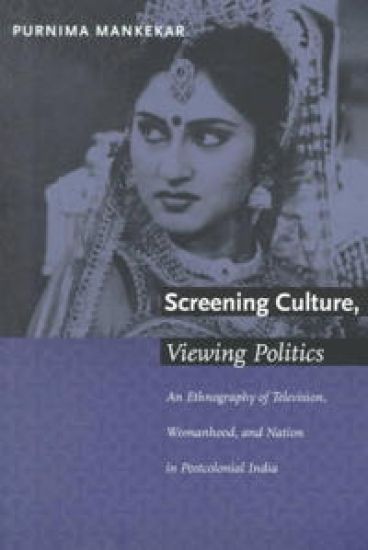
In Screening Culture, Viewing Politics Purnima Mankekar presents a cutting-edge ethnography of television-viewing in India. With a focus on the responses of upwardly-mobile, yet lower-to-middle class urban women to state-sponsored entertainment serials, Mankekar demonstrates how television in India has profoundly shaped women’s place in the family, community, and nation, and the crucial role it has played in the realignment of class, caste, consumption, religion, and politics. Mankekar examines both “entertainment” narratives and advertisements designed to convey particular ideas about the nation. Organizing her study around the recurring themes in these shows-Indian womanhood, family, community, constructions of historical memory, development, integration, and sometimes violence-Mankekar dissects both the messages televised and her New Delhi subjects’ perceptions of and reactions to these messages. In the process, her ethnographic analysis reveals the texture of these women’s daily lives, social relationships, and everyday practices. Throughout her study, Mankekar remains attentive to the tumultuous historical and political context in the midst of which these programs’ integrationalist messages are transmitted, to the cultural diversity of the viewership, and to her own role as ethnographer. In an enlightening epilogue she describes the effect of satellite television and transnational programming to India in the 1990s. Through its ethnographic and theoretical richness, Screening Culture, Viewing Politics forces a reexamination of the relationship between mass media, social life, and identity and nation formation in non-Western contexts. As such, it represents a major contribution to a number of fields, including media and communication studies, feminist studies, anthropology, South Asian studies, and cultural studies.
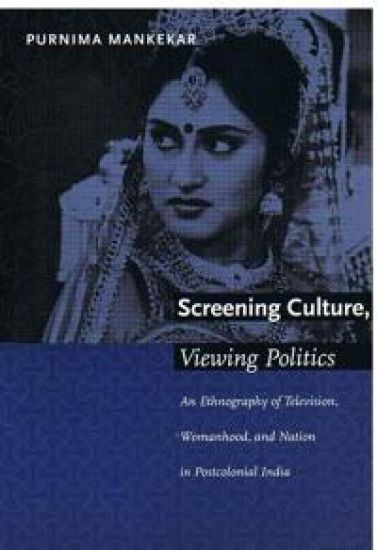
In Screening Culture, Viewing Politics Purnima Mankekar presents a cutting-edge ethnography of television-viewing in India. With a focus on the responses of upwardly-mobile, yet lower-to-middle class urban women to state-sponsored entertainment serials, Mankekar demonstrates how television in India has profoundly shaped women’s place in the family, community, and nation, and the crucial role it has played in the realignment of class, caste, consumption, religion, and politics. Mankekar examines both “entertainment” narratives and advertisements designed to convey particular ideas about the nation. Organizing her study around the recurring themes in these shows-Indian womanhood, family, community, constructions of historical memory, development, integration, and sometimes violence-Mankekar dissects both the messages televised and her New Delhi subjects’ perceptions of and reactions to these messages. In the process, her ethnographic analysis reveals the texture of these women’s daily lives, social relationships, and everyday practices. Throughout her study, Mankekar remains attentive to the tumultuous historical and political context in the midst of which these programs’ integrationalist messages are transmitted, to the cultural diversity of the viewership, and to her own role as ethnographer. In an enlightening epilogue she describes the effect of satellite television and transnational programming to India in the 1990s. Through its ethnographic and theoretical richness, Screening Culture, Viewing Politics forces a reexamination of the relationship between mass media, social life, and identity and nation formation in non-Western contexts. As such, it represents a major contribution to a number of fields, including media and communication studies, feminist studies, anthropology, South Asian studies, and cultural studies.