Kirjojen hintavertailu – 12 903 725 kirjaa ja 27 kauppaa

Kirjailija

Qing-Guo Wang

Kirjat ja teokset yhdessä paikassa: 8 kirjaa, julkaisuja vuosilta 1998–2018, suosituimpiin kuuluu Decoupling Control. Vertaile teosten hintoja ja tarkista saatavuus suomalaisista kirjakaupoista.

8 kirjaa

Kirjojen julkaisuvuodet: 1998–2018.

PID Control for Multivariable Processes

PID Control for Multivariable Processes

Qing-Guo Wang; Zhen Ye; Wen-Jian Cai; Chang-Chieh Hang

Springer-Verlag Berlin and Heidelberg GmbH Co. K
2008
nidottu
Thereare richtheories and designs for generalcontrolsystems,but usually, they will not lead to PID controllers. Noting that the PID controller has been the most popular one in industry for over ?fty years, we will con?ne our discussion hereto PIDcontrolonly. PID controlhasbeenanimportantresearchtopicsince 1950’s, and causes remarkable activities for the last two decades. Most of the existing works have been on the single variable PID control and its theory and design are well established, understood and practically applied. However, most industrial processes are of multivariable nature. It is not rare that the overall multivariable PID control system could fail although each PID loop may work well. Thus,demandforaddressingmultivariableinteractionsishighforsuccessful applicationofPIDcontrolinmultivariableprocessesanditisevidentfrommajor leading control companies who all rankedthe couplings of multivariable systems as the principal common problem in industry. There have been studies on PID control for multivariable processes and they provide some useful design tools for certaincases. But itis notedthat the existing worksaremainlyfor decentralized form of PID control and based on ad hoc methodologies. Obvious, multivariable PID control is much less understood and developed in comparison with the single variable case and actual need for industrial applications. Better theory and design have to be established for multivariable PID control to reach the same maturity and popularity as the single variable case. The present monograph puts together, in a single volume, a fairly comp- hensive, up-to-date and detailed treatment of PID control for multivariable p- cesses, from paring, gain and phase margins, to various design methods and applications.
Decoupling Control

Decoupling Control

Qing-Guo Wang

Springer-Verlag Berlin and Heidelberg GmbH Co. K
2002
nidottu
Decoupling or non-interactive control has attracted considerable research attention since the 1960s when control engineers started to deal with multivariable systems. The theory and design techniques for decoupling control have now, more or less matured for linear time-invariant systems, yet there is no single book which focuses on such an important topic. The present monograph fills this gap by presenting a fairly comprehensive and detailed treatment of decoupling theory and relevant design methods. Decoupling control under the framework of polynomial transfer function and frequency response settings, is included as well as the disturbance decoupling problem. The emphasis here is on special or relatively new compensation schemes such as (true and virtual) feedforward control and disturbance observers, rather than use of feedback control alone. The results are presented in a self-contained way and only the knowledge of basic linear systems theory is assumed of the reader.
Relay Feedback

Relay Feedback

Qing-Guo Wang; Tong H. Lee; Lin Chong

Springer London Ltd
2002
sidottu
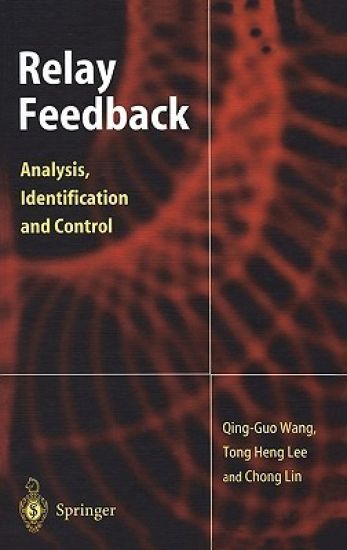
Relay feedback has attracted considerable research attention for more than a century but there has been no recent summary of the many newly-developed tools and results now available for this important area as a whole, those that have been published tending to focus on one process or controller type only. Relay Feedback is divided into three parts, the first of which is devoted to the analysis of relay feedback systems within a general setting with information on: existence of solutions; existence of limit cycles; local and global stability of limit cycles; limit cycles with more than two switchings per period; plants with time delay; relays with asymmetric hysteresis. The second part, on the improvement of process identification shows the reader how to: modify a standard relay to provide better excitation of a process at a number of important frequencies; devise new algorithms designed to make better use of information from relay feedback tests. The book's third part is a presentation of recent developments in control design providing: a unified framework for the design of internal-model, proportional-integral-derivative or general-single-loop controllers for SISO or MIMO systems with or without time delays; characterisation of time delays and non-minimum phase zeros for closed-loop systems. Relay Feedback presents a comprehensive, up-to-date and detailed treatment of relay feedback theory, the use of relay feedback for process identification and the use of identified models for general control design in a single volume. The work assumes only knowledge of linear system theory on the part of the reader and should therefore be of use to graduate students and practising engineers as well as to researchers.
Finite-Spectrum Assignment for Time-Delay Systems

Finite-Spectrum Assignment for Time-Delay Systems

Qing-Guo Wang; Tong H. Lee; Kok K. Tan

Springer London Ltd
1998
nidottu
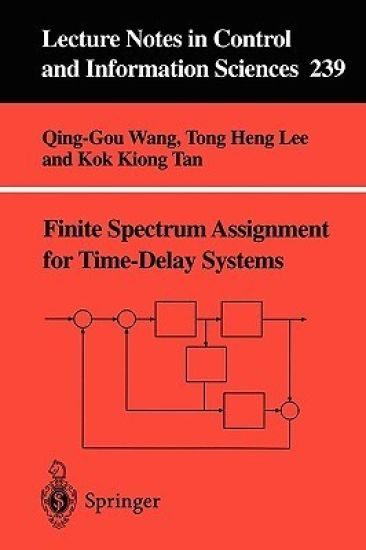
The presence of considerable time delays in many industrial processes is well recognized and achievable performances of conventional unity feedback control systems are degraded if a process has a relatively large time delay compared to its time constants. In this case, dead time compensation is necessary in order to enhance the performances. The most popular scheme for such compensation is the Smith Predictor, but it is unsuitable for unstable or lightly damped processes because the compensated closed-loop system always contains the process poles themselves. An alternative scheme for delay elimination from the closed-loop is the finite spectrum assignment (FSA) strategy and it can arbitrarily assign the closed-loop spectrum. One may note that the Smith­ Predictor Control can be found in delay systems control books and many process control books, but the FSA control is rarely included in these books. It is therefore timely and desirable to fill this gap by writing a book which gives a comprehensive treatment of the FSA approach. This is useful and worthwhile since the FSA provides not only an alternative way but also certain advantages over the Smith-Predictor. The book presents the state-of-the-art of the finite spectrum assignment for time-delay systems in frequency domain. It mainly contains those works carried out recently by the authors in this field. Most of them have been published and others are awaiting publication. They are assembled together and reorganized in such a way that the presentation is logical, smooth and systematic.
Filtering and Control of Wireless Networked Systems

Filtering and Control of Wireless Networked Systems

Dan Zhang; Qing-Guo Wang; Li Yu

Springer International Publishing AG
2018
nidottu
This self-contained book, written by leading experts, offers a cutting-edge, in-depth overview of the filtering and control of wireless networked systems. It addresses the energy constraint and filter/controller gain variation problems, and presents both the centralized and the distributed solutions. The first two chapters provide an introduction to networked control systems and basic information on system analysis. Chapters (3–6) then discuss the centralized filtering of wireless networked systems, presenting different approaches to deal with energy efficiency and filter/controller gain variation problems. The next part (chapters 7–10) explores the distributed filtering of wireless networked systems, addressing the main problems of energy constraint and filter gain variation. The final part (chapters 11–14) focuses on the distributed control of wireless networked systems. In view of the rapid deployment and development of wireless networked systems for communication and control applications, the book represents a timely contribution and provides valuable insights, useful methods and effective algorithms for the analysis and design of wireless networked control systems. It is a valuable resource for researchers in the control and communication communities
Filtering and Control of Wireless Networked Systems

Filtering and Control of Wireless Networked Systems

Dan Zhang; Qing-Guo Wang; Li Yu

Springer International Publishing AG
2017
sidottu
This self-contained book, written by leading experts, offers a cutting-edge, in-depth overview of the filtering and control of wireless networked systems. It addresses the energy constraint and filter/controller gain variation problems, and presents both the centralized and the distributed solutions. The first two chapters provide an introduction to networked control systems and basic information on system analysis. Chapters (3–6) then discuss the centralized filtering of wireless networked systems, presenting different approaches to deal with energy efficiency and filter/controller gain variation problems. The next part (chapters 7–10) explores the distributed filtering of wireless networked systems, addressing the main problems of energy constraint and filter gain variation. The final part (chapters 11–14) focuses on the distributed control of wireless networked systems. In view of the rapid deployment and development of wireless networked systems for communication and control applications, the book represents a timely contribution and provides valuable insights, useful methods and effective algorithms for the analysis and design of wireless networked control systems. It is a valuable resource for researchers in the control and communication communities
Relay Feedback

Relay Feedback

Qing-Guo Wang; Tong H. Lee; Lin Chong

Springer London Ltd
2012
nidottu
Relay feedback has attracted considerable research attention for more than a century but there has been no recent summary of the many newly-developed tools and results now available for this important area as a whole, those that have been published tending to focus on one process or controller type only. Relay Feedback is divided into three parts, the first of which is devoted to the analysis of relay feedback systems within a general setting with information on: existence of solutions; existence of limit cycles; local and global stability of limit cycles; limit cycles with more than two switchings per period; plants with time delay; relays with asymmetric hysteresis. The second part, on the improvement of process identification shows the reader how to: modify a standard relay to provide better excitation of a process at a number of important frequencies; devise new algorithms designed to make better use of information from relay feedback tests. The book's third part is a presentation of recent developments in control design providing: a unified framework for the design of internal-model, proportional-integral-derivative or general-single-loop controllers for SISO or MIMO systems with or without time delays; characterisation of time delays and non-minimum phase zeros for closed-loop systems. Relay Feedback presents a comprehensive, up-to-date and detailed treatment of relay feedback theory, the use of relay feedback for process identification and the use of identified models for general control design in a single volume. The work assumes only knowledge of linear system theory on the part of the reader and should therefore be of use to graduate students and practising engineers as well as to researchers.
Advances in PID Control

Advances in PID Control

Kok K. Tan; Qing-Guo Wang; Chang C. Hang

Springer London Ltd
2011
nidottu
Recently, a great deal of effort has been dedicated to capitalising on advances in mathematical control theory in conjunction with tried-and-tested classical control structures particularly with regard to the enhanced robustness and tighter control of modern PID controllers. Much of the research in this field and that of the operational autonomy of PID controllers has already been translated into useful new functions for industrial controllers. This book covers the important knowledge relating to the background, application, and design of, and advances in PID controllers in a unified and comprehensive treatment including: Evolution and components of PID controllersClassical and Modern PID controller designAutomatic Tuning Multi-loop Control Practical issues concerned with PID control The book is intended to be useful to a wide spectrum of readers interested in PID control ranging from practising technicians and engineers to graduate and undergraduate students.