Kirjailija
R. Austin Freeman
Kirjat ja teokset yhdessä paikassa: 242 kirjaa, julkaisuja vuosilta 2004–2026, suosituimpiin kuuluu The Aluminium Dagger: A Dr John Thorndyke Mystery: (R Austin Freeman Classic Collection). Vertaile teosten hintoja ja tarkista saatavuus suomalaisista kirjakaupoista.
Nimi esiintyy myös muodoissa: R Austin Freeman
242 kirjaa
Kirjojen julkaisuvuodet: 2004–2026.
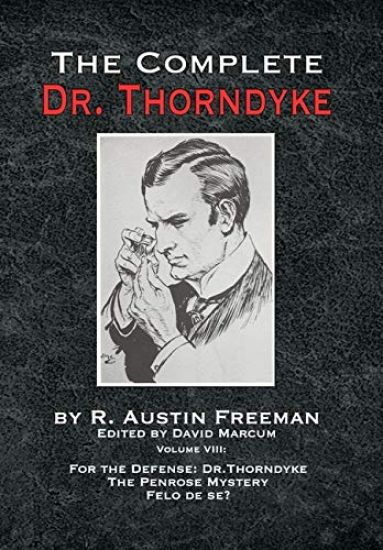
Volume VIII contains the sixteenth, seventeenth, and eighteenth full-length Thorndyke adventures, published in 1934, 1936, and 1937, respectively. For the Defense: Dr. Thorndyke - Andrew Barton dreaded meeting up with his identical cousin that he usually tried to avoid. Then Death joined them, and Andrew found himself in an unbelievable spiral of events that would rip him away from the life he loved forever. His only hope is if Dr. Thorndyke believes his impossible story The Penrose Mystery - The eccentric collector had vanished, leaving a locked room possibly full of valuables, and legal questions regarding what to do next. Thorndyke's involvement leads to even more puzzles, and the tragic excavation at an Ancient British Barrow. Felo de se? - The man found dead in his chambers appeared to have committed suicide - felo de se - but did he? The facts don't add up, and Thorndyke's scientific investigation reveals a most unique crime. When Sherlock Holmes began his practice as a "Consulting Detective", his ideas of scientific criminal investigations caused the London police to look upon him as a mere "theorist". And yet, through his work, the science behind catching criminals became so important that it's hard to now imagine the world without them. Many famous Great Detectives followed in Holmes's footsteps - Nero Wolfe and Ellery Queen, Hercule Poirot and Solar Pons - but before they began their careers, and while Holmes was still in practice in Baker Street, another London consultant - Dr. John Thorndyke - opened his doors, using the scientific methods developed and perfected by Holmes and taking them to a whole new level of brilliance. Between 1905, with his first appearance in a nearly forgotten novella (see below), to 1942, and through the course of twenty-one novels and over forty short stories, Dr. Thorndyke, often with the assistance of his friend Dr. Christopher Jervis, unraveled some incredibly complex puzzles. Besides providing very satisfying mysteries - some of which turned the literary form inside out - these adventures present vivid pictures of England in the late Victorian and early Edwardian eras, ranging from the doctor's own vividly drawn chambers at 5A Kings Bench Walk in the Temple to the surrounding London streets, and beyond into the villages and towns of the countryside. Many of the Thorndyke volumes have been difficult to obtain for decades. MX Publishing is proud to announce the return of Dr. Thorndyke in a collection of omnibus editions, bringing these masterful adventures of one of the world's greatest detectives together in an easily available format for modern readers." Thorndyke will cheerfully show you all the facts. You will be none the wiser . . . ."- Dorothy L. Sayers, Chronicler of Lord Peter Wimsey
This is the first Dr. Thorndyke novel, from 1907, one of the earliest forensics-based mysteries. A valuable shipment of diamonds goes missing from a safe, and a nice young man is put in the dock for it. As evidence mounts, a renowned forensics expert is called in to help with the defense. The plot twists are easily guessed, the characters speak in a mildly stilted manner that reflects their class(es) and origins, and the forensics seem extremely basic to us now, but this was one of the earliest and still holds up. The writing is smooth, the obligatory love story not intrusive, the forensics solid and well-presented, and the characters of Dr. Thorndyke and Dr. Jervis are likable and seem real. You can see the debt Freeman owed Doyle, and the one owed to him by Sayers and numerous others. Thorndyke has a "man" named Poulton who is, at the least, Bunter's very useful Uncle, and Jervis is pretty nearly "son-of-Watson", including the love story. Thorndyke is extremely Holmesian, withholding almost all information until the denouement, rationalized as being legal discretion, but still used for good effect at the end. The courtroom scene is wonderful. The net result is an enjoyable reminder of how life - and mysteries - used to be. (Abbey)
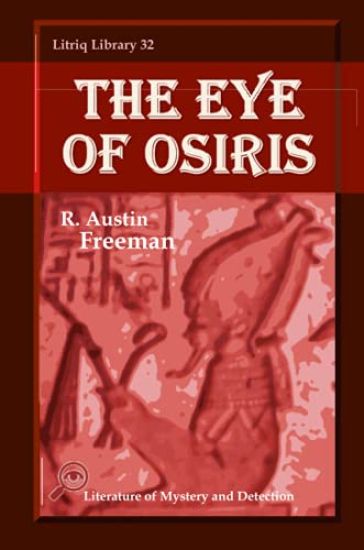
John Bellingham is a world-renowned archaeologist who goes missing mysteriously after returning from a voyage to Egypt where fabulous treasures have been uncovered. Bellingham seems to have disappeared leaving clues, which lead all those hunting down blind alleys. But when the piercing perception of the brilliant Dr Thorndyke is brought to bear on the mystery, the search begins for a man tattooed with the Eye of Osiris in this strange, tantalisingly enigmatic tale.
A grieving osteologist engages in a lifelong manhunt for the murderer of his beloved wife while maintaining his public persona by incorporating ingenious methods to first attain, then dispose of his victims' bodies. Weird. Nerdy to the max. Surprisingly unputdownable. (Alia Makki)
A classic English mystery with the detective, Dr. Thorndyke, solving what appears to be two disparate mysteries. One is an apparent suicide with a disputed will; the other is one of his sidekick's (Dr. Jervis) odd case of an apparent poisoning. Despite the twists and turns, the mysteries are solved. Language is precise and complex, which made this reader check the dictionary repeatedly; the story line not unlike that of Sherlock Holmes and Watson; and the setting is typical for the time. (Nancy Brady)
John Bellingham is a world-renowned archaeologist who goes missing mysteriously after returning from a voyage to Egypt where fabulous treasures have been uncovered. Bellingham seems to have disappeared leaving clues, which lead all those hunting down blind alleys. But when the piercing perception of the brilliant Dr Thorndyke is brought to bear on the mystery, the search begins for a man tattooed with the Eye of Osiris in this strange, tantalisingly enigmatic tale.
This is the first Dr. Thorndyke novel, from 1907, one of the earliest forensics-based mysteries. A valuable shipment of diamonds goes missing from a safe, and a nice young man is put in the dock for it. As evidence mounts, a renowned forensics expert is called in to help with the defense. The plot twists are easily guessed, the characters speak in a mildly stilted manner that reflects their class(es) and origins, and the forensics seem extremely basic to us now, but this was one of the earliest and still holds up. The writing is smooth, the obligatory love story not intrusive, the forensics solid and well-presented, and the characters of Dr. Thorndyke and Dr. Jervis are likable and seem real. You can see the debt Freeman owed Doyle, and the one owed to him by Sayers and numerous others. Thorndyke has a "man" named Poulton who is, at the least, Bunter's very useful Uncle, and Jervis is pretty nearly "son-of-Watson", including the love story. Thorndyke is extremely Holmesian, withholding almost all information until the denouement, rationalized as being legal discretion, but still used for good effect at the end. The courtroom scene is wonderful. The net result is an enjoyable reminder of how life - and mysteries - used to be. (Abbey)
A grieving osteologist engages in a lifelong manhunt for the murderer of his beloved wife while maintaining his public persona by incorporating ingenious methods to first attain, then dispose of his victims' bodies. Weird. Nerdy to the max. Surprisingly unputdownable. (Alia Makki)
Dr. Richard Austin Freeman MRCS LSA (11 April 1862 - 28 September 1943) was a British writer of detective stories, mostly featuring the medico-legal forensic investigator Dr. Thorndyke. He invented the inverted detective story (a crime fiction in which the commission of the crime is described at the beginning, usually including the identity of the perpetrator, with the story then describing the detective's attempt to solve the mystery). Roberts said that this invention was Freeman's most noticeable contribution to detective fiction. Freeman used some of his early experiences as a colonial surgeon in his novels. Many of the Dr. Thorndyke stories involve genuine, but sometimes arcane, points of scientific knowledge, from areas such as tropical medicine, metallurgy and toxicology. Freeman was a significant author of detective fiction in his day. He was most famous for his creation of Dr. Thorndyke, and many of the obituaries recording his death refer to this in the obituary headline. Thus the Birmingham Daily Gazette announced "Dr. Thorndyke" Creator Dead, the Belfast News-Letter announced Obituary Dr. R. A. Freeman, Creator of "Dr. Thorndyke", and the Evening Star (Dunedin) announced Obituary: Creator of Dr. Thorndyke. Critical comment has tended to concentrate on four aspects of Thorndyke: Freeman's quality as a writer; the close attention to logic, scientific accuracy and methods in his stories; the invention of the inverted detective story, and comparisons with Sherlock Holmes. The Times considered that the second and third of these were what singled Freeman out from the ruck. (wikipedia.org)
Reproduction of the original: The Mistery of 31 New Inn by R. Austin Freeman