Kirjojen hintavertailu – 12 903 725 kirjaa ja 27 kauppaa

Kirjailija

R H Tawney

Kirjat ja teokset yhdessä paikassa: 29 kirjaa, julkaisuja vuosilta 1920–2025, suosituimpiin kuuluu The Establishment of Minimum Rates in the Chain-Making Industry Under the Trade Boards Act of 1909.. Vertaile teosten hintoja ja tarkista saatavuus suomalaisista kirjakaupoista.

Nimi esiintyy myös muodoissa: R. H. Tawney, R.H. Tawney, R. H Tawney

29 kirjaa

Kirjojen julkaisuvuodet: 1920–2025.

Business and Politics under James I

Business and Politics under James I

R. H. Tawney

Cambridge University Press
2012
pokkari
First published in 1958, this volume by R. H. Tawney throws light on the background, conditions, and practices of England's economic life during the reign of James I. At the centre of the study is the figure of Lionel Cranfield, Earl of Middlesex, whose role as a merchant and then government minister - rapidly rising to the position of lord treasurer - here provides a unique framework within which to view the inter-reliance of commerce and politics in the first part of the seventeenth century. The study offers an illuminating account of the various successes and defeats of Cranfield's career, as well as presenting a broad view of foreign trade and financial policy in England at the end of the Jacobean period.
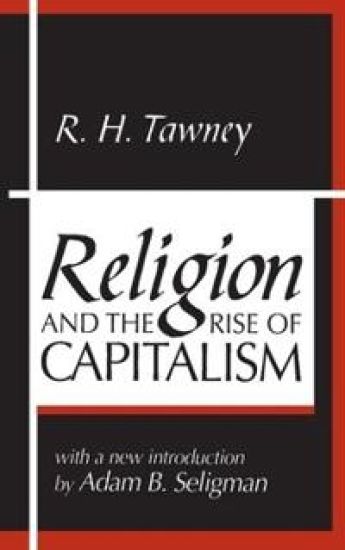
Religion and the Rise of Capitalism

Religion and the Rise of Capitalism

R.H. Tawney

Transaction Publishers
1998
nidottu
In one of the truly great classics of twentieth-century political economy, R. H. Tawney addresses the question of how religion has affected social and economic practices. He does this by a relentless tracking of the influence of religious thought on capitalist economy and ideology since the Middle Ages. In so doing he sheds light on why Christianity continues to exert a unique role in the marketplace. In so doing, the book offers an incisive analysis of the historical background of present morals and mores in Western culture. Religion and the Rise of Capitalism is even more pertinent now than when it first was published; for today it is clearer that the dividing line between spheres of religion and secular business is shifting, that economic interests and ethical considerations are no longer safely locked in separate compartments. By examining that period which saw the transition from medieval to modern theories of social organization, Tawney clarifies the most pressing problems of the end of the century. In tough, muscular, richly varied prose, he tells an absorbing and meaningful story. And in his new introduction, which may well be a classic in its own right, Adam Seligman details Tawney's entire background, the current status of social science thought on these large issues, and a comparative analysis of Tawney with Max Weber that will at once delight and inform readers of all kinds.
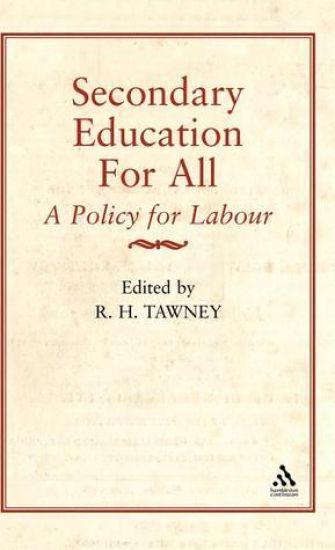
Secondary Education for All

Secondary Education for All

R. H. Tawney

Hambledon Continuum
1988
sidottu
Secondary Education for All cannot be considered independently from the life and career of its author, R. H. Tawney. Written in 1922 in time for the general election, it is the Labour party’s first major statement on adolescent education. It reflects the historical insights and ardent political convictions of an economic historian turned socialist, and helped to bring the issue of education reform from the periphery of politics to a more central position. Through the introduction of free secondary education for all, Tawney hoped to rid education of class inequality over a generation. This is a classic and influential text which acted as a springboard for educational advance which reflects the growing educational and political debate of 1920s Britain.
The Acquisitive Society

The Acquisitive Society

R H Tawney

Binker North
1920
pokkari
The Acquisitive Society was written by R. H. Tawney and published in 1920. Tawney herein criticizes the selfish individualism of modern industrial societies. He argues that capitalism corrupts via the promotion of economic self-interest, leading to aimless production in response to greed and insatiable acquisitiveness, and hence to perversions of industrialism. He attests further that, by extension, nationalism leads to the perversion of imperialism and to a necessarily failed balance of power strategy, resulting in unnecessary wars. It is a commonplace that the characteristic virtue of Englishmen is their power of sustained practical activity, and their characteristic vice a reluctance to test the quality of that activity by reference to principles. They are incurious as to theory, take fundamentals for granted, and are more interested in the state of the roads than in their place on the map. And it might fairly be argued that in ordinary times that combination of intellectual tameness with practical energy is sufficiently serviceable to explain, if not to justify, the equanimity with which its possessors bear the criticism of more mentally adventurous nations. It is the mood of those who have made their bargain with fate and are content to take what it offers without re-opening the deal. It leaves the mind free to concentrate undisturbed upon profitable activities, because it is not distracted by a taste for unprofitable speculations. Most generations, it might be said, walk in a path which they neither make, nor discover, but accept; the main thing is that they should march. The blinkers worn by Englishmen enable them to trot all the more steadily along the beaten {2} road, without being disturbed by curiosity as to their destination.