
Kirjailija
R S Conway
Kirjat ja teokset yhdessä paikassa: 9 kirjaa, julkaisuja vuosilta 2007–2026, suosituimpiin kuuluu New Studies of a Great Inheritance. Vertaile teosten hintoja ja tarkista saatavuus suomalaisista kirjakaupoista.
Nimi esiintyy myös muodoissa: R. S. Conway
9 kirjaa
Kirjojen julkaisuvuodet: 2007–2026.


This book has been considered by academicians and scholars of great significance and value to literature. This forms a part of the knowledge base for future generations. So that the book is never forgotten we have represented this book in a print format as the same form as it was originally first published. Hence any marks or annotations seen are left intentionally to preserve its true nature.
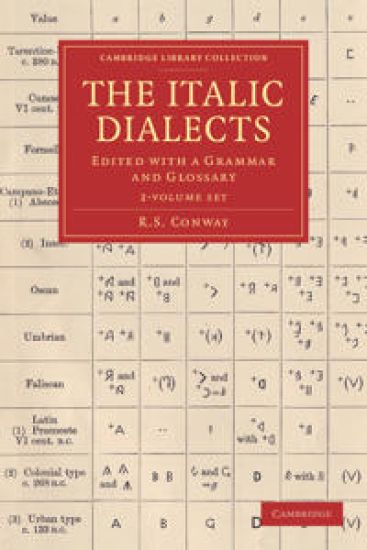
Published in 1897, this two-volume work by Robert Seymour Conway (1864–1933), classical scholar and comparative philologist, later Hulme Professor of Latin at the University of Manchester, aims to shed light on the origins of the Latin language and Roman institutions by careful examination of the dialects and customs of Rome's neighbours. The work is laid out in geographical order, so that the influence of one dialect on its neighbours can be traced. The first volume collects all the surviving remains of Oscan, Umbrian and other minor Italic dialects, gleaned primarily from epigraphic sources (such as Oscan inscriptions at Pompeii), but also from the evidence of coins, glosses and other references in later writers, and geographical and proper names from the dialect areas. The second volume contains an alphabet, a grammar and syntax of the dialects, appendices, indexes of names and a glossary of the dialect words.
Published in 1897, this two-volume work by Robert Seymour Conway (1864–1933), classical scholar and comparative philologist, later Hulme Professor of Latin at the University of Manchester, aims to shed light on the origins of the Latin language and Roman institutions by careful examination of the dialects and customs of Rome's neighbours. The work is laid out in geographical order, beginning with Southern Oscan in Sicily and moving north through Volscian and Latinian to conclude with Umbrian and Picenum, so that the influence of one dialect on its neighbours can be traced. This first volume collects all the surviving remains of these minor Italic dialects, gleaned primarily from epigraphic sources (such as Oscan inscriptions at Pompeii and elsewhere), but also from the evidence of coins, glosses and other references in later writers, and geographical and proper names from the dialect areas.
Published in 1897, this two-volume work by Robert Seymour Conway (1864–1933), classical scholar and comparative philologist, later Hulme Professor of Latin at the University of Manchester, aims to shed light on the origins of the Latin language and Roman institutions by careful examination of the dialects and customs of Rome's neighbours. The second volume provides an outline of the grammar of the Italic dialects, the surviving remains of which were collected in the first volume. There are six dialect alphabets given, followed by a sketch of their accidence and syntax. The first appendix discusses the Oscan measures of the mensa ponderaria at Pompeii; a second gives alien, doubtful or spurious inscriptions. The bulk of the volume consists of indexes of geographical and personal names, a glossary of the dialect words, and an index of Latin words used in the work.
Virgil's Messianic Eclogue
Joseph B. Mayor; W. Warde Fowler; R. S. Conway
Kessinger Pub
2007
pokkari