Kirjojen hintavertailu – 12 903 725 kirjaa ja 27 kauppaa
Kirjailija
Rabindra N. Kanungo
Kirjat ja teokset yhdessä paikassa: 6 kirjaa, julkaisuja vuosilta 1996–2016, suosituimpiin kuuluu Organizations and Management in Cross-Cultural Context. Vertaile teosten hintoja ja tarkista saatavuus suomalaisista kirjakaupoista.
*Winner in the Management and Leadership Textbook Category at CMI Management Book of the Year Awards 2015* An ideal course text for Organizational Behaviour, Human Resource Management or Cross-Cultural Management courses. Chapters present the fundamental theoretical approaches in all key areas including leadership, ethics and change, and then explore them in the context of culture and cross-cultural management. Encourages self-reflection and critical appraisal through a series of questions and scenarios designed to get you thinking like a manager working with an international team. Provides practical guidance on tackling the most complex issues facing managers today. Contains insights into the experiences of real employees working in a multicultural environment. The companion website provides a wealth of additional material to support students and teachers alike.
*Winner in the Management and Leadership Textbook Category at CMI Management Book of the Year Awards 2015* An ideal course text for Organizational Behaviour, Human Resource Management or Cross-Cultural Management courses. Chapters present the fundamental theoretical approaches in all key areas including leadership, ethics and change, and then explore them in the context of culture and cross-cultural management. Encourages self-reflection and critical appraisal through a series of questions and scenarios designed to get you thinking like a manager working with an international team. Provides practical guidance on tackling the most complex issues facing managers today. Contains insights into the experiences of real employees working in a multicultural environment. The companion website provides a wealth of additional material to support students and teachers alike.
Charismatic leaders have proven to be remarkable change agents, able to create or reinvent entire organizations. At the same time, these leaders provide us with lessons about the greatest dangers of leadership. For example, throughout history, certain charismatic leaders have demonstrated a shadow side as master manipulators and purveyors of evil. Charismatic Leadership in Organizations reflects the latest thinking on this seemingly elusive yet remarkable form of leadership. Written by two of the most important scholars on the subject, this volume not only integrates the growing body of research and theory on the subject, but also pushes the frontiers of our knowledge by introducing new theory and insights. It presents readers with a highly comprehensive model of the charismatic leadership process that is documented with extensive empirical research and richly illustrated with case examples of corporate leaders. The book also includes a questionnaire measure of charismatic leadership and suggests an agenda for future research in the field. Written in a highly accessible style, Charismatic Leadership in Organizations will be of interest to professionals, students, and scholars in management, public administration, psychology, political science, sociology, and religion.
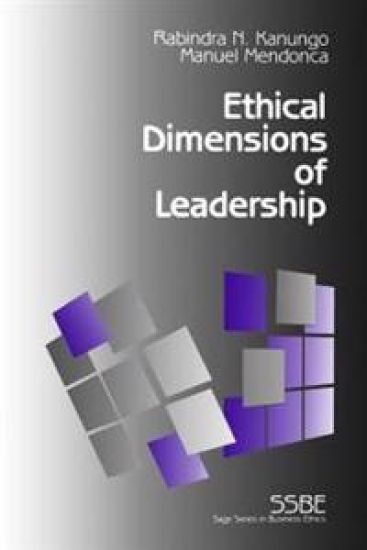
This book's practical orientation, in addition to the conceptual framework, offers practitioners and consultants strategies for effective leadership - such as empowerment - together with how leaders prepare for ethical leadership. It will be of valuable to enhance leadership courses in business schools or executive development programmes. --Financial Express "This volume is a timely, interesting, and courageous call for attention to moral standards that cross organizational and cultural boundaries, making it a worthwhile purchase for comprehensive general and academic management collections." --Choice The beliefs and values, the vision, and, above all, the actions of the leader of an organization set the ethical tone and standards for the organization. It is this fundamentally crucial role of the leader that is the basis of this book. Ethical Dimensions of Leadership proposes that one's understanding of leadership is severely incomplete, if not deformed, if one does not also consider the ethics or morality of leadership. The book examines the various modal orientations of leadership and demonstrates that true, effective leadership is that in which the leader's behavior and exercises of leadership processes are consistent with ethical and moral values. The book argues for an end to the traditional separation of personal and public morality. It also argues that the ethics of leadership is consistent with the spirituality of the different religious traditions. The practical orientation, in addition to the conceptual framework, offers practitioners and consultants strategies for effective leadership--such as empowerment--together with suggestions of how leaders can prepare for ethical leadership. Ethical Dimensions of Leadership will serve the needs of business education programs, business consultants, and researchers. The exhaustive and integrated conceptual treatment of the leadership phenomenon, consistent with ethical and moral values, will greatly enhance leadership courses in business schools or executive development programs. It is also of interest to students in business ethics, organization behavior, and managerial skills development. The inclusion of the cultural contingencies in leadership, in the context of non-Western socioculture environments, extends its suitability and usefulness for courses in international business and international management.
This book's practical orientation, in addition to the conceptual framework, offers practitioners and consultants strategies for effective leadership - such as empowerment - together with how leaders prepare for ethical leadership. It will be of valuable to enhance leadership courses in business schools or executive development programmes. --Financial Express "This volume is a timely, interesting, and courageous call for attention to moral standards that cross organizational and cultural boundaries, making it a worthwhile purchase for comprehensive general and academic management collections." --Choice The beliefs and values, the vision, and, above all, the actions of the leader of an organization set the ethical tone and standards for the organization. It is this fundamentally crucial role of the leader that is the basis of this book. Ethical Dimensions of Leadership proposes that one's understanding of leadership is severely incomplete, if not deformed, if one does not also consider the ethics or morality of leadership. The book examines the various modal orientations of leadership and demonstrates that true, effective leadership is that in which the leader's behavior and exercises of leadership processes are consistent with ethical and moral values. The book argues for an end to the traditional separation of personal and public morality. It also argues that the ethics of leadership is consistent with the spirituality of the different religious traditions. The practical orientation, in addition to the conceptual framework, offers practitioners and consultants strategies for effective leadership--such as empowerment--together with suggestions of how leaders can prepare for ethical leadership. Ethical Dimensions of Leadership will serve the needs of business education programs, business consultants, and researchers. The exhaustive and integrated conceptual treatment of the leadership phenomenon, consistent with ethical and moral values, will greatly enhance leadership courses in business schools or executive development programs. It is also of interest to students in business ethics, organization behavior, and managerial skills development. The inclusion of the cultural contingencies in leadership, in the context of non-Western socioculture environments, extends its suitability and usefulness for courses in international business and international management.