Kirjojen hintavertailu – 12 859 829 kirjaa ja 27 kauppaa

Kirjailija

Radhika Mohanram

Kirjat ja teokset yhdessä paikassa: 4 kirjaa, julkaisuja vuosilta 1995–2013, suosituimpiin kuuluu Imperialism as Diaspora. Vertaile teosten hintoja ja tarkista saatavuus suomalaisista kirjakaupoista.

4 kirjaa

Kirjojen julkaisuvuodet: 1995–2013.

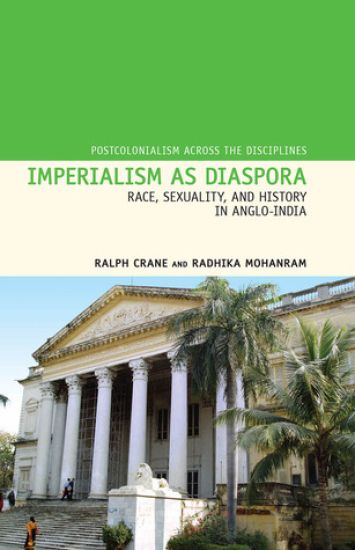
Imperialism as Diaspora

Imperialism as Diaspora

Ralph Crane; Radhika Mohanram

Liverpool University Press
2013
sidottu
Within postcolonial studies, Britain’s long contact with India has been read generally only within the context of imperialism to inform our understanding of race, gender, identity, and power within colonialism. Such postcolonial interpretations that focus on single dimensions of identity risk disregarding the sense of displacement, discontinuities, and discomforts that compromised everyday life for the British in India—the Anglo-Indians—during the Raj. Imperialism as Diaspora reconsiders the urgencies, governing principles, and modes of being of the Anglo-Indians by approaching Britain’s imperial relationship with India from new, interdisciplinary directions. Moving freely between the disciplines of literature, history, and art this new work offers readers a more nuanced and comprehensive understanding of the lives of Anglo-Indians. Focussing on the years between the Indian Mutiny of 1857 and Independence in 1947—the period of the British Raj in India—Imperialism as Diaspora at once sets in motion the multidisciplinary fields of cultural and social history, art and iconography, and literary productions while carefully maintaining the tension between imperialism and diaspora in a ground-breaking reassessment of Anglo-India. Crane and Mohanram examine the seamless continuum between cultural history, the semiotics of art, and Anglo-Indian literary works. Specifically, they focus on the influence of the Sepoy Mutiny on Anglo-Indian identity; the trope of duty and the white man’s burden on the racialization of Anglo-India; the role of the missionary and the status of Christianity in India; and gender, love and contamination within mixed marriages.
Imperial White

Imperial White

Radhika Mohanram

University of Minnesota Press
2007
nidottu
Radhika Mohanram shows not just how British imperial culture shaped the colonies, but how the imperial rule of colonies shifted-and gave new meanings to-what it meant to be British. Imperial White looks at literary, social, and cultural texts on the racialization of the British body and investigates British whiteness in the colonies to address such questions as: How was the whiteness in Britishness constructed by the presence of Empire? How was whiteness incorporated into the idea of masculinity? Does heterosexuality have a color? And does domestic race differ from colonial race? In addition to these inquiries on the issues of race, class, and sexuality, Mohanram effectively applies the methods of whiteness studies to British imperial material culture to critically racialize the relationship between the metropole and the peripheral colonies. Considering whether whiteness, like theory, can travel, Mohanram also provides a new perspective on white diaspora, a phenomenon of the nineteenth century that has been largely absent in diaspora studies, ultimately rereading-and rethinking-British imperial whiteness. Radhika Mohanram teaches postcolonial cultural studies in the School of English, Communication and Philosophy at Cardiff University, Wales. She is the author of Black Body: Women, Colonialism, Space (Minnesota, 1999) and edits the journal Social Semiotics.
English Postcoloniality

English Postcoloniality

Radhika Mohanram; Gita Rajan

Praeger Publishers Inc
1996
sidottu
As the British empire expanded throughout the world, the English language played an important role in power relations between Britain and its colonies. English was used as a colonizing agent to suppress the indigenous cultures of various peoples and to make them subject to British rule. With the end of World War II, many countries became gradually decolonized, and their indigenous cultures experienced a renaissance. Colonial mores and power systems clashed and combined with indigenous traditions to create postcolonial texts. This volume treats postcoloniality as a process of cultural and linguistic interplay, in which British culture initially suppressed indigenous cultures and later combined with them after the decline of the British empire. The first section of this book provides an introductory overview of English postcoloniality. This section is followed by chapters discussing postcoloniality and literature from an historical perspective in particular countries around the world. The third section gives special attention to the literature and culture of indigenous peoples. A selected bibliography concludes the work.
Postcolonial Discourse and Changing Cultural Contexts

Postcolonial Discourse and Changing Cultural Contexts

Radhika Mohanram; Gita Rajan

Praeger Publishers Inc
1995
sidottu
Postcolonial discourse is fast becoming an area of rich academic debate. At the heart of coloniality and postcoloniality is the contested authority of empire and its impact upon previously colonized peoples and their indigenous cultures. This book examines various theories of colonization and decolonization, and how the ideas of a British empire create networks of discourses in contemporary postcolonial cultures. The various essays in this book address the question of empire by exploring such constructs as nation and modernity, third-world feminisms, identity politics, the status and roles of exiles, exilic subjectivities, border intellectuals, and the presence of a postcolonial body in today's classrooms. Topics discussed include African-American literature, the nature of postcolonial texts in first-world contexts, jazz, films, and TV as examples of postcolonial discourse, and the debates surrounding biculturalism and multiculturalism in New Zealand and Australia.